



Panasonic Develops APD-CMOS Image Sensor
 Published2016.02.08 13:15
High-gradation color images
Panasonic Corporation announced today that it has developed a CMOS image sensor (APD-CMOS) in which avalanche photodiodes (APD) *1 are applied to each pixel. The company succeeded in obtaining an electrical signal amplified 10,000 times by multiplying photoelectrons generated in the photodetector using an APD.
This enables the capture of clear color images even under starlight with an illumination of about 0.01 lux or in similarly dark places.
*1 A photodiode capable of acquiring a large amount of electrical signal from weak illumination (a small number of photons). A high-power signal can be obtained by multiplying the photoelectrons generated in the photoelectric conversion layer.
*2 Comparison with image sensors without magnification function (Panasonic's own research results, February 3, 2016)
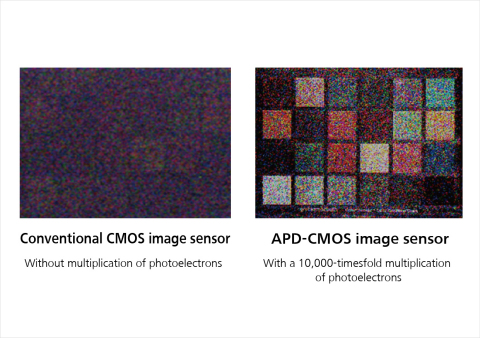
Panasonic’s newly introduced image sensor enables the capture of high-sensitivity video by utilizing photomultiplication to produce high-gradation color images even in dark environments without the need to increase exposure time. In addition, photomultiplication can be rapidly controlled by changing the voltage applied to the APD according to the illumination level during shooting, thereby allowing images to be captured in various illumination levels ranging from bright to dark. This solution is expected to be applicable to products such as surveillance cameras requiring wide dynamic range color video capture and industrial cameras requiring ultra-high sensitivity video.
This product features high-sensitivity color imaging of 40 million lux·sec·μm2 (10,000 times that of a standard device) and a wide dynamic range of 100 dB (more than 40 dB compared to a standard CMOS image sensor).
The development was realized based on the following technology. An APD pixel design technology was applied to the photoelectric conversion unit, which combines an avalanche photodiode and a charge storage to simultaneously multiply and accumulate photoelectrons containing color information generated. By controlling the voltage applied to the APD, multiplication is controlled within 1/1000th of a second, providing variable sensitivity technology that enables 30-fps video recording that changes according to changes in illumination.
In the case of conventional image sensors, photoelectric conversion of photoelectrons can drop below noise levels while capturing images in dark environments, which means images could only be captured under conditions similar to moonlight (illumination of 0.1 lux). This is why shooting using near-infrared light sources and photomultiplier tubes is performed. However, near-infrared light sources cannot capture color images, and photomultiplier tubes require a large power supply, which has the disadvantage of increasing the size of the camera.
The results of this development were presented at the 2016 International Solid-State Circuits Conference held in San Francisco on February 1, 2016.

관련뉴스

ams Expands Process Portfolio to Include CMOS Optoelectronics Foundry, Delivering Value Beyond Semiconductors
이번 플랫폼은 ams가 추구하는 “반도체 이상의 가치(More Than Silicon) 실현”을 위한 포트폴리오 확장이며, ams의 특화 기술을 기반으로 고객사가 최첨단 아날로그와 혼성신호 회로 설계를 성공적으로 개발할 수 있도록 기술 모듈, IP(Intellectual property), 셀 라이브러리, 엔지니어링 컨설턴트 및 서비스 패키지를 제공한다는 내용을 따르고 있다.
2015.08.13by 명세환 기자

RFaxis Expands CMOS RF Front-End IC Portfolio for IoT
Fabless semiconductor company RFaxis announced today additional products that expand its portfolio of RF front-end integrated circuit solutions for the global IoT (Internet of Things)/M2M (Machine-to-Machine) market. The new products expand RFaxis's RF front-end ICs product line for sub-GHz and 2.4GHz frequencies, which are primarily used to extend the operating range of wireless communication systems for various grades of IoT devices.
2016.01.05by 명세환 기자
NXP Radar Accelerates ADAS Adoption with Single CMOS Chip
NXP Semiconductor has announced the smallest single-chip 77GHz radar transceiver that delivers ultra-high resolution performance in a 7.5 x 7.5mm form factor. As a global provider of secure connected car technology, NXP has expanded its automotive radar portfolio. The newly launched single-chip 77GHz radar transceiver delivers ultra-high resolution performance while maintaining a minimal size of only 7.5 x 7.5mm. Radar provides a means to accurately perceive the vehicle's surrounding environment, reducing driver burden and serving as a key enabling technology for future Advanced Driver Assistance Systems (ADAS). NXP has already provided working prototypes of the RFCMOS IC to major customers and is conducting field tests in Google's self-driving car project.
2016.01.06by

Intel Unveils Next-Generation 'Core Ultra Series 3' and vPro Platform for Enterprise PCs
Intel has officially unveiled the "Intel Core Ultra Series 3" for next-generation enterprise PCs and the latest vPro platform, addressing a wide range of demands from enterprise notebooks to high-performance workstations.
2026.03.26by 배종인 기자

ROHM Launches ESD Protection Diode Compatible with High-Speed Interfaces of 10Gbps or Higher
반도체 전문 기업 로옴(ROHM)이 10Gbps를 넘어서는 차세대 고속 데이터 통신 환경에 대응할 수 있는 ESD(정전기 방전) 보호 다이오드 ‘RESDxVx 시리즈’를 개발하며, 고속 인터페이스에서 요구되는 신호 품질 유지와 IC 보호 성능을 동시에 끌어올렸다.
2026.03.26by 배종인 기자











