


The Ministry of Education and the Ministry of Science, ICT and Future Planning plan to select an additional 682 leading software education schools.
 Published2016.02.11 11:31
The Ministry of Education (Deputy Prime Minister and Minister of Education Lee Jun-sik) and the Ministry of Science, ICT and Future Planning (Minister Choi Yang-hee, hereinafter the Ministry) announced that they will select 682 new 'Software Education Leading Schools' this year to make substantial preparations for making software education mandatory.
In addition to the 68 research schools under the Ministry of Education and 150 leading schools under the Ministry of Science, ICT and Future Planning that have been supported since last year, a total of 900 'Software Education Research and Leading Schools' will be operated. Furthermore, in accordance with the announcement of the 'Talent Development Plan for a Software-Centric Society' (July 21, 2015) last year, the two ministries agreed to share the budget and jointly manage and operate the schools.
Prospects for Software Education Schools and Beneficiary Students
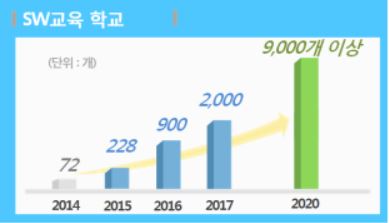
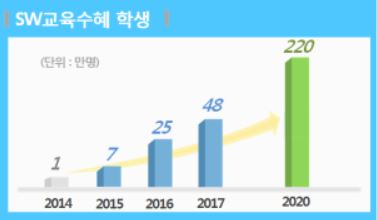
SW education becomes mandatory for middle schools starting in 2018 and elementary schools starting in 2019 (grades 5 and 6).
The operation of research and leading schools is a project aimed at building an in-school foundation and spreading excellent educational models in preparation for the mandatory implementation of software (hereinafter SW) education in elementary and secondary schools, and last year, SW education was provided to approximately 70,000 students.
In particular, last year focused on discovering and disseminating excellent models and improving awareness With a focus on this, SW education training for students and teachers at nearby schools and information sessions for parents were conducted. For example, at Samsung Elementary School in Chungbuk, as a result of conducting parent training and home projects with parents, an internal survey showed that 74% of respondents (38% at the beginning of the year) answered that "SW education is necessary in elementary school," and 73% (49% at the beginning of the year) answered that "it helps improve children's abilities."
Starting this year, in preparation for the mandatory implementation of SW education under the '2015 Revised Curriculum (Ministry of Education Notice No. 2015-74, Sep. 23, 2015),' we plan to provide focused support to schools that follow the hourly operation plan of the 'Software Education Operation Guidelines.'
To be selected, a certain amount of time must be spent on SW education within the regular curriculum.
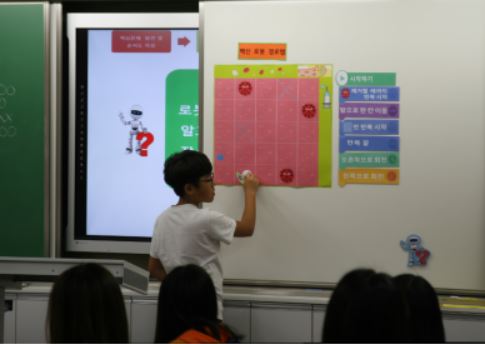 First, in order to be selected as a new leading school, schools must operate SW education for a certain amount of time in the regular curriculum for each school level, in accordance with the 'Software Education Operation Guidelines' announced by the Ministry of Education last February.
Elementary schools must provide SW education for at least 17 hours per year through the 'Practical Arts' subject and creative experiential activities, and middle schools must provide SW education for at least 34 hours per year through the 'Information' subject and creative experiential activities. However, high schools must organize information-related subjects.
Accordingly, the final selection is scheduled to be made based on the internal selection criteria set by the city and provincial offices of education.
The Ministry of Education and the Ministry of Science, ICT and Future Planning are expanding leading schools to ensure the successful implementation of SW education in the field and to discover and spread best practices, while also strengthening collaboration with 17 metropolitan and provincial education offices nationwide.
First, unlike last year, the 682 newly added schools will be selected by each city and provincial office of education through their own open competitions. In addition, the city and provincial offices of education will establish a support system at the office level to manage leading schools within their jurisdiction, and will identify best practices by region through interim reports in the first half of the year and a final performance evaluation at the end of the year.
The annual subsidy for SW education leading schools is an average of 10 million won per school and can be used for operating the SW education curriculum, teacher training, promotion to parents, purchasing educational equipment, and improving infrastructure. An additional 3 million won is scheduled to be provided to each of the 89 schools that received an excellent grade or higher in last year's final evaluation of leading schools, and support is planned to continue until 2017 through annual evaluations.
Deputy Prime Minister and Minister of Education Lee Joon-sik stated, “SW education is a subject that has high interest and perceived satisfaction among students and parents and serves as a foundation for cultivating world-class SW talent; we plan to provide support so that it can be learned systematically through public education.” Minister of Science, ICT and Future Planning Choi Yang-hee stated, “SW education is the most effective way to foster creative thinking skills, and we plan to continuously provide support so that more students can receive SW education.”
Recruitment for SW Education Leading Schools is scheduled to be conducted by 17 Metropolitan and Provincial Offices of Education during February and March, with the final results to be announced on March 25 following an evaluation process by each office. Details regarding support methods, evaluation procedures, and evaluation criteria for the specific projects will be provided. Detailed information regarding the rest can be found on the websites of each city and provincial education office starting February 22.
관련뉴스
Artificial intelligence, virtual reality, sensing homes… consumers consider them the near future
According to this report, consumers expect to be able to interact with objects without looking at smartphone screens in the not-too-distant future through the use of artificial intelligence (AI). Approximately half of smartphone users anticipate that smartphones will become outdated devices within the next five years.
2015.12.22by 신윤오 기자

[it-Movie] The present and future of artificial intelligence as seen through movies. Is 'Jarvis' from 'Iron Man' our friend?
At CES 2016, IBM Chairman Virginia Rometty forecast that artificial intelligence (A.I.)—technology that thinks and makes judgments like humans—will lead the future of the IT industry. In her keynote address, she explained that "digital alone cannot create differentiated value in the massive Internet of Things market," and emphasized that "artificial intelligence technology capable of understanding and reasoning about data is necessary for data analysis that brings business insights." Artificial intelligence has always been a topic of interest, as seen in many films up to now. But why is it being discussed in this way this year?
2016.01.25by
[Interview] Outstanding Domestic AI Technology Needs Regulations Lifted and Ecosystem Established to Develop
After IBM's 'Deep Blue' defeated a human opponent in chess in 1997, there were predictions that Go would still be difficult. The reason was that Go has far more cases and is much more complex than chess. However, on January 19th, at 'e4ds,' the words of Kim Jin-hyung, Director of the Software Policy Research Institute, differed. "Artificial intelligence will win at Go before long. If we make up our minds and invest money intensively, we will win," he said. Starting with his words, "don't get excited and don't be cynical," we were able to hear candidly about the current state and future of artificial intelligence in our country.
2016.02.01by 명세환 기자

Nvidia invests $5 billion in Intel
NVIDIA and Intel, leaders in global AI computing technology, are now forging ahead in providing cutting-edge solutions through NVLink-based architecture integration. NVIDIA and Intel have officially announced a strategic partnership and stated that they will jointly develop customized data center and personal computing products to accelerate diverse applications and workloads ranging from hyperscale to enterprise and consumer markets, thereby laying the foundation for the next generation computing era.
2025.09.22by 배종인 기자
.jpg)
Applied Materials Launches Environmental Protection Campaign to Mark World Cleanup Day
어플라이드 머티어리얼즈 코리아(대표 박광선)가 ‘세계 청소의 날(World Cleanup Day)’을 맞아 동탄 신리천 일대에서 임직원 및 가족과 함께 환경 정화 활동을 펼치며, 기술 혁신을 넘어 지역사회와 함께하는 기업으로 거듭나고 있다.
2025.09.22by 명세환 기자











