


This page was machine-translated and may differ from the original. View original
ADI, the era of wearables for material composition analysis devices has arrived.
 Published2016.02.24 15:05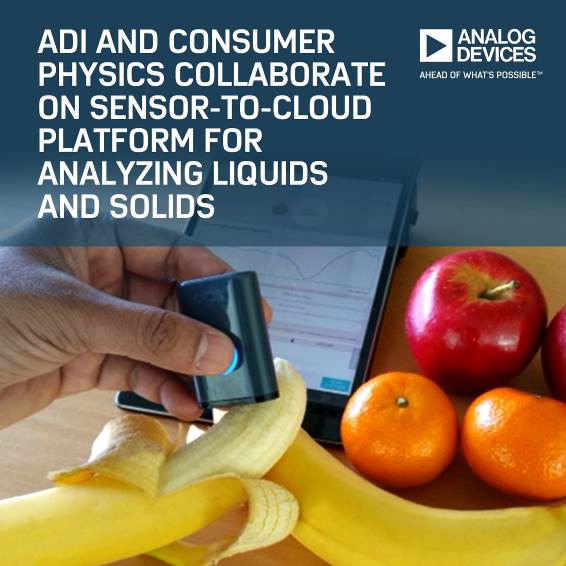
IoT platform-based joint development by ADI and Consumer Physics
Capable of identifying quality, content, and composition of substances such as food and pharmaceuticals
Analog Devices (ADI) and Consumer Physics (NASDAQ: CP) announced a joint development of a personal and industrial IoT platform that transmits information from sensors to the cloud to analyze diverse liquid and solid materials such as food, plants, pharmaceuticals, chemicals, and human body.
The two companies plan to integrate Consumer Physics' SCiO (material sensing) technology into smartphones, wearable devices, and industrial and medical applications. Using the jointly developed sensor-to-cloud platform, substances can be rapidly and accurately detected and quality managed, with the capability to measure various characteristics including nutritional information such as calories, fat, sugar, and protein, sweetness (brix value, where 1 brix = 1g of sugar per 100g of grape juice) of fruits and vegetables, alcohol content in alcoholic beverages, and chemical composition of fuels and oils.
Martin Cotter, Vice President of IoT Business Unit at Analog Devices, stated, "ADI and Consumer Physics share the vision of helping customers interpret diverse information encountered in the real world around us," and added, "Together with Consumer Physics, we plan to develop a safe, reliable, and robust material analyzer that can be used practically anywhere with power efficiency and at an appropriate price, and collaborate to create a safer and healthier world."
Embedding SCiO technology from Consumer Physics into applications
Developing portable molecular sensors with this technology
Dror Sharon, co-founder and CEO of Consumer Physics, stated, "We are pleased that through our collaboration with ADI, we can now integrate SCiO technology for material detection into more applications and industries," and added, "The world's first portable molecular sensor has been developed using SCiO technology, and now there lies tremendous potential to interpret real-world information not only through sensing technology embedded in smartphones but also through automotive, energy, industrial, and medical applications supported by ADI."
The core scientific and technical field of SCiO is near-infrared (NIR) spectroscopy, which has been used in numerous laboratories across various industries worldwide including food, pharmaceuticals, agriculture, healthcare, oil and natural gas, plastics, cosmetics, geology, and mineralogy for decades. However, currently available instruments are large in size and expensive, making them unsuitable for current and future IoT applications.
The physical principle underlying material analysis through NIR spectroscopy is that each molecule constituting a substance vibrates in its own unique manner depending on its type. These vibrations interact with light and exhibit optical characteristics unique to each molecule (also known as molecular signature). These optical characteristics are captured through optical sensors and signal conditioning electronic devices. Advanced algorithms analyze the spectrum through an updatable database and transmit information about the analyzed sample to the user in real time.
Developer kits are available for custom applications. SCiO Eco-System Partners can immediately use available SCiO developer kits to develop smartphones and wearable devices.
To request a correction, reply or follow-up report on this article, see how to file a request. Previously published statements are collected in corrections & replies.
Related news

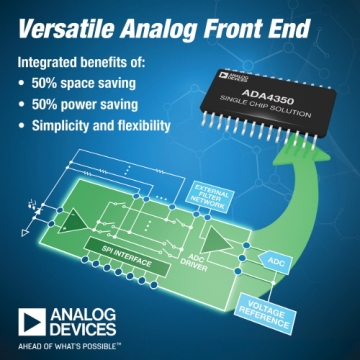
ADI Simplifies Sensor Interfaces with Integrated AFE
2015.05.18by 명세환 기자

Mouser Begins Sales of ADI's Precision Analog Microcontrollers
Mouser has begun sales of Analog Devices' ADuCM310 precision analog microcontroller. The ADuCM310 is designed for diagnostic control in tunable laser optical module applications such as data acquisition and instrument equipment. As a multi-stack architecture on-chip system, it integrates a 16-bit (14-bit accurate) multichannel SAR analog-to-digital converter (ADC), an ARM® Cortex®-M3 processor, 8 voltage output digital-to-analog converters (VDAC), 6 current output DACs, as well as flash/EE memory.
2016.02.04by












Sponsored Company