


Samsung Electronics to Mass-Produce 256GB UFS Internal Memory for Smartphones
 Published2016.02.25 11:06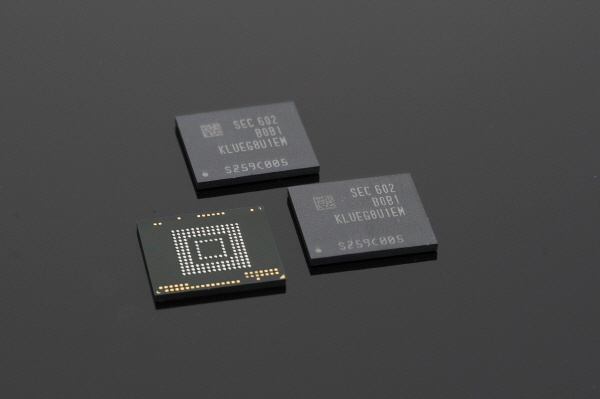
9x faster than high-performance microSD cards and 2x faster than standard laptop SSDs
Samsung Electronics will be the first in the world to mass-produce the next-generation smartphone built-in memory, '256GB UFS (Universal Flash Storage),' starting this month.
The '256GB (gigabyte) UFS' is expected to raise the growth paradigm of the memory storage market from capacity-centered to performance-centered, as it is nine times faster than a high-performance microSD card (based on sequential read speed) and nearly twice as fast as a general-purpose SSD for laptops.
'UFS' is a product that applies the 'UFS 2.0' interface, the latest built-in memory standard of the international semiconductor standardization organization 'JEDEC'.
Samsung Electronics created the era of UFS for smartphones by being the first in the industry to mass-produce 128GB UFS in January of last year, and then, just one year later, it launched a product with double the capacity and speed, fully expanding its premium memory market.
This '256GB UFS' memory is the only one in the industry that satisfies the 'ultra-high speed, ultra-large capacity, and ultra-small size' characteristics required for next-generation smartphones equipped with ultra-high-resolution large-screen LCDs, providing an unrivaled mobile memory solution to global smartphone manufacturers.
Equipped with V-NAND flash memory and a proprietary high-performance controller
Ultra-small size smaller than a micro SD card
Especially cutting-edge V-NANDBy implementing flash memory and a proprietary high-performance controller, it has achieved an ultra-small size smaller than a micro SD card, thereby increasing the convenience of design in the smartphone development process.
Samsung Electronics' '256GB UFS' has achieved a sequential read speed of 850MB/s by configuring two UFS data transmission channels (lanes) and also increased the sequential write speed to 260MB/s, which is about three times faster than the external high-speed microSD card used as expansion memory in smartphones.
Additionally, the random read/write speed, which has the greatest impact on system speed, can achieve 45,000/40,000 IOPS, which is more than twice as fast as existing UFS products (19,000/14,000 IOPS), significantly improving the performance of smartphones.
Meanwhile, next-generation smartphones that support the USB 3.0 interface can increase data processing speed with the outside world by more than 10 times compared to existing smartphones, allowing them to transmit 5GB of full HD video in just 11 seconds.
Additionally, with the industry's largest capacity of 256GB, it can store 47 5GB full HD movies, further enhancing the convenience of using ultra-high-resolution, large-screen smartphones.
Through this, it is expected that future smartphone users will be able to freely enjoy complex tasks such as searching for photo files and downloading videos without delay (buffering) while watching ultra-high-definition (UHD) content.
“With the launch of this UFS memory, the growth paradigm of the memory card market will rapidly shift to a performance-centered one,” said Choi Joo-sun, Vice President of the Strategic Marketing Team at Samsung Electronics’ Memory Business Division. “In line with the era of large-capacity content, we will further strengthen our unrivaled product competitiveness by simultaneously increasing the performance and capacity of our three premium product groups, including NVMe SSD, portable SSD, and UFS.”He emphasized that.
Comments
Related news
.jpg)
Samsung Electronics Launches V-NAND-Based '2 Terabyte' SSD
2015.07.17by 명세환 기자
Samsung Electronics Unveils 'Exynos 8 Octa,' a 14nm Process-Based One-Chip Solution
Samsung Electronics has unveiled the "Exynos 8 Octa (8890)," a premium-class second-generation mobile SoC that applies state-of-the-art 14-nanometer FinFET process technology. The "Exynos 7 Octa," the first-generation 14-nanometer product that began mass production for the first time globally earlier this year, is a standalone mobile Application Processor (AP), whereas the second-generation product announced this time is characterized by integrating a mobile AP and a top-tier modem into a single chip.
2015.11.12by 신윤오 기자
Samsung Electronics Unveils Premium 2TB Portable SSD 'T3'
Samsung Electronics is unveiling 'T3', a new high-performance, high-capacity portable SSD (Solid State Drive) based on third-generation V-NAND, and launching a full-scale expansion into the external SSD market. The company will first introduce the 'T3' at 'CES 2016', the world's largest consumer electronics exhibition opening on the 6th in Las Vegas, USA, and plans to sequentially release it starting in February across 50 countries worldwide, including South Korea, the United States, China, and Germany.
2016.01.05by 명세환 기자

Intel Unveils Next-Generation 'Core Ultra Series 3' and vPro Platform for Enterprise PCs
Intel has officially unveiled the "Intel Core Ultra Series 3" for next-generation enterprise PCs and the latest vPro platform, addressing a wide range of demands from enterprise notebooks to high-performance workstations.
2026.03.26by 배종인 기자

ROHM Launches ESD Protection Diode Compatible with High-Speed Interfaces of 10Gbps or Higher
Semiconductor specialist ROHM has developed the 'RESDxVx series' of ESD (electrostatic discharge) protection diodes capable of responding to next-generation high-speed data communication environments exceeding 10Gbps, simultaneously enhancing both signal quality maintenance required in high-speed interfaces and IC protection performance.
2026.03.26by 배종인 기자











