


'Increase image resolution' Smartphone camera lens patent applications increase
 Published2016.06.21 10:42
The technological competition in smartphone cameras started with a competition over the number of pixels in image sensors and has recently expanded to a competition over lenses.
As the number of pixels increases, the area occupied by each pixel becomes smaller, so the lens aperture must be larger to receive a sufficient amount of light for each pixel. In addition, the resolution of the lens must be sufficiently high to correspond to the increase in the number of pixels in order to expect improved photo quality. However, with ultra-slim phones becoming the trend, lens modules have size constraints, so there is a task of pursuing miniaturization and weight reduction along with improved performance.
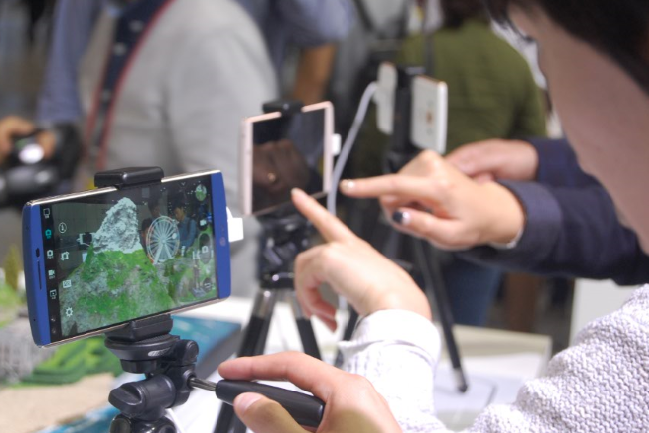
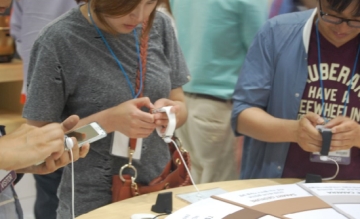
▲ Exhibition visitors taking pictures with their smartphones
According to the Korean Intellectual Property Office (KIPO, Commissioner Choi Dong-gyu), there were a total of 707 patent applications for smartphone camera lenses from 2011 to 2015. The number of applications by year shows a steady increase: 102 in 2011, 122 in 2012, 155 in 2013, 162 in 2014, and 166 in 2015.
By technology, ‘auto focus (AF) and drive system technology’ was the most prevalent at 39.9%, followed by ‘housing and assembly structure technology’ at 20.2%, ‘lens optics, aperture system, and filter technology’ at 13.9%, ‘optical image stabilization (OIS) technology’ at 11.3%, ‘manufacturing and inspection technology’ at 10.0%, and ‘zoom and multiple-angle technology’ at 4.7%. The increase in applications for ‘optical image stabilization technology’ and ‘auto focus (AF) and drive system technology’ was particularly notable. This is understood to reflect recent consumer demand for high-performance, high-function cameras.
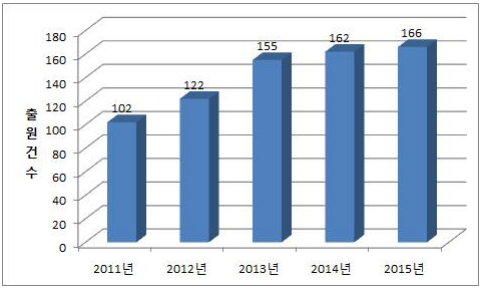
▲ Status of patent applications related to smartphone camera lenses
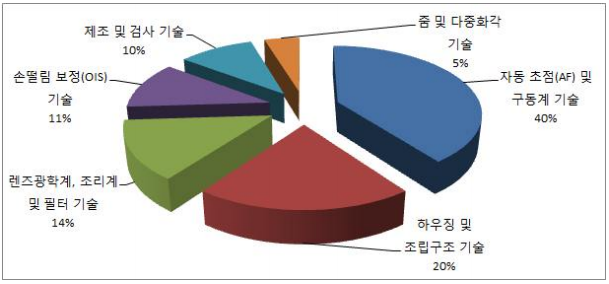
▲ Status of patent applications by technology field related to smartphone camera lenses
By applicant, Samsung Electronics had the most with 161 applications (22.8%), followed by LG Innotek with 158 applications (22.3%), Samsung Electronics with 38 applications (5.4%), and LG Electronics with 38 applications (5.4%). It was also revealed that mid-sized companies such as Jahwa Electronics with 35 applications (5.0%), Optis with 26 applications (3.7%), and Sekonix with 20 applications (2.8%) are also actively pursuing technology development.
Meanwhile, there were a total of 1,288 PCT international patent applications, with LG Innotek filing the most (81 applications, 6.3%), followed by Samsung Electronics filing the most (45 applications, 3.5%), Samsung Electronics filing the most (1.6%), Apple filing the most (1.6%), and Largan Precision (Taiwan) filing the most (1.6%), showing that domestic companies account for the majority of the top applicants.
A patent office official said, “In the current situation where smartphone manufacturers and component material companies are intricately intertwined, the competition in the smartphone market is becoming fiercer day by day, so we need to protect patent competitiveness related to lenses, which are the core technology of cameras and are considered the most important competitive point of smartphones. “It takes effort,” he said.
관련뉴스
The era of double-digit growth smartphones is over.
세계적인 IT 자문기관인 가트너(Gartner Inc.)는 2016년 전세계 스마트폰 시장이 사상 처음으로 한 자릿수 성장률을 기록할 것으로 전망했다. 가트너는 2016년 전세계 스마트폰 판매량이 전년대비 불과 7% 증가한 15억 대에 그칠 것으로 예상했으며, 전체 모바일 시장 판매량은 19억 대에 이를 것으로 내다봤다. 가트너는 또한 PC, 태블릿, 울트라모바일 및 휴대폰을 포함한 모든 디바이스의 전체 출하량이 전년 대비 0.6% 증가한 24억 대에 이를 것으로 전망했다.(표 참조). 반면, 최종 소비자 지출은 미 달러화 기준으로 전년대비 1.6% 감소할 것으로 예측했다.
2016.04.04by 명세환 기자
ARM, 이미징 전문 업체 인수로 스마트폰 카메라 시장 확장
ARM은 차세대 기기들이 주변 환경에서 전송한 정보를 이해하고 지능적으로 수행하도록 지원할 이미징 및 임베디드 컴퓨터 비전 기술 분야의 세계적인 선도 기업인 애피컬을 인수했다. 애피컬은 영국에서 가장 빨리 성장하는 기술 업체 중 하나이며, 이 회사의 첨단 이미징 제품은 15억 대 이상의 스마트폰과 약 3억 대에 이르는 인터넷 카메라, 디지털 카메라 및 태블릿 등을 비롯한 기타 소비자/산업용 장치에서 사용되고 있다.
2016.05.20by 명세환 기자
Mid-range smartphones driving growth are seeing a trend of upgrading core component specifications.
The core component specifications of mid-range smartphones, which are driving the global smartphone market, are being upgraded. There is an increasing trend of mounting application processors (AP), which are core components, with proprietary products, and memory capacity such as NAND and DRAM is also expanding. Additionally, Chinese handset manufacturers are increasingly adopting larger display sizes of 5 inches or more, and in particular, components such as fingerprint sensors and NFC are serving as growth drivers for mid-range smartphones. The Korea Semiconductor Industry Association and GfK, a global market research specialist, disclosed these findings in their recently conducted 2016 Market Briefing report and forecasted specific handset component trends.
2016.05.23by 신윤오 기자
VR Camera for Smartphones Capable of 360-Degree Immersive Capture and Live Streaming Launched
360도 파노모프(panomorph) 렌즈를 개발한 몰입형 광학/이미징 기술 전문 기업인 ImmerVision과 노트북 PC 생산업체인 콴타 컴퓨터(Quanta Computers)가 끊임없이 성장 중인 스마트폰 시장을 위해 디자인된 세계 최초의 360도 라이브 VR 스트리밍 애드온(add-on) 카메라를 출시했다고 밝혔다. 인증 받은 ImmerVision Enables 2.0을 사용한 콴타의 새로운 360 VR 카메라는 손바닥 안에 들어오는 작은 크기이며 후면에 자석이 있어 어떤 스마트폰이든지 어렵지 않게 부착할 수 있다.
2016.06.01by 명세환 기자

Foldable smartphone, smartphone that supports augmented reality...Lenovo's counterattack
레노버(www.lenovo.com)가 지난 6월 9일 미국 샌프란시스코에서 개최한 연례 혁신기술 컨퍼런스인 `레노버 테크 월드 2016(Lenovo TechWorld 2016)`에서 커넥티드 디바이스에 대한 미래 비전을 발표했다. 또한, 세계 최초로 구글의 증강현실 기술인 탱고를 지원하는 스마트폰인 팹2 프로(PHAB 2 PRO), 모토 모즈(Moto Mods)라는 모듈을 장착해 새로운 모듈 기능을 추가할 수 있는 모토 Z(Moto Z) 시리즈 스마트폰 등과 같이 하반기에 출시될 혁신적인 제품들을 선보였다. 이와 더불어, 세계 최초로 손목에 착용할 수 있는 구부러지는(Bendable) 스마트폰과 펼치면 태블릿, 반으로 접으면 스마트폰이 되는 미래기술을 시연했다.
2016.06.13by 명세환 기자











