



Learning IT English in Secret - Around one in ~ : One of ~
 Published2016.07.04 14:25
IT ENGLISH, learning through keywords from IT-related news or companies. Today, we will learn simple English conversation expressions using the radar chips used in autonomous vehicles from Infineon , a radar chip manufacturer. It is said that one out of every 15 new cars this year will be equipped with this company's 77GHz radar chip. I believe that using a familiar subject will be very helpful in learning and utilizing these expressions.
Today's expression is "Around one in ~: one of ~ ." Easy, right? However, these are expressions that were difficult to apply in actual conversation. Learn these useful phrases through a short dialogue.
A: You know what? Around one in 15 new cars (around: approximately, one in ~ : one of ~,) in this year uses radar chips from Infineon,co for driver assistance. That's big news, isn't it?
B: Yes, I've read it from the e4ds newsletter. It's amazing! I really look forward to a new car with them.
A : Ummmmmm......
But, depending on a vehicle's category and how it's equipped , it will have between one and three radar systems.
B: Then, when can I ride an amazing automated driving car?
A : Maybe...around 2020. According to the article, in the autonomous vehicle, which the automobile industry expects to be available from around 2020, at least ten radar systems may be installed.
B: Wow~ I am really excited about it!!
A: Did you know? They say that one out of every 15 cars produced this year uses an Infineon radar chip for its driver assistance system. Isn't that totally awesome?
B: Yeah, I know. I read about it in the e4ds newspaper. It's really amazing. I wonder what kind of car will come out... lol. I'm looking forward to it.
A: Um... But I heard that depending on the car model and how it's equipped, about one to three radar systems are installed?
B: Then, when will we be able to ride in a cool self-driving car?
A: It'll probably be around 2020. I saw an article saying that autonomous vehicles will become possible in the automotive industry around 2020, and they will come equipped with at least 10 radar systems.
B: Ah~ I'm so excited!!!
Learning sentence structure
Around one in 15 new cars
It is common to use "one of~" when expressing one of ~ .
However, let's try learning and using another expression.
The preposition "in" means "inside." While the most commonly known meaning of "inside" is familiar as an expression referring to a place, let's also learn that it can be expressed as shown above, meaning "(used before something referring to a part or the whole) ...in [among]."
I've read it
" Have pp" is a present perfect expression used to describe events that have already occurred in the past, or to indicate states such as experiences, results, or completion. In fact, it is one of the most frequently used expressions in conversation, but there are many cases where people fail to use it not because they don't know how to express it, but because they don't know when to use it.
For example, “I’ve done ~ (I’ve pp~)" is mainly used when expressing things like “ She has already gone .” The third-person singular form is Has Pp , and in particular, “Has he heard of ~? (has he heard of~?)” is expressed as “She has already met ~.”
I really look forward to
Usually, it is often expressed in the progressive form to emphasize it, such as "Be looking forward to~" .
This expression means “ I am looking forward to it .” It is used in positive conversations while waiting for something. It is rarely used to express anticipation for a negative situation. Since it is used to mean " looking forward to it with bated breath," it is naturally a positive expression, isn't it?
depending on
The verb ' depend ' is used with the preposition ' on' to mean "to depend on, " but it is not used as a verb. Instead, as in the expression 'script,' ' depending on ' is frequently used at the beginning of a sentence to mean "depending on ." Since there are various expressions in Korean that have the same meaning, it is best to learn the situations in which to use them.
For example, if you use expressions such as ' by you' (when you want to express that it is decided by you) , ' according to public preference,' or ' depending on the type, ' you can lead a smooth conversation.
관련뉴스
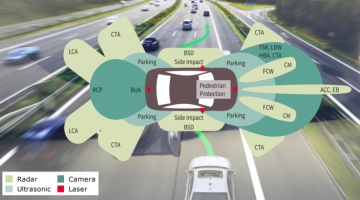
They say that one out of every 15 new cars produced this year uses this company's radar chip.
More than half of the 77GHz radar systems for automobiles produced in 2016 are expected to adopt chips from Infineon Technologies (Korea Representative Director Lee Seung-soo). Statistically speaking, this means that one out of every fifteen new vehicles will be equipped with a driver assistance system that adopts Infineon's 77GHz radar chip. According to a market research conducted by IHS, Infineon is the global leader in the radar chip market for rapidly growing driver assistance systems. Over the past several years, Infineon has shipped 20 million radar chips, and plans to ship 30 million chips for driver assistance systems in the coming year alone. This means that Infineon's radar chip sales will double every year over a five-year period.
2016.06.30by 김수지 기자











