


Why IT, automotive, and machine learning companies are coming together to achieve fully autonomous driving
 Published2016.07.04 14:21
Building an open platform for next-generation automotive, from vehicles to data centers.
Intel, BMW Group, and Mobileye are joining forces to develop self-driving cars and make future mobility concepts a reality.
These three companies, leaders in the automotive, computer vision and technology, and machine learning industries, have joined forces to develop solutions that will enable commercialization of highly autonomous driving by 2021.
The future of automated driving promises to significantly improve our lives and society. However, the path to a fully autonomous world is complex and requires end-to-end solutions that integrate intelligence across the entire network, from vehicle door locks to data centers. Transportation service providers of the future must effectively leverage rapidly evolving technologies, collaborate with entirely new partners, and be prepared for disruptive innovation opportunities.
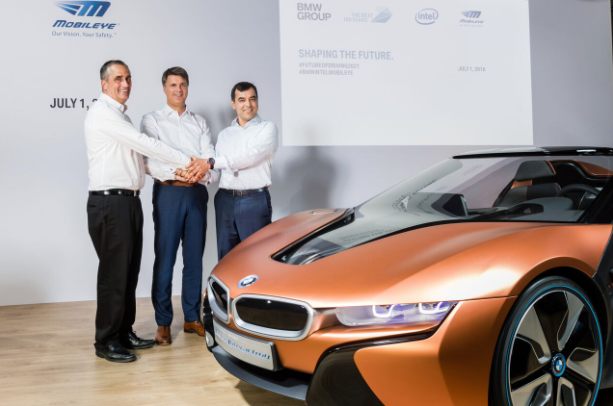
Intel, BMW, and Mobileye will jointly develop the solutions and innovative systems needed to commercialize fully autonomous driving by 2021. The BMW iNEXT model will be the cornerstone of the BMW Group's autonomous driving strategy and lay the foundation for fully autonomous vehicle operation, enabling autonomous driving on highways as well as automated ride-sharing solutions in urban environments.
The three companies believe that automated driving technology will make travel safer and easier. The goal of this collaboration is to develop future-ready solutions that not only eliminate the need for drivers to take their hands off the steering wheel, but also move beyond Level 3 (eyes off) to the ultimate level (mind off) where they don't need to think about driving at all, freeing them to use their driving time for leisure or work. This level of autonomy will technically enable the final step (Level 5) of driverless vehicles. This opens the door to autonomous driving by 2021 and lays the foundation for entirely new business models in a connected, mobile world.
These three companies gathered at BMW Group headquarters in Munich, Germany, on the 1st to pledge to actively pursue industry standardization and define an open platform for autonomous driving. The joint platform will address Level 3 to Level 5 autonomous driving challenges and will be available to various automakers and other industries that can benefit from autonomous devices and deep machine learning.
The three companies have already agreed on a set of deliverables and milestones to deliver a fully autonomous vehicle based on a common reference architecture. In the near future, the three companies plan to demonstrate autonomous driving testing with a highly automated driving (HAD) prototype. Furthermore, in 2017, the platform will be expanded to operate multiple autonomous vehicles based on scalable autonomous driving testing.
Intel offers a comprehensive portfolio of technologies needed to power and connect hundreds of millions of smart, connected devices, including automobiles. Intel will deliver powerful computing performance that scales from Intel® Atom™ to Intel® Xeon™ processors, up to a total of 100 teraflops (trillion operations per second) of power-efficient performance without the need to rewrite code, to handle the complex workloads required by autonomous vehicles in urban environments.
Through its Strategy Number One > Next, the BMW Group has developed its own framework to continue to lead the way in premium individual mobility. This approach will be realized in 2021 with the BMW iNEXT model, marking a new chapter in mobility, the company said.
관련뉴스

[Reporter's Notebook] The Autonomous Vehicle Industry: How to Avoid Going Backwards
For autonomous vehicles to be realized, core enabling technologies must be supported. Advanced technologies are required, including LIDAR systems, GPS technology, IMU (inertial measurement unit technology for measuring speed and direction), HVI (optimal UI for drivers), smart actuator technology, V2X communication technology, and LDM (digital map technology). In other words, all technologies must be mobilized—from core components to road infrastructure and mapping technologies.
2016.04.04by 신윤오 기자
Why did Google's self-driving car spend 3.85 million kilometers on road tests?
국내 대표적인 미래학자이자 아스팩미래기술경영연구소(주) 대표 소장인 차원용 박사는 최근 펴낸 ’구글 인공지능형 자율자동차 집중 특허 분석’이라는 책을 통해 이같이 밝히며, “구글 대부분의 특허는 미국 SAE에서 규정한 레벨(L) 3과 4에 맞춰져 있다”며, “자율주행차의 핵심인 인공지능(AI)-기계학습(ML)-딥러닝(DL)과 관련된 소프트웨어 설계능력과 이를 바탕으로 실제 도로주행테스트를 하면서 일어난 상황과 대처와 학습에 관한 특허”라고 말했다. 차 박사는 구글의 셀프 드라이빙 카(SDC, Self-Driving Car) 프로젝트인 반자율차(Self-Autonomous Car)와 자율차(Autonomous Car)와 관련하여, 2009년부터 2015년 12월 31일까지의 구글의 특허 250개를 찾아, 그 중 110개의 중요한 특허를 분석하였다. 이들 특허의 대부분은 자율주행차의 핵심인 센서 시스템(Sensor System)과 자율주행컴퓨터시스템(Autonomous Driving Computer System), 상용화되었을 때 사용자와 자율차 간의 인증 시스템 등이다.
2016.05.02by 신윤오 기자
Can domestic LiDAR technology, the eyes of autonomous vehicles, drastically lower prices?
Last May, when a fatal accident involving a Tesla electric vehicle occurred while driving with autonomous driving capability (Autopilot), autonomous vehicles once again became the center of controversy. The U.S. National Highway Traffic Safety Administration (NHTSA) regards this accident as the first fatal accident occurring in autonomous driving mode. This accident has become an opportunity to comprehensively review autonomous vehicle technology, from the sensor role to commercialization. Accordingly, we examined autonomous vehicle forward detection technology through the current domestic technology status of LiDAR (Light Detection and Ranging), which can be considered the "eyes" of autonomous vehicles, and related technologies.
2016.07.04by 신윤오 기자

A single misaligned light means 'defect'… Vehicle interior lighting now guarded by semiconductors and software
Automotive interior lighting is moving beyond its role as 'auxiliary lighting.' As it becomes a core element of user experience (UX) that expresses brand identity through color and animation while reflecting driver preferences, the LED interior ambient lighting market is growing rapidly. In connection with this, we met in advance with Choi Young-jae, Research Director at Dabo Corporation, who will present a technical webinar session on "Intelligent LED Interior Lighting Solutions Illuminating Future Vehicles," to hear about market trends and changes in design requirements.
2026.08.28by 명세환 기자
TI, HEV·EV 트랙션 인버터용 다축 코어리스 전류 센서 TMCS2100-Q1 공개
Texas Instruments가 HEV·EV 트랙션 인버터용 다축 코어리스 홀 효과 전류 센서 TMCS2100-Q1을 공개했다. 수평·수직 자기장을 동시에 측정하는 다축 센싱 기술로 기존 단일 축 센서 대비 최대 20배 높은 정확도를 달성하며, 버스바 무개조 설계로 기계 설계 유연성을 확보했다. 800V 아키텍처 확산에 따른 고정확도 요구 충족과 소형화를 동시에 구현한다.
2026.08.27by 배종인 기자











