

.png)

75% of Security Survey Respondents Say 'Our Organization Is Highly Exposed to Cyber Security Risks'
 Published2016.07.19 10:46
Insufficient detection and response, the organization's security priority limited to prevention
EMC Korea (CEO Kim Kyung-jin) announced the 'RSA Cybersecurity Poverty Index' report.
Published for the second time following last year, this report covers the maturity and status of cybersecurity across key areas such as organization size, industry, and region, based on a survey of IT professionals worldwide conducted by RSA, EMC's security business unit. A total of 878 participants from 81 countries—including 240 from Europe, the Middle East, and Africa; 200 from the Asia-Pacific region; and 438 from North and South America—participated in the survey for this report.
In this self-assessment-based survey, 75% of all respondents answered that their organizations are significantly exposed to risk due to insufficient security capabilities. Only 18% of respondents rated their organization's security capabilities relatively highly, and only 7% said they had top-level capabilities.
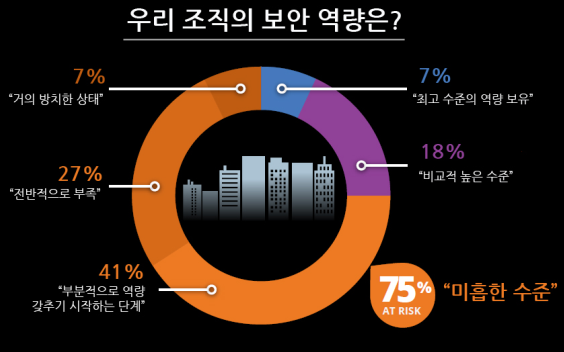
EMC 'RSA Cybersecurity Vulnerability Index' Report
In response to questions regarding the key areas of cybersecurity—Identify, Protect, Detect, Respond, and Recover—66% of respondents assessed that all aspects were inadequate. Among these, the most lacking areas were Detect and Respond, which have recently emerged as core elements of security strategies, while Protect was found to be the most mature. This indicates that organizations' security priorities are still focused on Protect, or preventive policies.
In terms of specific capabilities, the ability to identify, investigate, and mitigate risk types was found to be the most lacking. Only 24% of respondents reported possessing mature or proficient capabilities in this area. As organizations fail to properly assess risk factors, it is highly likely that investments to improve security levels are not being prioritized correctly. Threat detection capabilities were also found to be relatively lacking. Only 28% of companies were properly equipped with the capabilities to monitor networks, endpoints, servers, and applications to detect potential security issues. On the other hand, the Identity and Access Management (IAM) section showed a relatively high level of maturity (37%).
67% of respondents experienced a security incident within the past year, and by industry, the government and energy sectors showed low maturity.
It was also found that there are significant differences in cybersecurity capability levels depending on company size. Among respondents from organizations with 10,000 or more employees, 33% rated their organization's security maturity as high or top-tier. This figure is about 10% higher than the 24% for organizations with 1,000 to 10,000 employees and 23% for respondents from organizations with fewer than 1,000 employees.
67% of respondents reported experiencing a security incident within the last 12 months that could have a negative impact on their business. Of these, only 24% rated their security strategy as mature, indicating that organizations lacked proper security strategies and capabilities even after experiencing incidents. However, the more security incidents an organization experienced, the more its security levels improved. Organizations that experienced 21 or more incidents over the past 12 months were 65% more likely to rate their security maturity highly compared to organizations that experienced 10 or fewer incidents.
By industry sector, the aerospace and defense industry had the highest level of security maturity. 39% of employees in the aerospace and defense industry rated security maturity highly, surpassing the high-tech industry (31%). Financial services, which are the primary targets of cyber attacks, stood at only 26%, while the government and energy industries showed the lowest security maturity (18%).
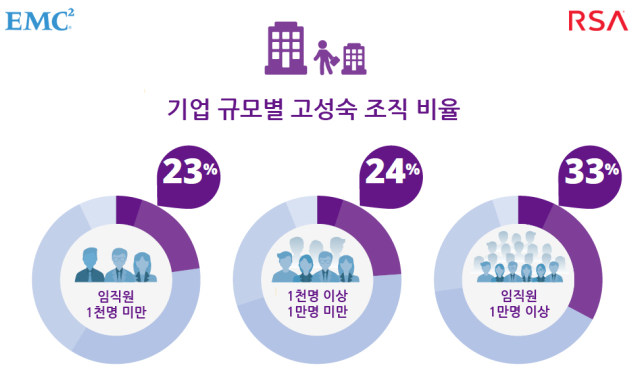
EMC 'RSA Cybersecurity Vulnerability Index' Report
Meanwhile, the most notable change compared to last year is that the number of companies with the most mature security capabilities increased by 51%, from 4.9% to 7.4%. In addition, in terms of individual capabilities, the maturity level in the field of 'conducting security education and training for employees, executives, and partners' improved significantly, demonstrating that security awareness is spreading.
"This survey shows that the capabilities of many companies are still insufficient to respond to rapidly increasing cyber threats," said Kim Kyung-jin, President of EMC Korea. "Businesses must enhance stability by determining the correct security investment priorities through security risk analysis and strategy formulation, and by focusing on improving capabilities in detection and response, which have recently become major issues."
Meanwhile, this survey was evaluated based on the National Institute of Standards and Technology (NIST) Cybersecurity Framework (hereinafter CSF). Developed in the United States to reduce risks to critical infrastructure, the CSF is used as a standard to evaluate management and security capabilities regarding major cyber risks. CSF defines the five major functions of security as Identify, Protect, Detect, Respond, and Recover.
관련뉴스
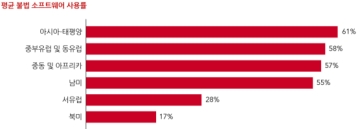
35% Illegal Software Usage Rate in Korea, High Cybersecurity Risks
소프트웨어 얼라이언스(BSA)는 불법 소프트웨어와 사이버 공격 간 높은 상관관계가 있음에도 불구, 한국 내 컴퓨터 사용자들의 불법 소프트웨어 사용률이 35%를 기록했다고 발표했다. 이 결과는 소프트웨어 얼라이언스가 최근 발간한 ‘BSA 글로벌 소프트웨어 조사 보고서: 라이센스 준수를 통한 기회의 포착(BSA Global Software Survey: Seizing Opportunity Through License Compliance)’을 통해 밝혀진 것으로, 2013년 실시한 동일 조사 대비 3 포인트 감소한 수치이나 여전히 국내 다수의 시스템이 사이버 공격에 노출되어 있음을 의미한다.
2016.05.25by 명세환 기자
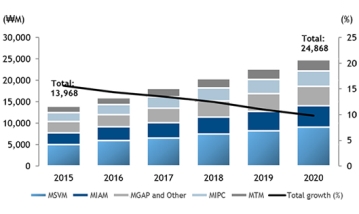
Mobile Security Industry Growth Outlook: Will Adoption of Cloud-Based EMM Solutions Increase?
한국IDC(대표 홍유숙)가 최근 발간한 ‘국내 기업용 모바일 보안 소프트웨어 전망 보고서 2016-2020에 따르면, 지난해 국내 기업용 모바일 보안 소프트웨어 시장은 약 140억원 규모로 추산된다. 또한 이 시장은 향후 5년간 연평균 12.2%로 성장해 오는 2020년 250억원 규모를 형성할 것으로 전망된다. 보고서는 스마트워크 환경이 보편화 됨에 따라 기업들이 보다 강력한 보안 정책을 바탕으로 전사적 모바일 업무 지원을 위한 다양한 모바일 보안 솔루션을 검토하게 될 것으로 내다봤다. PC, 스마트폰, 태블릿은 물론 최근 스마트워치와 같은 웨어러블 기기까지 연결되어 스마트 기기의 통제 범위가 넓어짐에 따라 관리해야 할 영역도 커지고 있는 상황인 만큼 전사적 차원의 디바이스 관리가 요구되는 상황이다. 이에 따라 클라우드 기반의 EMM 솔루션 도입과 적용에 대한 관심이 점차 늘어날 것으로 보인다.
2016.06.14by 김수지 기자

Symantec Announces Automotive IoT Security Solution to Detect Automotive Hacking Issues
Symantec (www.symantec.co.kr) has announced the "Symantec Anomaly Detection for Automotive" solution, which detects abnormal behavior in connected cars. The vehicle IoT security solution announced this time was developed by Symantec by adapting its long-accumulated experience and expertise in complex network environments to the automotive environment, providing core security functions capable of detecting and resolving issues such as vehicle hacking.
2016.06.15by 명세환 기자
.png)
Databricks Unveils Open AI Security Monitoring 'Lakewatch'
데이터브릭스가 3월 24일 개방형 에이전틱 SIEM ‘레이크워치’를 공개하며 보안 시장에 진입했다. 이 제품은 보안, IT, 비즈니스 데이터를 단일 환경에서 통합 분석해 AI 기반 위협 탐지와 조사를 지원하는 것이 핵심이다. 회사는 고비용 구조 때문에 일부 데이터를 포기해온 기존 보안관제의 한계를 줄이고, 개방형 형식과 생태계를 바탕으로 대규모 데이터 분석과 자동화를 가능하게 한다고 설명했다. 레이크워치는 현재 프라이빗 프리뷰로 제공되며, 어도비와 드롭박스 등이 초기 고객으로 언급됐다. 데이터브릭스는 앤트로픽과 협력을 확대하고 안티매터, SiftD.ai 인수도 함께 발표했다.
2026.03.26by 배종인 기자

Kaspersky Unveils Revamped 'NEXT' Combining SOC Integrated Management and AI Analytics
기업들이 보안관제센터(SOC) 구축과 운영에서 통합 관리와 자동화 수요를 키우는 가운데, 카스퍼스키가 자사 B2B 보안 제품군 ‘카스퍼스키 넥스트’의 개편 내용을 공개했다. 이번 업데이트는 OSMP 기반 단일 콘솔로 EPP·EDR·XDR·SIEM 연계를 넓히고, DLL 하이재킹 탐지와 계정 탈취 의심 행위 식별 같은 AI 기능, 생성형 AI 보조도구 KIRA 연동을 담았다. 회사는 대규모 배포 환경에서 EDR Expert는 최대 30%, XDR Expert는 최대 60%까지 자원 요구량을 낮출 수 있다고 밝혔다.
2026.03.25by 배종인 기자











