


ON Semi Launches Power Integrated Module Solution for Next-Generation Automotive BLDC
 Published2016.07.28 11:03
Highly integrated module with 30A, 40V MOSFET function
ON Semiconductor (Nasdaq: ON) has expanded its automotive Power Integrated Modules (PIMs) product family by launching the STK984-190-E.
Optimized to drive 3-phase brushless motors (BLDC) in the latest automotive models, this module includes a total of six 40V, 30A MOSFETs arranged in a 3-phase bridge, with the addition of a 40V, 30A upper reverse battery protection MOSFET. These MOSFETs are mounted on a Direct Bond Copper (DBC) substrate to create a compact module that provides excellent heat dissipation performance, reducing the board space occupied by the same components by half.
This module is suitable for driving 12V electric motors in automobiles with a power rating of up to 300W, including electric pumps, fans, and wipers. The high-efficiency BLDC solution, used with motor controllers such as the LV8907UW, incorporates an ultra-small PCB that significantly reduces both size and weight for design engineers, ensuring superior heat dissipation performance.
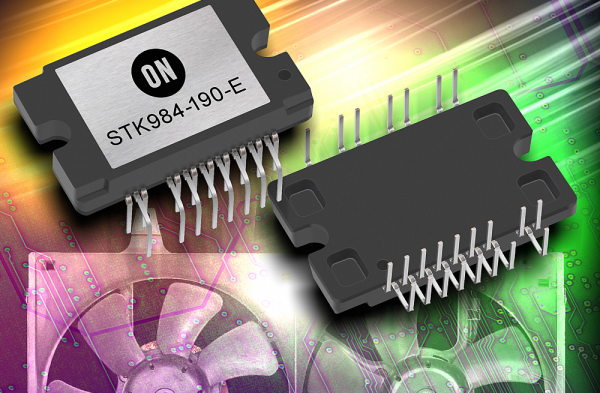
This module offers the effect of significantly reducing not only the number of components in the system but also the bill of materials. The DBC substrate reduces thermal resistance, thereby lowering the operating temperature of the MOSFET. This reduces power loss, which in turn minimizes temperature fluctuations caused by thermal cycling. Insulation is also improved by using a direct-bonded copper substrate. The STK984-190-E has an operating temperature of -40°C to 150°C, and all MOSFETs embedded in it meet the AEC-Q101 standards.
Chris Chey, General Manager of ON Semiconductor’s System Solutions Group, emphasized, “While developing BLDC drive solutions typically requires 13 to 15 components, the STK984-190-E automotive power module is sufficient with less than half that number of components. The module’s strong heat dissipation performance has allowed for a reduction in the size of the heatsink. With both size and weight reduced in this way, the challenges faced by engineers who had to overcome space constraints while improving fuel efficiency have been completely resolved.”
Comments
Related news
ON Semiconductor Unveils HD Streaming Video and Audio Platform for Smart Homes
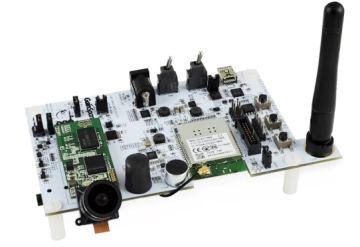
IT solutions provider GainSpan, together with ON Semiconductor and GEO Semiconductor, has unveiled a reference design for a low-power battery-operated video doorbell that enables HD video streaming and bidirectional, telephone-quality audio over Wi-Fi networks. Developed to address the growing IoT market for video/audio streaming products, this reference design platform not only accelerates product time-to-market but also reduces product development costs and OEM cycle time. Through this partnership, customers benefit from the technological advantages of three companies that excel in their respective domains: GEO Semiconductor's low-power, highly integrated video encoder solutions, ON Semiconductor's superior image sensor solutions, and GainSpan's low-power cloud-connected Wi-Fi solutions.
2016.05.18by 명세환 기자
ON Semiconductor Launches Sensorless 3-Phase Motor Controller for Automotive BLDC Implementation
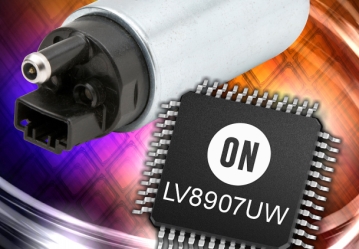
On Semiconductor has expanded its motor controller portfolio with the launch of the LV8907UW. This high-performance and multifunctional device, supporting a driving power range of 5.5 to 20 volts (with transient voltages of 4.5 to 40 volts), is the latest solution for efficient operation of three-phase brushless motors. The newly released LV8907UW integrates a two-stage charge pump for 100% duty cycle operation and gate drivers for six N-channel MOSFETs. This integrated circuit, featuring a design configuration optimized for minimum cost, is capable of operating without an external microcontroller.
2016.06.21by 명세환 기자
ON Semiconductor Enhances Near-Infrared Capability of CCD Image Sensors to 8 Megapixels
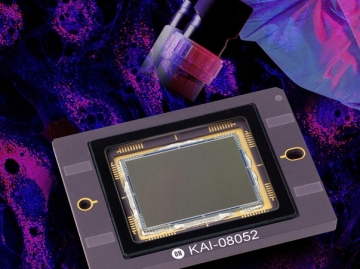
ON Semiconductor (Nasdaq: ON) is upgrading image performance required in various industrial applications through technology that enhances near-infrared CCD image sensors. The KAI-08052 image sensor, an 8-megapixel product from ON Semiconductor's CCD-related product portfolio incorporating this technology, has doubled near-infrared wavelength sensitivity and begun shipping as the standard for the company's interline transfer CCD pixel design. Interline transfer refers to a method in which a transfer path called a vertical transfer CCD is installed between pixel rows, and accumulated charge is transferred through this path.
2016.07.13by 홍보라 기자

Intel Unveils Next-Generation 'Core Ultra Series 3' and vPro Platform for Enterprise PCs
Intel has officially unveiled the "Intel Core Ultra Series 3" for next-generation enterprise PCs and the latest vPro platform, addressing a wide range of demands from enterprise notebooks to high-performance workstations.
2026.03.26by 배종인 기자
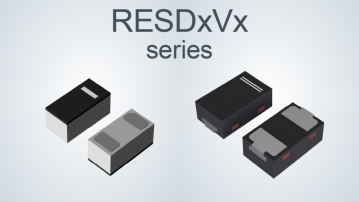
ROHM Launches ESD Protection Diode Compatible with High-Speed Interfaces of 10Gbps or Higher
Semiconductor specialist ROHM has developed the 'RESDxVx series' of ESD (electrostatic discharge) protection diodes capable of responding to next-generation high-speed data communication environments exceeding 10Gbps, simultaneously enhancing both signal quality maintenance required in high-speed interfaces and IC protection performance.
2026.03.26by 배종인 기자











