



New Separator Membrane Enhancing Lithium-Ion Battery Performance
 Published2016.08.04 14:03
Not Just a Simple Ion Pathway but Chemical Filtering Possible… Published in Nano Letters August Issue
A new separator membrane has been developed to enhance the performance of lithium-ion batteries.
It is a 'chemically functional membrane' that enables the separator membrane, which was previously used only as an ion pathway, to participate in chemical reactions. Since it can filter out impurities that degrade battery performance through chemical reactions, it is expected to contribute to the manufacturing of high-performance lithium-ion batteries.
A joint research team led by Professor Kim Byong-su from the Division of Natural Sciences and Professor Lee Sang-young from the Department of Energy and Chemical Engineering at Ulsan National Institute of Science and Technology (UNIST) has developed a 'chemically functional membrane' incorporating functional nanocellulose. Functional nanocellulose is a substance functionalized through synthetic molecular sieves derived from cellulose obtained from wood. This allows the separator membrane to participate in chemical reactions and perform roles such as filtering out impurities.
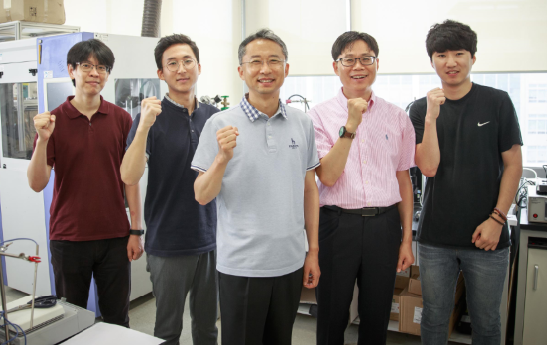
▲From left: Dr. Min Sa-hoon, Researcher Kim Jeong-hwan, Professor Lee Sang-young, Professor Kim Byong-su, and Researcher Gu Min-su.
The separator membrane is a material located between the positive and negative electrodes in secondary batteries. Originally, it does not directly participate in the battery's chemical reaction, but this research has opened new possibilities for dramatically improving battery performance by utilizing the chemical activity function of the separator membrane.
The research team led by Professors Kim Byong-su and Lee Sang-young designed an effective two-layer structure that enhances separator membrane performance. By attaching porous polymer fibers with large pores (㎛) to functional nanocellulose with small pores (㎚), they created a structure with numerous and uniform pores. Additionally, since functional nanocellulose participates in chemical reactions, it helps remove impurities that degrade battery performance.
Gu Min-su, an integrated master's and doctoral degree student from the Department of Energy and Chemical Engineering who participated as a first author in this research, explained, "We imparted chemical functionality to cellulose by attaching molecular sieves capable of forming compounds with heavy metal ions," and added, "Since hydrofluoric acid, which causes battery performance degradation, can also be removed by porous polymer fibers, we were able to enhance various battery characteristics."
Cellulose, the primary raw material of wood, has been engineered to form compounds with metal ions. Cellulose, the primary raw material of wood, has been engineered to form compounds with metal ions. The newly developed separator membrane is expected to contribute to the commercialization of lithium manganese oxide (LiMn₂O₄, LMO), which is attracting attention as a next-generation cathode active material. While this material is inexpensive and has excellent power characteristics, drawing attention for high-capacity batteries, it has the disadvantage of manganese dissolution at high temperatures. This severely deteriorates battery performance at high temperatures, but using the new separator membrane can improve this phenomenon.
Kim Jeong-hwan, an integrated master's and doctoral degree student from the Department of Energy and Chemical Engineering who also participated as a first author, stated, "When using this separator membrane together with a lithium manganese oxide electrode, we observed that manganese ions released at high temperatures were filtered out," and added, "This demonstrates the potential of an 'electrochemically active separator membrane' that goes beyond the general function of separator membranes and gains function through chemical reactions."
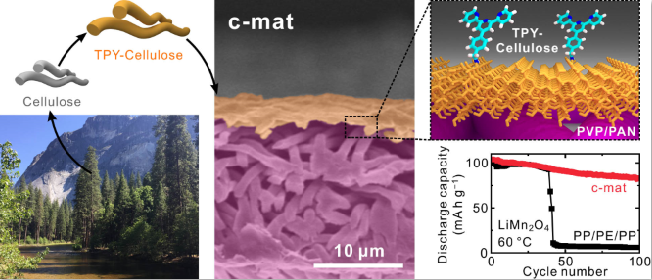
▲Cellulose, the primary raw material of wood, has been engineered to form compounds with metal ions.
Professor Lee Sang-young stated, "The conventional approach using polyolefin-based separator membranes currently employed as separator membranes has reached its limits," and evaluated, "This separator membrane research applying novel materials and structures that have never been previously reported could become a breakthrough for the stagnant battery industry."
Professor Kim Byong-su emphasized, "This research is an extremely rare and excellent example of successfully modifying the chemical properties of the structure possessed by polymers to impart different functions and applying them to actual batteries," and added, "This achievement was made possible by the convergence of long-accumulated expertise in organic material synthesis technology (Professor Kim Byong-su's team) and separator membranes (Professor Lee Sang-young's team), with significant contributions from Dr. Min Sa-hoon's theoretical calculations."
This research was conducted with support from the Ministry of Future Creation and Science through the National Research Foundation of Korea's 'Mid-career Researcher Support Program' and 'Global Doctoral Training Program,' and the 'IT/R&D Project' from the Korea Evaluation Institute of Industrial Technology under the Ministry of Trade, Industry and Energy. The research results will be published in the August issue of 'Nano Letters,' a globally authoritative publication in the nanoscience field of the American Chemical Society.
Related news
.jpg)
ROHM 'Solves' Secondary Lithium-Ion Battery Protection with a Single LSI Realizing 14 Series Cells
ROHM Group's Lapis Semiconductor (www.lapis-semi.com/kr) announced the development of the ML5232, a lithium-ion battery secondary protection LSI that supports up to 14 series cells and a maximum of 80V, the industry's largest capacity, to realize functional safety in lithium-ion battery systems for electric bicycles, power storage systems, and UPS.
2016.03.23by 명세환 기자

SII Semiconductor Announces 1-Cell Lithium-Ion Battery Protection IC
SII Semiconductor Corporation, a subsidiary of Seiko Instruments Inc., has introduced two new 1-cell lithium-ion battery protection IC products. The S-82A1 series integrates a Sense Pin (VINI) that enables very precise detection of overcurrent conditions using an external sensitivity resistor. The S-82B1 series is equipped with a Control Pin (CTL) that allows users to externally control charging and discharging through control pin signals. Both products are suitable for all applications using 1-cell lithium-ion batteries, including smartphones and wearable devices.
2016.05.13by 명세환 기자

Intel Unveils Next-Generation 'Core Ultra Series 3' and vPro Platform for Enterprise PCs
Intel has officially unveiled the "Intel Core Ultra Series 3" for next-generation enterprise PCs and the latest vPro platform, addressing a wide range of demands from enterprise notebooks to high-performance workstations.
2026.03.26by 배종인 기자

ROHM Launches ESD Protection Diode Compatible with High-Speed Interfaces of 10Gbps or Higher
Semiconductor specialist ROHM has developed the 'RESDxVx series' of ESD (electrostatic discharge) protection diodes capable of responding to next-generation high-speed data communication environments exceeding 10Gbps, simultaneously enhancing both signal quality maintenance required in high-speed interfaces and IC protection performance.
2026.03.26by 배종인 기자











