


[ICT R&D Overview] ③ Urgent Development of ICT Devices, Complex Sensors, and Intelligent Semiconductors
 Published2016.08.16 13:49
Aiming to dominate the global ICT device market by 2022
The Ministry of Science, ICT and Future Planning (MSIP ) has unveiled its Technology Roadmap 2022 (draft), which includes 10 key ICT R&D technology areas and artificial intelligence. The 10 ICT R&D technologies selected by MSIP to strengthen the interconnectivity of science and technology (ICT) and discover new industries include : digital content, convergence services , ICT devices, mobile communications, networks, broadcasting/smart media, radio waves and satellites, basic software computing, software, and information security. e4ds News will present the R&D strategies for these areas in turn, presenting a roadmap for future technology development. [Reporter Shin Yun-oh]
ICT devices are a comprehensive term for intelligent terminals and components that deliver information and communication technologies and services between users and objects in an IoT environment, beyond existing terminals such as PCs and smartphones.
It includes devices and related component technologies used in various fields such as healthcare, transportation, safety, education, and convenience based on functions such as sensing, processing, and communication. ICT devices covered by the Ministry of the Future include smart devices, wearable devices, lead-free vehicles, intelligent semiconductors, smart cars, and 3D printing.
As we enter a hyper-connected society where all people, objects, and spaces are connected through ICT, the number of devices connected to the network is rapidly increasing and numerous types of application products and services are emerging, raising high expectations for ICT devices.
Wearable devices : Focus on securing killer services and creating an ecosystem.
Wearable devices, a representative ICT device, are attracting attention. Smartphone manufacturers like Samsung and LG are releasing smartwatches and fitness bands, focusing their efforts on securing platform technologies to foster killer services and ecosystems. ETRI is actively conducting basic research, including a bio-shirt that monitors biometric signals like electrocardiograms, respiration, and exercise levels, and KAIST is developing a fabric-mounted health monitoring system.
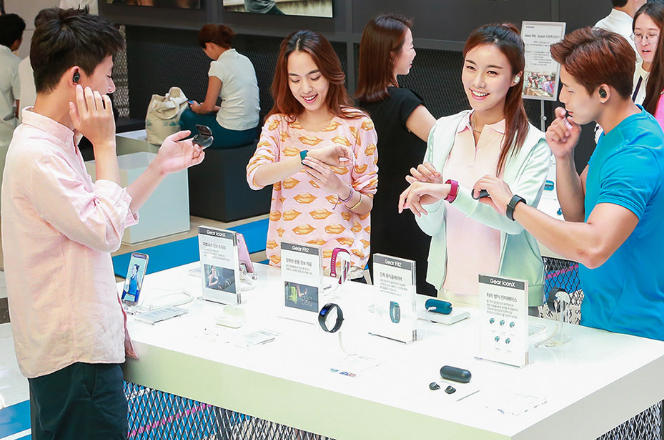
▲ Consumers are wearing and experiencing the ‘Gear IconX’ and ‘Gear Fit2’.
The situation overseas is the same. Leading IT companies such as Apple and Google are launching accessory devices to link their search and cloud services, focusing on fitness band products and biosignal and motion measurement technologies, and expecting to improve user experience by incorporating voice gesture augmented reality (AR) technology.
However, the domestic wearable device market suffers from a device-centric growth paradigm that leaves a lack of content/service technology integration. Furthermore, each device operator operates its own proprietary platform, leading to incompatibility issues. Furthermore, the market's adventurous nature, particularly in its early stages, hinders active R&D investment. Furthermore, global leaders like Google and Apple dominate patents and the early market, present challenges that must be overcome.
Core components and platforms of ICT devices , and intelligent sensing services being developed overseas.
ICT convergence devices , domestic research institutes focus on autonomous driving and vehicle communication technologies.
Accordingly, the development of core components and platforms for ICT devices is also fiercely competitive. In the field of intelligent semiconductors, companies are focusing on developing technologies for automotive, robotics, and smart device applications, while research institutes are researching manycore/neural cores. However, the domestic industry still focuses on basic sensors such as images, gas detection, and fingerprint recognition, with weaker complex sensor technology. Furthermore, the industry lacks core intelligent semiconductor technologies and original design technology. China's aggressive investment in intelligent semiconductors is widening the technology gap and resulting in a sharp exodus of high-level architect-level design talent.
Overseas, the United States, Germany, and Japan are developing intelligent sensing services that combine voice recognition and virtual/augmented reality. Solutions incorporating artificial intelligence are being released, primarily for autonomous vehicles and mobile devices, and research and development on new concepts such as neuromorphic are actively underway.
The situation is similar when looking at ICT convergence devices. Domestic research institutes are focusing on autonomous driving and vehicle communication technologies, and some are pursuing the development of 3D printing-related equipment, materials, and software application technologies. However, securing fundamental technologies in these fields is inadequate, and fundamental technologies related to unmanned aerial vehicles (UAVs) also lag behind. Consequently, research and development is currently focused on specialized ICT-integrated unmanned vehicles.
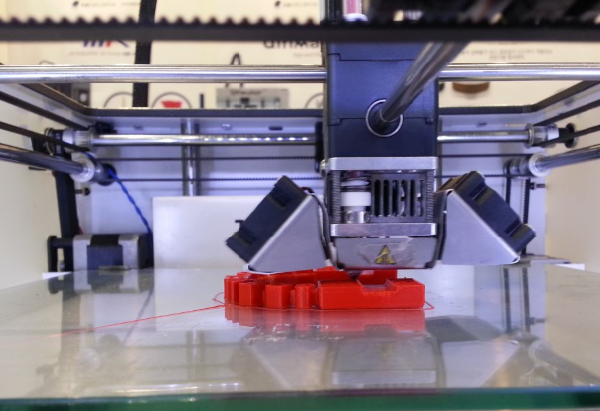
Furthermore, the domestic industry is weak in core technologies for complex information analysis devices, and its low level of core technologies compared to advanced countries is also a problem. In contrast, overseas markets are far ahead. The US leads in core technologies related to 3D printing, while China dominates the market with its mass production capabilities. China is also focusing on mass production of drones suitable for filming control, while the US and Europe are actively developing various services. Google is developing autonomous driving technology with a goal of Level 3, while global manufacturers such as BMW and Mercedes-Benz are developing autonomous driving technology with a goal of Level 2.
Lee Kyu-bok, CP of the ICT device sector, said, “It is true that we are behind in the wearable device market, but since it is in the early stages of market formation, we can secure competitiveness through continuous investment, and we can launch various innovative products, so there is high market growth potential.” He emphasized, “The ICT device core components and platforms and ICT convergence device markets are also sufficiently competitive because we have world-class competitiveness in intelligent semiconductor manufacturing.”
Expectations are rising for high-growth new ICT devices such as wearables, IoT, smart cars, and 3D printing.
Accordingly, the government has set a vision to dominate the global ICT device market by 2022. This goal involves securing core technologies for ICT device platforms and component modules, supporting the commercialization of ICT devices, and strengthening the industry-academia-research cooperation system in the ICT device component sector.
ICT device R&D investment areas include wearable HW and SW platforms, other wearable device element technologies, intelligent semiconductors, smart sensors and sensor platforms, ICT device article element technologies, 3D printing, unmanned aerial vehicles, ICT intelligent automobiles, and other ICT convergence device element technologies.
Looking at some of the detailed promotion plans for these investment areas, the wearable HW platform aims to develop an ultra-high-speed wearable interface using HBC that is friendly to high-speed multimedia transmission, and the intelligent semiconductor will develop the original design technology for an ultra-intelligent, ultra-light, functionally safe processor. In addition, the smart sensor and sensor platform aims to develop ICT intelligent sensor platform technologies such as environmental information and user recognition, and the unmanned aerial vehicle field aims to develop transmission method protocol design technology for A2A (Air to Air) communication.
CP Lee Kyu-bok said, “Expectations are rising for the high-growth new ICT device market, such as wearables, IoT, smart cars, and 3D printing,” and “Based on future prospects, competition among global manufacturers and startups to secure the early market is accelerating, but the market is still in its early stages of formation, and the demand for smart sensor components installed in ICT devices is expected to increase rapidly, so preparations are urgent.”
Comments
Related news

[Reporter's Notebook] Is the Wearable Device Industry Really an Item for SMEs?
We are now in the golden age of wearable devices. The term "wearable" has become quite familiar. Anyone interested in IT devices has at least considered owning a smartwatch. At IT-related exhibitions, visitors are busy putting exhibited smartwatches on their wrists and operating them in various ways. You can also frequently see people wearing smart bands. Wearable smart devices are no longer a matter of future possibilities but have become an active, current trend.
2016.06.14by 신윤오 기자
[ICT R&D Overview] ① Digital content, VR/AR realistic content development is vital
Can we lead in immersive content technology, the core of virtual reality and augmented reality? As immersive and emotional intelligence-based content emerges as a future trend in the digital content industry, attention is concentrating on related industries. Digital content refers to the software and hardware technologies necessary for planning, producing/manufacturing, and utilizing databases of materials, information, knowledge, and data expressed in electronic form through the combination of codes, text, voice, sound, audio, images, video, and other elements with ICT technology in the form of services or products. This includes ▲immersive content ▲interactive content ▲emotional content ▲content distribution and services.
2016.08.01by 신윤오 기자

[ICT R&D Overview] ② Convergence Services: Deregulation and an Ecosystem Needed
Convergence services refer to technologies for providing services that combine Internet of Things infrastructure to realize a hyper-connected society and integrate IoT and intelligent information technologies such as ICT across the fields of industrial convergence, public convergence, and smart life. Prior to 2015, convergence technology was characterized by technology-driven terminals (H/W) and connectivity (N/W), with sensor utilization and ICT applications and intra-industry convergence being the main issues. However, post-2016 convergence technology is characterized by service-oriented intelligent solution services and applications (S/W), and it is anticipated that ecosystem building utilizing ICBM and intelligent information technology-based standard platforms, as well as the activation of inter-industry convergence, will become the main issues. In other words, in the early stage, services will be aggregated around representative platforms for each service, and in the later stage, they are expected to be utilized in an integrated and linked manner across industries centered on winning platforms.
2016.08.05by 신윤오 기자

ESP32 Development Environment Selection and GPS Application Implementation
The ESP32 is a microcontroller that integrates Wi-Fi, Bluetooth, 12-bit ADC, capacitive touch, PWM, DAC, and UART in a single SoC. However, the abundance of features does not by itself solve the designer's problems. The real challenges lie in selecting the appropriate development environment, determining which pins can be used and which must be avoided, and converting raw data from modules into usable information. This document addresses ESP32 peripheral constraints (ADC2 and Wi-Fi coexistence limitation, UART1 occupancy, ADC non-linear regions), the trade-offs between Arduino IDE and ESP-IDF, and the process from connecting NEO-6M/NEO-M8N GPS modules to UART2, parsing NMEA sentences, and visualizing routes in Google Earth, all organized based on documented references.
2026.10.12by 편집부

MIPI CSI-2, DSI-2, C-PHY, D-PHY Test Solution Technical White Paper
The MIPI interface adopts a burst mode that transitions between low-power (LP) and high-speed (HS) states for low-power consumption, and in return, strict timing rules are imposed on state transitions. Additionally, the high-speed section operates as a packet-based protocol with headers, ECC, and CRC, so verification engineers must handle waveforms and protocols simultaneously. Traditional configurations combining general-purpose oscilloscopes and AWGs reveal limitations in setup complexity, measurement uncertainty, and lack of reproducibility when faced with these requirements. This white paper, based on webinar materials, organizes the structure of this problem and describes how the SV5C-DPTXCPTX generator for receiver testing and SV5C-DPRXCPRX analyzer for transmitter testing integrate state transition testing, stressed eye testing, and protocol analysis into a single bench, along with their application boundaries.
2026.10.12by 편집부











