



Nanobrick Pilots 'Nano Security Paper' on Malaysian Halal Certificates
 Published2016.09.12 09:42
Nano Brick Co., Ltd. (CEO: Jaehyun Ju), a company specializing in anti-counterfeiting based on nano new materials, announced on the 12th that its 'nano security paper' using nano new materials has been adopted for Halal certificates issued by the Malaysian government.
Nanobrick has signed a supply contract for its anti-counterfeiting security paper with the Malaysian Islamic Development Authority (JAKIM), which is responsible for issuing Halal certificates, and has decided to apply it on a trial basis to Halal certificates issued by the agency. In the future, the security paper provided to JAKIM is expected to be widely applied to Halal certificates for food, pharmaceuticals, cosmetics, and other products imported into Malaysia after obtaining Halal certification.
The 'Nano Security Paper' for Halal certificates is printed with a special pattern of magnetic color-changing material, the source material of Nanobrick's anti-counterfeiting solution, 'M-Tag'. When a magnet is applied to a document printed with this nano material, the color and pattern change, making it easy to determine if the document has been forged. Furthermore, in addition to the magnetic color-changing source material, embossing, color-shifting ink, fluorescent ink, and thermochromic ink have been applied to enhance security to the level of currency.
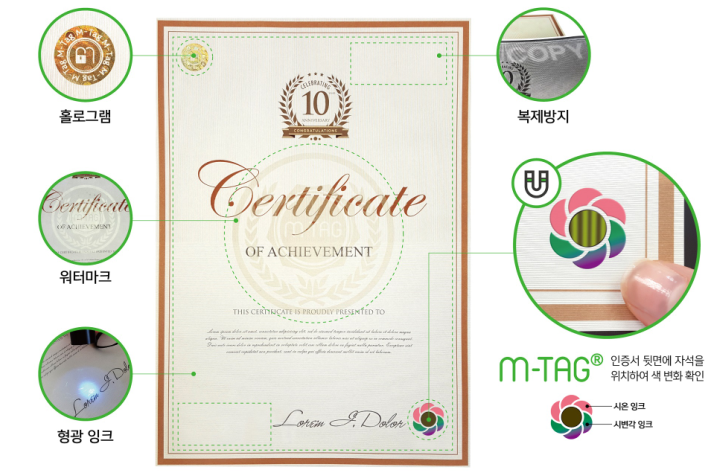
Malaysia is an Islamic country where 62% of the population is Muslim, so to export products to this country, you must obtain Halal certification. Halal certification is a certification mark granted only to food that has been slaughtered, processed, and manufactured in accordance with Islamic law so that it may be eaten or used by Muslims.
In reality, there are over 300 halal certification bodies operating around the world, and each body has different standards and issues different certification marks. However, unlike other Islamic countries, Malaysia has unified its halal certification process with JAKIM as the sole channel. This was made possible by the Malaysian government's efforts to foster the halal industry and become a global halal hub.
A Nanobrick official stated, "We have launched 'Nano Security Paper' following 'M-Tag' in response to consumer requests for security paper incorporating high-security nanotechnology that fundamentally blocks counterfeiting." The official added, "We have laid the foundation for entering the Halal market by successfully signing a contract for Halal certification with the Malaysian government, which is recognized globally as the best among Islamic nations for Halal certification." The official further noted, "Based on the pilot application of Halal certification, Nanobrick plans to expand its security paper business and simultaneously broaden the application of M-Tag into the Halal market."
Meanwhile, 'M-Tag' is an anti-counterfeiting solution utilizing a novel nanomaterial that changes color depending on the strength of a magnetic field. It is gaining significant attention from domestic and international companies suffering from damage caused by counterfeit products by combining high security using source materials with the convenience of incorporating IT technology. Recognizing M-Tag's advanced technology, Nanobrick was registered as the only official member from the domestic anti-counterfeiting industry in the International Alliance Against Counterfeiting (IACC), from which even Alibaba was expelled. Furthermore, M-Tag was adopted as the 'ASEM-Tag' for authenticity certification at the 2016 Asia-Europe Summit (ASEM), protecting the safety of leaders from 53 countries.
관련뉴스
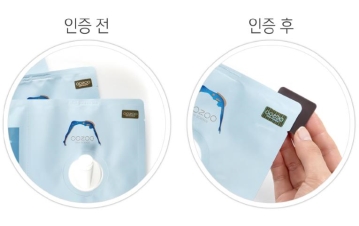
Counterfeit Cosmetics, Beware! with M-Tag Nano Authentication Technology
THE OOZOO, a mask pack brand famous for Park Seo-joon, announced that it has reviewed various anti-counterfeiting solutions to protect its brand and consumers, and ultimately adopted M-Tag, which can fundamentally prevent counterfeit products, as its genuine product authentication solution.
2016.03.22by 명세환 기자
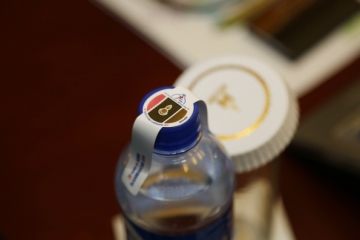
Nanobrick showcases ASEM Tag technology at international food safety event
신소재 기반 위조방지 전문기업 ㈜나노브릭(대표 주재현)이 현지시간으로 20일 몽골 울란바토르 정부청사 그랜드홀에서 개최된 ‘식품안보협의회의(Consultative Meeting on Food Security)’에 공식 초청돼 자사의 원천기술로 만든 안전보장 정품인증 태그인 ‘아셈태그(ASEM-Tag)’를 소개 및 발표했다고 밝혔다.
2016.06.21by 명세환 기자

Nano Korea 2016 showcases cutting-edge nanotechnology for automotive applications.
7월 13일부터 킨텍스에서 개최되는 나노코리아 2016에 국내 대표 나노융합제품을 한자리에서 만나볼 수 있는 ‘나노융합제품 T2B 특별관’이 마련된다. T2B 특별관은 국내 나노기업의 우수 융합제품을 발굴하고 수요기업과 연계하여 사업화를 지원하는 T2B 활용 나노융합 R&BD 촉진 사업(산업통상자원부, 경기도)의 일환으로 마련되었다. 특별관에서는 “생활 속의 나노제품”을 주제로 나노기술 적용 제품 60여종이 시연되어 참관객들의 큰 관심을 끌 것으로 보인다.
2016.07.01by 명세환 기자
.png)
Databricks Unveils Open AI Security Monitoring 'Lakewatch'
데이터브릭스가 3월 24일 개방형 에이전틱 SIEM ‘레이크워치’를 공개하며 보안 시장에 진입했다. 이 제품은 보안, IT, 비즈니스 데이터를 단일 환경에서 통합 분석해 AI 기반 위협 탐지와 조사를 지원하는 것이 핵심이다. 회사는 고비용 구조 때문에 일부 데이터를 포기해온 기존 보안관제의 한계를 줄이고, 개방형 형식과 생태계를 바탕으로 대규모 데이터 분석과 자동화를 가능하게 한다고 설명했다. 레이크워치는 현재 프라이빗 프리뷰로 제공되며, 어도비와 드롭박스 등이 초기 고객으로 언급됐다. 데이터브릭스는 앤트로픽과 협력을 확대하고 안티매터, SiftD.ai 인수도 함께 발표했다.
2026.03.26by 배종인 기자
Kaspersky Unveils Revamped 'NEXT' Combining SOC Integrated Management and AI Analytics
기업들이 보안관제센터(SOC) 구축과 운영에서 통합 관리와 자동화 수요를 키우는 가운데, 카스퍼스키가 자사 B2B 보안 제품군 ‘카스퍼스키 넥스트’의 개편 내용을 공개했다. 이번 업데이트는 OSMP 기반 단일 콘솔로 EPP·EDR·XDR·SIEM 연계를 넓히고, DLL 하이재킹 탐지와 계정 탈취 의심 행위 식별 같은 AI 기능, 생성형 AI 보조도구 KIRA 연동을 담았다. 회사는 대규모 배포 환경에서 EDR Expert는 최대 30%, XDR Expert는 최대 60%까지 자원 요구량을 낮출 수 있다고 밝혔다.
2026.03.25by 배종인 기자











