



[ICT R&D Overview] ⑧Wireless Power, Unmanned Aerial Vehicles and Convergence Products Transform the Radio Frequency Industry
 Published2016.09.19 13:57
'Intelligence' Added to Communication, Sensing, and Energy…Domestic Market Expected to Grow at Average Annual Rate of 16.6%
The Ministry of Science and ICT unveiled the Technology Roadmap 2022 (Draft) adding 10 major ICT R&D technology fields and artificial intelligence sectors. The 10 major ICT R&D technologies selected by the Ministry for strengthening mutual linkages in science and technology ICT and discovering new industries are ▲digital content ▲convergence services ▲ICT devices ▲information security ▲mobile communications ▲networks ▲broadcasting/smart media ▲radio frequency, satellite ▲foundational SW computing ▲software, and others. Accordingly, e4ds news plans to introduce the R&D strategies in these sectors in sequence and present future technology development roadmaps. [Reporter Shin Yun-oh]
As the utilization of radio frequency expands beyond existing mobile communications and broadcasting industries to converge with diverse life-oriented industries including medical care, welfare, security, and wireless charging, interest in the radio frequency and satellite industry is increasing.
The government aims to maximize the value of limited radio frequency resources through this technology roadmap and create new industries by discovering new radio frequency application fields. Furthermore, the plan is to enter leading nations through the expansion of high-quality satellite broadcasting services and unmanned aerial vehicle utilization technologies. The radio frequency and satellite industry includes radio frequency infrastructure, electromagnetic environment, radio frequency applications, and satellite-unmanned aerial vehicle sectors.
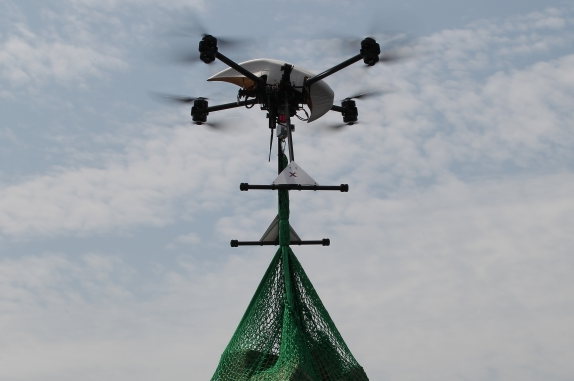
▲The plan is to secure the nation's technological competitiveness in the radio frequency industry by reflecting international standards for emerging industry-leading technologies such as wireless power transmission and unmanned aerial vehicles. The photo shows a demonstration of wildfire monitoring and suppression using unmanned aircraft at the National Comprehensive Flight Performance Test Center in Goheung, Jeollanam-do, a regulation-free zone, in May.
Radio frequency resources and environment are foundational technologies for efficient utilization and management of frequency resources and safe radio frequency use, while radio frequency-based applications refer to radio frequency material and component technologies, sensing, energy transmission, and specialized communications. Satellites and unmanned aerial vehicles refer to satellite frequency management and satellite broadcasting, communication navigation services, and unmanned aerial vehicle detection technologies.
Until 2015, radio frequency utilization in industry was centered on licensed frequency band allocation, with radio frequency applied primarily to mobile communications and broadcasting sectors. Frequency auctions and competition in communication and broadcasting frequency allocation were major issues, but the environment changed after 2016. Utilization of unlicensed frequency bands expanded, and radio frequency application fields including medical care, security, and wireless charging broadened. With the announcement of technical standards for frequency bands with flexible use, development has progressed in the direction of strengthening the industrial ecosystem in the radio frequency sector by expanding the scope of frequency utilization to sensing and power sectors.
Global Market of $520.2 Billion in 2022, Expected Growth of 7.8% Average Annual Rate
The global market size of the radio frequency and satellite industry, which will develop as a convergence form with 'intelligence' added to the keywords of communication, sensing, and energy, is expected to grow at an average annual rate of 7.8% from $332.1 billion in 2015 to $520.2 billion in 2022. During the same period, the domestic market size is expected to grow from $4.8 billion to $12.1 billion at an average annual rate of 16.6%. Currently, the domestic market size accounts for 1.65% of the global market.
Specifically, the global radio frequency resources/environment market is projected to expand from $57.6 billion in 2016 to $81.3 billion in 2022, the radio frequency infrastructure/applications market from $27.7 billion to $82.7 billion, and the satellite and unmanned aerial vehicle market from $246.9 billion to $356.2 billion.
As market prospects are favorable, the strengths and weaknesses of the domestic market are also clear. The country possesses the advantage of having established world-class wireless communications infrastructure, possessing application technologies, and having abundant development experience in low-power and high-frequency technologies. Additionally, possessing technologies in the satellite mobile VSAT and RCS fields and key technologies for mobile tracking antennas is also positive.
However, a shortage in competitiveness in developing core RF components and parts and lacking standardization competitiveness in radio frequency application technologies and core original source technologies are disadvantages. In particular, the risk of obsolescence of existing secured technologies due to insufficient continuous investment in the satellite sector is pointed out as a weakness. Furthermore, the radio frequency application sector is expected to face high barriers to entry due to market preemption by technologically advanced countries, and both the satellite and unmanned aerial vehicle sectors face a narrow domestic market with fierce market competition from other emerging nations.
Accordingly, voices are strong for intensively fostering 5G RF components and parts sectors as items capable of possessing global competitiveness, and securing advanced human resource development and research and development infrastructure for core original source technology development. National-level satellite and unmanned aerial vehicle policies must be established, and prompt investment support must follow.
Lee Moon-gyou, CP in charge of R&D in radio frequency and satellite sectors, stated, "We must develop 5G technology in the millimeter band, an untapped mobile communications frequency sector, and respond to social demands for diverse radio frequency application services in medical care, security, and welfare," adding, "We must secure ICT original source technologies for unmanned aerial vehicles based on mobile communications and satellite control technologies."
Accordingly, the government presented a vision to implement a fourth industrial revolution infrastructure of a wirelessly hyper-connected society through radio frequency and satellite original source technology research and new industry discovery. The strategy focuses on pioneering new radio frequency utilization fields, promoting industrial vitalization, and building ecosystems and fostering human resources.
Securing Technological Competitiveness through Reflection of International Standards for Industry-Leading Technologies
R&D investment areas in the radio frequency resources and environment sector include frequency resource discovery and sharing technologies and EMI/EMC/EMF technologies for safe radio frequency utilization, encompassing ▲new frequency discovery ▲efficient frequency sharing ▲radio frequency electromagnetic analysis ▲EMC measurement, evaluation, and countermeasures, and others. The radio frequency infrastructure-based applications industry encompasses antenna and RF material component technologies and application fields where radio frequency can be converged with medical care, security, energy, and communications, including ▲phased array antennas ▲integrated/wearable/implantable/conformal antennas ▲non-radiative wireless power transmission ▲RF energy harvesting ▲non-radio band wireless power transmission ▲low-power radar ▲terahertz sensing ▲VLC/OWC/ultra-high-speed Li-Fi applications, and others.
Satellite-unmanned aerial vehicle ICT encompasses satellite infrastructure and service sectors including communication payloads and satellite broadcasting, as well as unmanned aerial vehicle operation and utilization service sectors, including ▲digital-based satellite payloads ▲channel environment adaptive broadband satellite broadcasting and communications convergence transmission ▲future satellite navigation systems and applications ▲unmanned aerial vehicle control and safe operation ▲unlicensed band unmanned aerial vehicle wireless communications ▲unmanned aerial vehicle mission communications, and others.
Lee Moon-gyou, CP, stated, "The government plans to secure national technological competitiveness by reflecting international standards for emerging industry-leading technologies such as wireless power transmission and unmanned aerial vehicles, and will share technology development support for small and medium enterprises and verification testbeds," adding, "The R&D will be pursued in the direction of securing medium and long-term human resource competitiveness in the stagnant radio frequency and satellite sector through human resource development in future technologies."
Related news

[ICT R&D Review] ⑤Mobile Communications: Losing Leadership in Core Technologies and Mobile Ecosystem
Domestic mobile communications industry is a national strategic core industry with significant forward and backward linkage effects driving economic growth, accounting for 21.7% of total ICT production value (2014). In the terminal device sector, Samsung Electronics leads while Apple's pursuit and China's rapid growth stand out. In Q1 2016, global smartphone market share was Samsung Electronics (23.6%), Apple (15.3%), Huawei (8.5%), Xiaomi (4.7%), and Lenovo (4.4%). In 2015, domestic smartphone market share was Samsung Electronics (46%), Apple (33%), LG Electronics (14%), and others (7%). In the systems sector, three companies—Ericsson, Nokia, and Huawei—dominate the global market. Aside from Samsung, the industry consists of small and medium-sized enterprises with a domestic-focused structure, with domestic manufacturers holding 43.6% (2014) of the domestic mobile communications equipment market share. In the services sector, most global operators provide 4G services, with 360 operators supporting LTE services. As of 2015, service penetration rate stands at 11.5%.
2016.08.30by 홍보라 기자
[ICT R&D Overview] ⑥ Network: Build the World's Most Connected Network
A network refers to the collective technologies that handle large-capacity traffic in real-time in response to new services, efficiently and flexibly respond to diverse service demands, and constitute high-reliability, high-availability internet infrastructure under any circumstances. The overall network equipment market is projected to grow at a rate of 3.52%, expanding from a market size of 92.7 billion dollars this year to 114.1 billion dollars in 2022. According to Gartner's forecast, routers/switches and transmission equipment are expected to grow to 38.9 billion dollars (4.6%) by 2022, subscriber equipment to 15.0 billion dollars (6.3%), enterprise equipment to 46.2 billion dollars (1.4%), and SDN/NFV solutions to 18.8 billion dollars and 11.6 billion dollars respectively.
2016.09.05by 신윤오 기자

[A Close Look at ICT R&D] ⑦ Foster New Media Industries such as VR/AR
Broadcasting and smart media services refer to a series of processes and forms in which content is produced targeting multiple users, delivered through wired and wireless networks, and consumed by users through various reception devices. This includes broadcasting and smart media-related services, content, media infrastructure, consumer terminals, mobile broadcasting, broadcasting-telecommunications convergence, immersive broadcasting, signage and other platforms, as well as public welfare and disaster safety technologies. Accordingly, the market size is substantial. The broadcasting and smart media industry is projected to grow at a compound annual growth rate of 11.5%, from 23.86 billion dollars in 2016 to 43.92 billion dollars in 2022. Specifically, services and content are expected to grow at an annual average rate of 2.2%, from 3.22 billion dollars to 3.67 billion dollars, the infrastructure and consumer (terminal) sector is projected to expand at a compound annual rate of 20.1%, from 7.53 billion dollars to 22.63 billion dollars, and the platform sector is anticipated to grow at an annual average rate of 6.4%, from 12.04 billion dollars to 17.51 billion dollars.
2016.09.09by 김수지 기자
European Patent Applications Surpass 200,000 for the First Time… South Korea Maintains 5th Place, Led by Batteries and Telecommunications
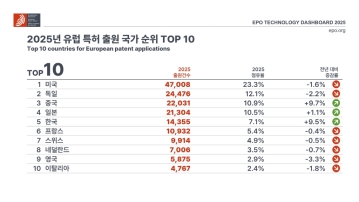
According to the European Patent Office (EPO)'s 'Technology Dashboard 2025', European patent applications last year reached 201,974, surpassing 200,000 for the first time. Korean companies and inventors filed 14,355 applications, representing a 9.5% increase from the previous year and maintaining 5th place by country. Battery, digital communication, and semiconductor technologies led the growth, with Samsung ranking as the top EPO applicant for the second consecutive year and LG reaching 3rd place. The presence of major domestic cities such as Seoul, Suwon, and Yongin was also confirmed. It was also revealed that Korea's European patent strategy is expanding beyond individual technologies to span the entire industry.
2026.03.24by 명세환 기자
SK Telecom First Applies AI-Based Network Operations at Gwanghwamun K-Pop Concert
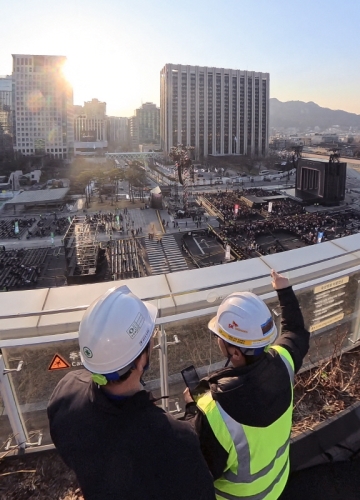
SK Telecom announced that it applied an AI-based network operation system for the first time at a large-scale K-pop concert held in the Gwanghwamun area of Seoul on March 21st, managing communication quality throughout the event. Mobile data usage during the three hours before and after the concert reached 12.15TB, approximately doubling compared to the same time slot the previous weekend. SK Telecom monitored traffic using the AI system 'A-One' in five-minute and 50-meter units to respond to potential overload situations, while also operating temporary communication facilities and on-site personnel in parallel. This case is interpreted as confirmation of the practical applicability of AI-based autonomous network operation in an environment where demand from dense events and foreign users increases simultaneously.
2026.03.23by 명세환 기자











