



[Seminar] What Should Be Done for the Early Commercialization of AI-Based Autonomous Vehicles
 Published2016.10.17 14:36
Six experts from various fields conduct an in-depth analysis of AI-based autonomous vehicles
As the Korea Electronics Show (KES), now in its 47th year, expands its exhibition scope to include automobiles and electric vehicles, a venue will be set up to analyze foundational technologies and explore promotion strategies for the early commercialization of AI-based autonomous vehicles.
Smart & Company (http://www.autoelectronics.co.kr) announced that it will hold the “Seminar on AI-based Autonomous Vehicle Development Trends and Response Strategies” on Friday, October 28, starting at 9:00 AM at Hall E5, 3rd Floor, COEX, Seoul.
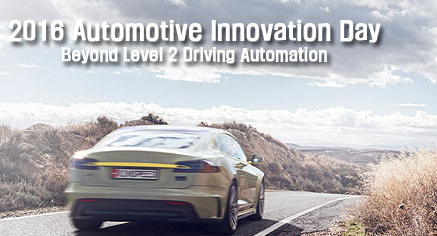
People's dreams regarding automobiles are expanding beyond Advanced Driver Assistance Systems (ADAS) to fully autonomous vehicles. In fact, while the history of research on autonomous vehicles is long, they were far from feasible. This was because the underlying core technologies had not sufficiently matured. However, with the emergence of Google's self-driving car, autonomous vehicles have risen as an "icon of innovation" following the smartphone, leading IT companies are flocking to the autonomous vehicle market.
Currently, not only Google but also major global automakers such as BMW, Toyota, Volvo, and Ford have declared the launch of autonomous vehicles and have entered into a full-scale competition for commercialization, while at the same time actively working to revise related regulations. Accordingly, IT companies are striving to establish close cooperative relationships with automakers, believing that new business opportunities will increase as the era of autonomous vehicles arrives sooner. For example, Intel is developing autonomous vehicles in partnership with BMW, Ford with Microsoft, Toyota with KDDI, and Honda with SoftBank.
This seminar will focus on the aspects and current significance of autonomous vehicles from the perspective of the IT industry, as well as the automotive industry, and will examine the challenges and key issues that need to be resolved, such as accidents involving Tesla’s Autopilot autonomous driving function, artificial intelligence (AI), big data, and cyber risks.
The event will proceed with a total of eight sessions covering the following topics: ▲Development trends and countermeasures for the commercialization of autonomous vehicles ▲The automotive revolution—semiconductor technology ushering in the era of autonomous driving ▲U.S. autonomous vehicle policies and implementation strategies ▲Analysis of key patents and opportunities regarding Google's AI autonomous vehicles ▲Applications of deep learning technology used in autonomous vehicles ▲Current status and future directions of software technology installed in actual autonomous vehicles ▲"Autonomous" driving planning and maintenance for autonomous vehicles ▲Security issues and integrated security technologies for V2X services in preparation for the era of automotive autonomous driving.
"We expect this year's Korea Electronics Show to be an opportunity to witness the convergence of automobiles and IT firsthand, with a senior executive from General Motors (GM) delivering the keynote speech at the opening ceremony," said Yoon Beom-jin, Editor-in-Chief of Automotive Electronics. "This seminar, held concurrently with the Korea Electronics Show, aims to present concrete solutions that can provide new growth momentum to the automotive and IT industries, which are currently facing a dilemma of convergence."
관련뉴스
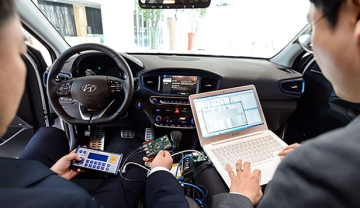
Self-driving car patent applications are booming domestically, while overseas applications are plummeting.
According to the Korea Institute for Intellectual Property Strategy (KISTA), the leading autonomous vehicle countries—Japan, the United States, and Germany—hold an average of 41.8% of major market share, while Korea achieved only 7.9%. This is analyzed as being due to insufficient technology acquisition targeting overseas markets, given that Korea's autonomous vehicle development stage is still in its early phases. Overall patent applications related to autonomous vehicles have surged since 2002 as autonomous vehicle concept cars and R&D development plans have increased. Patent applications are primarily concentrated in the United States and Japan, with Japan focused mainly on a small number of completed vehicle manufacturers, while the United States showed diverse applicants including numerous component suppliers, internet companies, and completed vehicle manufacturers.
2016.09.05by 신윤오 기자
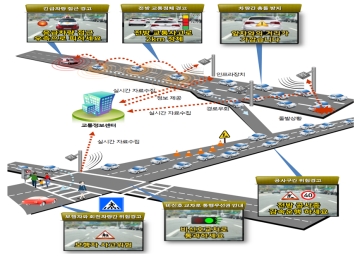
Accelerating the era of V2X autonomous vehicles with dedicated frequency supply.
미래창조과학부와 국립전파연구원은 차세대 지능형 교통체계 통신용 주파수 공급 및 기술기준 마련을 완료한다. 이번 주파수 공급과 기술기준 마련은 자율주행자동차 본격 확산에 대비하기 위한 것으로, 신산업 투자 관련 네거티브 규제 개선을 위하여 지난 3월부터 운영 중인 국무조정실 신산업투자위원회의 심의를 거친 바 있다.
2016.10.04by 신윤오 기자
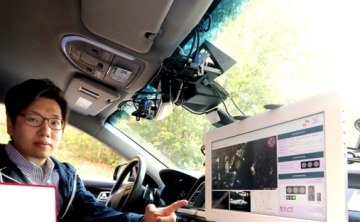
SK Telecom Successfully Demonstrates Autonomous Vehicle with V2X Technology
SK텔레콤이 서울대가 연구 중인 자율주행차량 ‘스누버(SNUver)’에 통신사 처음으로 차량통신(V2X)을 적용한 자율주행 기술을 개발?공개했다. SK텔레콤과 서울대 지능형자동차IT연구센터(IVIT연구센터?센터장 서승우 교수)는 차량통신 및 영상인식으로 자율주행 차량의 탐지거리를 확대하는 기술을 공동 개발하고, 서울대 캠퍼스에서 시연했다고 밝혔다.
2016.10.07by 신윤오 기자

A single misaligned light means 'defect'… Vehicle interior lighting now guarded by semiconductors and software
자동차 실내조명이 '보조 조명'의 자리를 벗어나고 있다. 색상과 애니메이션으로 브랜드 아이덴티티를 드러내고 운전자 취향을 담아내는 사용자 경험(UX)의 핵심 요소로 올라서면서, LED 실내 앰비언트 시장도 빠르게 커지는 중이다. 이에 관하여 '미래 자동차를 밝히는 지능형 LED 실내 조명 솔루션' 이라는 내용으로 기술 웨비나 세션을 발표하는 최영재 다보코퍼레이션 연구위원을 앞서 만나, 시장의 온도와 설계 요구의 변화를 들었다.
2026.08.28by 명세환 기자
TI, HEV·EV 트랙션 인버터용 다축 코어리스 전류 센서 TMCS2100-Q1 공개
Texas Instruments가 HEV·EV 트랙션 인버터용 다축 코어리스 홀 효과 전류 센서 TMCS2100-Q1을 공개했다. 수평·수직 자기장을 동시에 측정하는 다축 센싱 기술로 기존 단일 축 센서 대비 최대 20배 높은 정확도를 달성하며, 버스바 무개조 설계로 기계 설계 유연성을 확보했다. 800V 아키텍처 확산에 따른 고정확도 요구 충족과 소형화를 동시에 구현한다.
2026.08.27by 배종인 기자











