



[Reporter's Notebook] South Korea and China's Perspectives on the Virtual Reality (VR) Industry
 Published2016.10.17 16:41
Virtual reality, or VR, rapidly emerged as a key player in future industries following Facebook's acquisition of Oculus for $2 billion in 2014. Leading global IT companies are now scrambling to actively foster their VR businesses. Companies seeking revenue streams in the post-smartphone era are bustling about, as if virtual reality has literally appeared as "real reality."
In particular, the VR craze originating from the U.S. feels like a whirlwind in China. According to Chinese research institutions, the size of China's VR market reached 1.5 billion yuan in 2015, and grew to 5.6 billion yuan—more than three times—in just one year, 2016. It is predicted that this market will grow tenfold to 55.6 billion yuan by 2020.
This difference can also be observed in the scale of VR/AR investment. China's investment volume, which was merely 0.1 billion yuan in 2012 (compared to 500 million yuan globally), reached 1.5 billion yuan in the first half of 2016, accounting for one-fifth of the global market (7.9 billion yuan). Starting in the second half of 2015, Chinese listed companies and industrial funds began investing in VR/AR, and this is expected to expand with investments from major Chinese funds in the second half of 2016. This scene offers a glimpse into how China views the importance of the VR/AR industry.
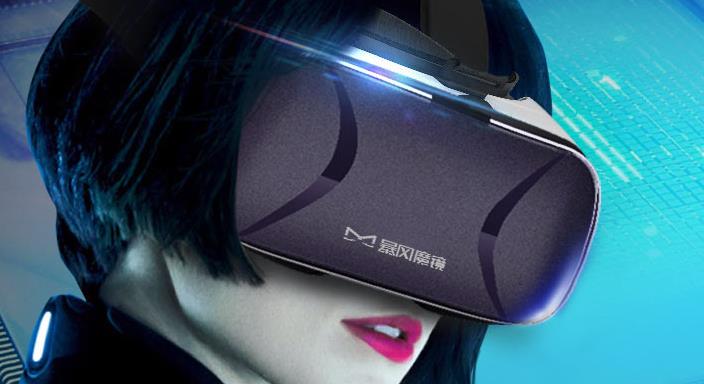
▲ China Storm Mirror VR
Wu Jingwei of Greenpie Storm VR Industry Fund, who attended the Korea-China Virtual Reality Industry Workshop held on the 7th, said, “The fact that large-scale industry funds began investing in VR in the second half of last year is an unusual move not seen in other industries. In particular, the fact that more mainstream funds have been investing in the VR/AR industry since the second half of 2016 is a very optimistic sign for the industry. It is especially encouraging that even conservative funds are investing in this industry.”
In addition to these companies, Chinese capital is also flowing into major VR firms. Magic Leap, a company with an asset valuation of $4.5 billion, is receiving significant interest from Chinese capital, including Alibaba. In the case of NextVR (asset valuation of $800 million), which is currently in the spotlight, the investor is known to be a Chinese company called NETEASE.
So, how does this Chinese capital view the VR industry? Wu Jingwei, CEO of Storm Mirror, predicted, “We consider the VR industry to be a complement to the internet industry. From the present to the near future, VR products will not deviate significantly from their current state. However, they will play an important role in industrial applications.”
Judging by his words, it means that the VR industry plays a role that complements other businesses, not the main business. It likely means that rather than viewing the VR industry as a golden goose right now, they are keeping an eye on its applications with other industries.
Let's hear more of his story. He explained, “I am interested in whether VR will realize true miniaturization, but I do not expect to see exceptionally outstanding products within the next 5 to 10 years. If such a product were to emerge, it would replace mobile phones and displays, but that is not something that will happen in the short term. I think it is something that could happen in 15, 20 years, or even further in the future.”
The point is that product value depends on convenience (portability), and it is anticipated that it will take time for such products to emerge. At the current stage, investments and product development are being pursued based on the expectation that VR will be utilized more in applications across other industries, rather than for its intrinsic commercial or utility value.
In addition to CEO Wu Jingwei, Chinese VR entrepreneurs participating in the workshop also emphasized this point several times. Their message is that instead of viewing other industries through the lens of VR, one should consider VR in terms of its value for existing industries. In other words, this implies that VR should be used as a tool to revitalize existing industries, and that there must be clear content (killer apps) available to utilize VR.
This is something the domestic VR industry should also take note of. As seen in the recent Galaxy Note 7 debacle, the industry's foundation will become more solid only if software technology (including content) is developed in parallel, rather than focusing excessively on hardware-centric development. For example, effectively leveraging our game content development capabilities—which Chinese companies envy—in the VR industry would be one approach.
관련뉴스
Could Micro LED Displays Solve Everything from VR Wearables to TVs?
Can micro LED displays catch up with the OLED display market beyond conventional LED displays? As interest in next-generation smart devices such as wearable devices increases, demand for technological development of micro LED displays is intensifying. Micro LED displays, which are manufactured with chip sizes typically in the 10–100 μm range and can be applied to all optical applications requiring low power consumption, miniaturization, and weight reduction, can be extensively utilized in flexible displays, smart textiles, bio contact lenses, HMDs, wearable body-attached devices, and wireless communication applications. In a situation where LEDs, which were primarily used in lighting and display applications, are increasingly showing potential for use in biomedical and medical fields, micro LEDs—which have secured stability in high efficiency, yield, and reliability—have emerged as a next-generation display technology.
2016.05.30by 신윤오 기자
[Reporter's Notebook] VR Industry, Is There Any Good Content?
This was several years ago during the height of 3D TV competition. A major device manufacturer came forward with plans to create an ecosystem in the 3D TV field on its own, and even blocked its partner companies from collaborating with competing firms. Naturally, inter-company exchanges became closed-off, and technological development and content production failed to materialize properly, leaving 3D TV facing fundamental limitations. The lessons learned from 3D TV can be summarized into several points. First, ecosystem building is necessary for a specific market and technology to develop. Second, ecosystem building cannot be achieved through unilateral leadership by any single party. Third, a shortage of content ultimately brings about limitations in market expansion.
2016.07.04by 신윤오 기자

What is needed to enter the Chinese VR market is 'this'
중국 가상현실(VR) 산업이 빠르게 성장하는 이유는 무엇일까. 전문가들은 중국 정부의 육성 정책과 중국 기업들의 발 빠른 대처, 중국의 사회 문화 환경 등에서 그 이유를 찾는다. 중국 가상현실 산업의 현재와 미래를 들여다 볼 수 있는 자리가 마련됐다. 10월 첫째 주에 정부가 개최한 ‘Korea VR Festival’ 행사의 일환으로 열린 한-중 가상현실 산업 워크숍에서 그 실마리를 찾을 수 있었다. 행사 주간에 열린 이 워크숍에서는 현재 중국 가상현실 산업에서 두각을 나타내고 있고 기업의 전문가들이 참여하여 중국 시장의 생생한 정보를 전달하였다. 이에 본지에서는 토론 지상 중계를 통해 중국 가상현실 산업의 현실과 국내 산업이 나아갈 길을 모색하고자 한다. 다음은 토론을 요약 정리한 내용이다.
2016.10.17by 신윤오 기자
The Problem with AI is Not Performance, but Trust
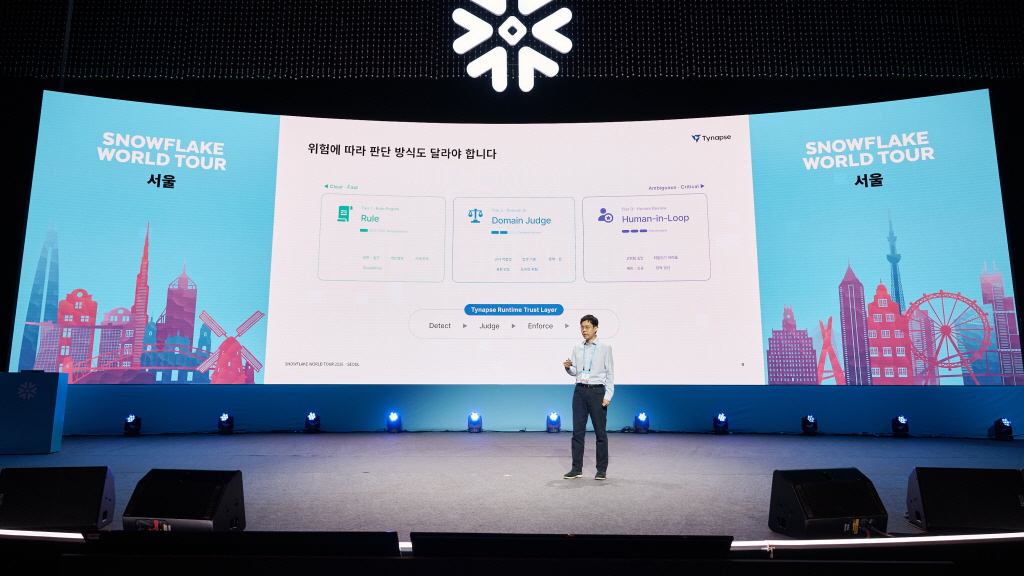
CEO Kang Min-seung emphasized at Snowflake's World Tour Seoul that generative AI has entered a phase where "trust" rather than accuracy becomes the key competitive advantage. As AI is applied to various tasks including consultation, risk management, and operational automation, incorrect data, erroneous responses, and bias are creating actual business risks. He pointed out that enterprises must build a trust layer above AI. To achieve this, accurate data management, semantic structuring, governance, and prompt security are essential. He explained that AI is not merely an automation tool but a technology that reorganizes the entire organization's workflows and decision-making systems. Snowflake provides a platform that supports this trust-based AI operation, emphasizing that enterprises should build "trustworthy AI" rather than "intelligent AI."
2026.08.28by 배종인 기자
The Decisive Factor for AI Agents in Finance: "Trustworthy Data Infrastructure"
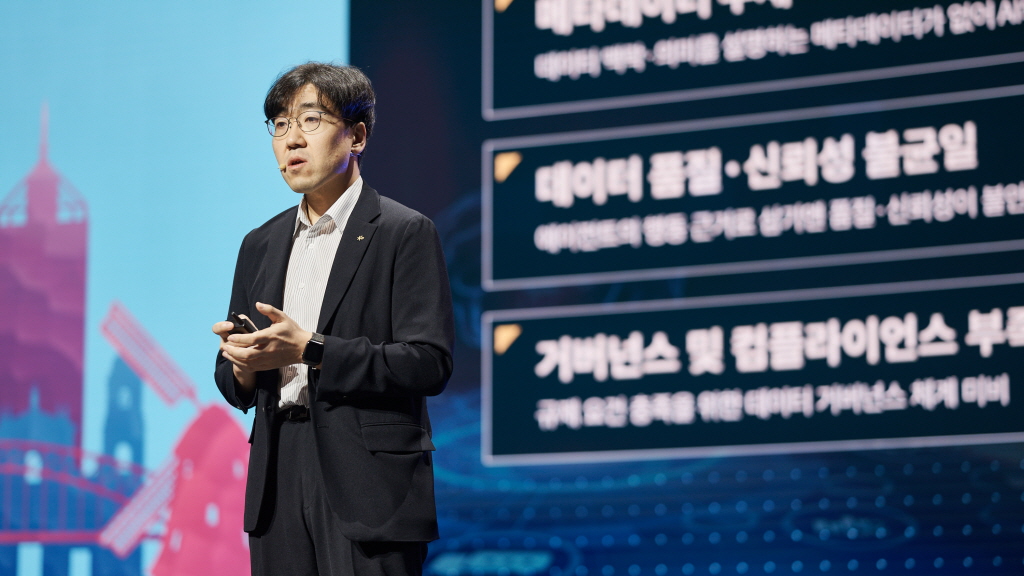
The key to spreading AI agents in the financial sector is establishing a trustworthy data system. KB Kookmin Bank is operating over 100 AI agents by 2025 and is promoting expansion to 300. AI is automating repetitive tasks across various areas such as consultation, risk management, wealth management, and relationship management. However, if data quality, governance, and semantic structuring are insufficient, errors and risks increase. KB is building an AI-Ready organization through a multi-model strategy of GPT, Gemini, and Claude, as well as a Snowflake-based data system. The bank emphasized that AI has entered a phase where it restructures not just simple automation but the entire work process and decision-making system.
2026.08.28by 배종인 기자











