



Mentor Embedded RTOS Nucleus Supports 64-Bit ARMv8-A
 Published2016.10.18 18:12
Targeting real-time applications in automotive, industrial, medical, military aviation, and networking systems.
Mentor Graphics Korea (CEO Young-in Yang) announced that Nucleus RTOS (an operating system for embedded systems developed by Mentor Graphics) supports the 64-bit ARMv8-A architecture.
This allows the Nucleus RTOS to take advantage of 64-bit processing across the full range of 64-bit SoCs. The Nucleus RTOS also supports the ARMv8-A aarch32 (32-bit) execution mode, which allows users to run legacy 32-bit code on 64-bit SoCs. This support for ARMv8-A SoC features enables device manufacturers to develop cutting-edge products for markets including automotive, industrial, medical, military/aerospace, and networking.
First, initial support for Nucleus is provided for the NXP QorIQ LS2085A-RDB Reference Design Board.
Device support is available for kernels including NEON, Nucleus Process Model, CPU, and UART. Device support can be easily extended by customers or Mentor Embedded Professional Services. This architecture port can also support related SoCs such as NXP's QorIQ LS2080A/40A, LS2045A, LS2084/44A, LS2088A/48A, LS1012A, LS1046A/26A, LS1043A/23A, and LS1088A/48A processors.
“Mentor Graphics continues to demonstrate its leadership in embedded software and complements NXP’s advantages in providing high-performance ARMv8-A SoCs,” said Noy Kucuk, vice president of product management, Digital Networking business unit, NXP Semiconductors. “With 64-bit Nucleus RTOS support for NXP QorIQ communications processors, our joint customers can develop smarter, higher-performing devices with a proven, commercial real-time operating system solution.”
ARMv8-A support for the Nucleus RTOS is included in the Nucleus ReadyStart developer tool suite. This provides developers with the Eclipse-based Sourcery CodeBench IDE development environment and complete source code, enabling embedded developers to quickly bring their products to market.
The Sourcery CodeBench IDE is an embedded development platform that comes with ARM DSTREAM support for NXP's QorIQ LS2085 device and a prebuilt, hardened, and supported GNU Compiler Collection (GCC) toolchain. This toolchain is bundled with aarch64 and aarch32 multilibs, providing flexibility and choice for end users working with ARMv8-A-based processors. Sourcery Analyzer technology, included in the Sourcery Codebench tool, is a powerful embedded design analysis solution that combines a proprietary profiling and analysis engine with data visualization capabilities.
Nucleus products are feature-rich, hard real-time, low-footprint, highly scalable RTOSs with strict development time constraints, delivering advanced functionality without compromising the simplicity and compactness of the solution. At its core, the Nucleus RTOS implements multicore technologies such as SMP and the Mentor Embedded Multicore Framework, and supports USB 3.0, PCI Express, and the TI WiLink 8 stack. This gives it a unique position in the embedded market.
The Nucleus Process Model (NPM) is a lightweight process model that allows for the isolation of tasks and libraries. It also provides memory protection, significantly improving product reliability by allowing software defects to be isolated more quickly and enabling deployed systems to self-diagnose. Furthermore, it allows for dynamic loading and unloading of processes, thereby increasing runtime scalability.
Embedded developers can also take advantage of the built-in Nucleus Power Management Framework. Developers specify application requirements using hardware-independent APIs, and the Nucleus RTOS automatically identifies power-aware components, streamlining the design process, increasing code reuse, and accelerating time to market.
관련뉴스

멘토그래픽스, 자동차 파워 전자장비 신뢰성 테스트 ‘열’ 관리 되네
EDA(반도체설계자동화) 업체로는 유일하게 기계 분석(Mechanical Analysis) 비즈니스를 하고 있는 멘토그래픽스(www.mentorkr.com)가 전기 및 하이브리드 자동차의 파워 전자장비 열시뮬레이션 검증 솔루션인 ‘MicReD 파워 테스터(Power Tester) 600A’를 출시한 이유는 여기에 있다. 멘토그래픽스는 이번에 발표한 비파괴 온도테스트 하드웨어 장비 외에 전자 쿨링 소프트웨어와 1D & 3D 범용 CFD(Computational Fluid Dynamics) 소프트웨어 제품군을 기계 분석 비즈니스로 운영하고 있다. 이번에 새롭게 발표한 ‘MicReD 파워 테스터 600A’는 파워사이클링 시에 전기 및 하이브리드 자동차(EV/HEV)의 파워 전자장비의 신뢰성을 테스트하는 장비이다. EV/HEV 개발 및 신뢰성 검증을 담당하는 엔지니어들은 이 장비를 이용해 IGBT, MOSFET, 트랜지스터 및 충전기와 같은 파워 전자장비의 동작에 필수적인 열 신뢰성 및 수명주기 성능을 테스트할 수 있다.
2016.05.24by 명세환 기자
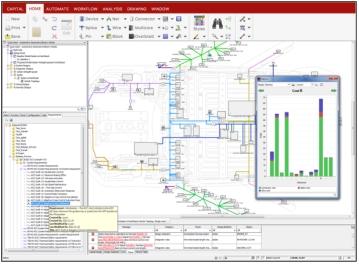
Mentor Graphics Supplies Wire Harness Design Verification Solutions to Automotive Electronics Companies
Korea Mentor Graphics (CEO Yang Young-in) announced that it has supplied 'Mentor® Capital®', its electrical systems and wire harness domain design verification solution, to LVPG (Lear Virtual Proving Grounds), the electrical design system of Lear Corporation, a global leader in automotive electronics systems development. Lear Corporation's LVPG is a solution developed for automotive OEM customers to optimize and verify electrical systems and wire harness design. LVPG enables the development of differentiated competitive products in the market by responding quickly and powerfully to customer requirements.
2016.06.08by 명세환 기자
[Automotive Innovation Day] Mentor, a Leader in Automotive Design Tools and Software
오토모티브 일렉트로닉스 주최로 지난 14일 열린, 오토모티브 이노베이션 데이(2016 Automotive Innovation Day) 행사에 참여한 멘토 그래픽스는 자동차 설계 툴 및 소프트웨어 부문을 선도하는 제품 포트폴리오를 소개했다. 시스템 엔지니어링 분야의 깊은 전문 지식을 기반으로 한 이 제품 포트폴리오는 고객들이 업계가 직면하고 있는 가장 복잡한 설계 문제들을 해결할 수 있도록 돕고 있다. 솔루션들이 망라하고 있는 자동차 전기 및 전자 설계의 주요 분야 세 가지는 커넥티비티 및 네트워킹, 차량 내 경험 그리고 서브시스템 및 기술이다.
2016.07.19by 신윤오 기자
.jpg)
SalePoint Signs Multi-Year Partnership Agreement with AWS… Promoting Identity Security that Integrates Even AI Agents
세일포인트가 AWS와 다년간의 전략적 협력 계약을 체결하고, 인간과 비인간 아이덴티티를 함께 관리하는 통합 거버넌스 체계 구축에 나선다. AI 에이전트가 업무 수행 주체로 늘어나는 환경에서 접근 권한을 일관되게 관리하고, 최소 권한 원칙과 자동화된 정책 집행을 적용하겠다는 구상이다. 양사는 AWS 환경에서 AI 에이전트를 포함한 다양한 주체의 아이덴티티를 하나의 레이어에서 관리하는 기능을 공동 확대할 계획이다. 이번 협력은 AI 도입이 확대되는 기업 환경에서 보안과 거버넌스를 함께 설계하려는 움직임으로 해석된다.
2026.03.26by 배종인 기자
.png)
Databricks Unveils Open AI Security Monitoring 'Lakewatch'
데이터브릭스가 3월 24일 개방형 에이전틱 SIEM ‘레이크워치’를 공개하며 보안 시장에 진입했다. 이 제품은 보안, IT, 비즈니스 데이터를 단일 환경에서 통합 분석해 AI 기반 위협 탐지와 조사를 지원하는 것이 핵심이다. 회사는 고비용 구조 때문에 일부 데이터를 포기해온 기존 보안관제의 한계를 줄이고, 개방형 형식과 생태계를 바탕으로 대규모 데이터 분석과 자동화를 가능하게 한다고 설명했다. 레이크워치는 현재 프라이빗 프리뷰로 제공되며, 어도비와 드롭박스 등이 초기 고객으로 언급됐다. 데이터브릭스는 앤트로픽과 협력을 확대하고 안티매터, SiftD.ai 인수도 함께 발표했다.
2026.03.26by 배종인 기자











