



The 5 challenges that determine the competitiveness and popularization of VR technology are
 Published2016.11.08 09:39
The platform market is a three-way battle between Facebook, Google, and China.
The VR platform market will evolve into a three-way battle between the Facebook/Oculus alliance, the Google/Android alliance, and the China alliance, and advancements in hardware, as well as the content ecosystem, must follow.
Park Min-woo, a professor of Smart Media at Chungkang University of Culture and Industry, drew attention by stating this in his article "The Evolution and Prospects of Mobile VR Platforms," recently contributed to Digieco Issue & Trend, and by presenting five challenges that determine the competitiveness and popularization of VR technology.
According to Professor Park, Facebook is simultaneously targeting both PC-based and mobile-based VR markets, centering on Oculus and Samsung Electronics. He suggests that Samsung Electronics' lukewarm approach to producing Daydream-dedicated devices stems from its relationship with Facebook. Currently, the power of the Facebook/Oculus alliance in the early market is immense. In particular, Facebook has a strong desire to pioneer a new genre called "Social VR" in the mobile VR market, and he predicted that various initiatives would be undertaken utilizing the Facebook platform.
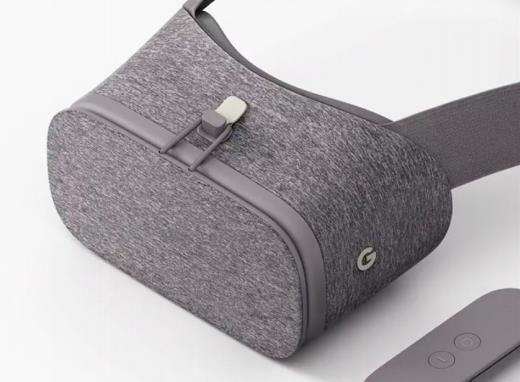
▲ Google's high-performance mobile VR headset <Daydream View>
The counterattack from the Chinese alliance is also formidable. This is because the Chinese IT swarm of Xiaomi, Alibaba, and Tencent is actively investing in VR/AR technology, starting with the HTC Vive. The Chinese alliance's greatest competitive advantage lies in possessing the world's largest gaming market and backed by government investment and efforts in the VR industry. The report predicted that the technologies and experiences pouring out of the diverse hardware startup ecosystem will rapidly elevate China's VR technology to a global level.
In response, Professor Park suggested five tasks, stating that for the development of the VR industry, hardware development must follow as well as the content ecosystem.
The first factor is smartphone performance. It will require performance exceeding that of existing premium phones. Even if it does not meet the standards required by PC VR, it will be difficult to guarantee the desired content quality unless performance exceeds that of a laptop. This is also why Google requires minimum specifications through "Daydream Ready" certification. Professor Park predicted that if the mobile VR market grows, the stagnant smartphone market will naturally revive as well.
Second is display technology. It is not simply a competition over high-definition displays. Considering comfort and mobility, there must ultimately be a transition from smartphone-connected devices to standalone devices. In this regard, a combination of a flexible display and a headset may be necessary, and display methods capable of enhancing immersion even without light blocking must also be considered. On top of this, an affordable price is essential.
The third is the controller. Initially, sensor-based controllers will be the mainstream, but various controllers linked to VR content will be released. However, since too many controllers create a burden of purchasing costs and management issues, the development of a universal controller will become necessary at an appropriate time. It was predicted that it would be worth noting how the Nintendo Wii controller is used in a wide variety of games.
The fourth factor is the communication environment. Network bandwidth must be increased to transmit 4K or 5K videos. Proper consumption of VR video content will only occur once the 5G communication technology currently under development is commercialized. Domestic telecommunication companies and broadcasters plan to produce and transmit coverage of the PyeongChang Winter Olympics in 360-degree VR video. Since 5K 360-degree VR video requires more than four times the data transmission volume of existing 5K video, it is difficult to transmit high-quality video without expanding communication bandwidth.
Finally , there is cognitive dissonance. Dizziness still occurs due to the time lag between reality and the VR environment. While this may be partially resolved as hardware performance improves, an ultimate solution is needed. As pointed out by Jeremy Bailenson, a professor of communication at Stanford University and founder of the Virtual Human Interaction Lab, “VR is a technology that evokes strong emotions while simultaneously consuming a lot of energy, and its intense immersion results in physical, mental, and economic costs,” the VR field still has many problems to solve compared to existing digital devices.
In addition to this, Professor Park pointed out that the fact that most current VR technologies are focused on hardware is another problem that needs to be addressed. The types of hardware are changing too frequently and too quickly compared to the volume of content. He also noted that consumer expectations have become excessively high due to the overhyping of the VR industry.
VR services centered on consoles, including PCs, will still secure a certain market focused on enthusiasts. In contrast, while the mobile VR market has high potential, it is uncertain whether it will secure a position as a secondary device like tablet PCs or if its role will be reduced to that of an accessory, similar to wearable devices. However, what is clear is that if a new market opens up in the IT industry, VR is currently the most likely candidate to be the protagonist.
관련뉴스

What is needed to enter the Chinese VR market is 'this'
중국 가상현실(VR) 산업이 빠르게 성장하는 이유는 무엇일까. 전문가들은 중국 정부의 육성 정책과 중국 기업들의 발 빠른 대처, 중국의 사회 문화 환경 등에서 그 이유를 찾는다. 중국 가상현실 산업의 현재와 미래를 들여다 볼 수 있는 자리가 마련됐다. 10월 첫째 주에 정부가 개최한 ‘Korea VR Festival’ 행사의 일환으로 열린 한-중 가상현실 산업 워크숍에서 그 실마리를 찾을 수 있었다. 행사 주간에 열린 이 워크숍에서는 현재 중국 가상현실 산업에서 두각을 나타내고 있고 기업의 전문가들이 참여하여 중국 시장의 생생한 정보를 전달하였다. 이에 본지에서는 토론 지상 중계를 통해 중국 가상현실 산업의 현실과 국내 산업이 나아갈 길을 모색하고자 한다. 다음은 토론을 요약 정리한 내용이다.
2016.10.17by 신윤오 기자
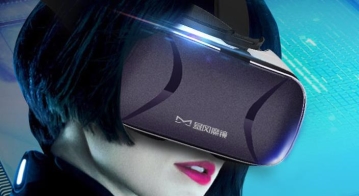
[Reporter's Notebook] South Korea and China's Perspectives on the Virtual Reality (VR) Industry
지난 2014년 페이스북이 오큘러스를 20억 달러에 인수하면서 가상현실, 즉 VR이 미래산업의 주역으로 급부상했습니다. 내노라하는 세계 IT 기업들도 앞다퉈 VR 사업을 적극 육성하겠다고 나서고 있는 상황입니다. 포스트 스마트폰 시대의 먹거리를 찾던 기업들의 눈에 말 그대로 가상 현실이 ‘진짜 현실’로 나타난 것 마냥 부산스럽습니다.
2016.10.17by 신윤오 기자
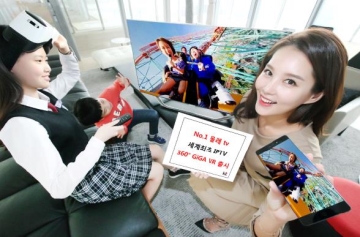
Enjoy VR content at home with a remote control without expensive VR devices
KT는 자사 IPTV서비스인 올레 tv를 통해 세계최초로 IPTV에서 TV리모컨으로 즐길 수 있는 가상현실(VR) 서비스인 ‘올레 tv 360도 기가 VR’을 전격 공개한다고 밝혔다. KT 올레 tv 360도 기가 VR은 Full HD급 이상 고화질로 제공되며, VR전용 주문형비디오(VOD)를 재생하고 TV리모컨으로 360도 상/하/좌/우는 물론 확대/축소 조종을 할 수 있다.
2016.11.07by 김수지 기자
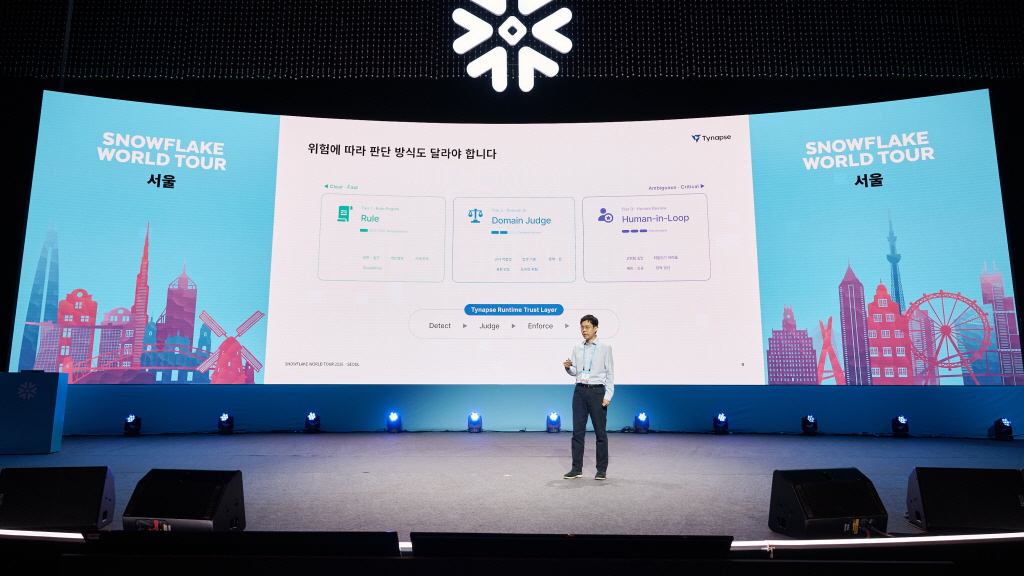
The Problem with AI is Not Performance, but Trust
CEO Kang Min-seung emphasized at Snowflake's World Tour Seoul that generative AI has entered a phase where "trust" rather than accuracy becomes the key competitive advantage. As AI is applied to various tasks including consultation, risk management, and operational automation, incorrect data, erroneous responses, and bias are creating actual business risks. He pointed out that enterprises must build a trust layer above AI. To achieve this, accurate data management, semantic structuring, governance, and prompt security are essential. He explained that AI is not merely an automation tool but a technology that reorganizes the entire organization's workflows and decision-making systems. Snowflake provides a platform that supports this trust-based AI operation, emphasizing that enterprises should build "trustworthy AI" rather than "intelligent AI."
2026.08.28by 배종인 기자
The Decisive Factor for AI Agents in Finance: "Trustworthy Data Infrastructure"
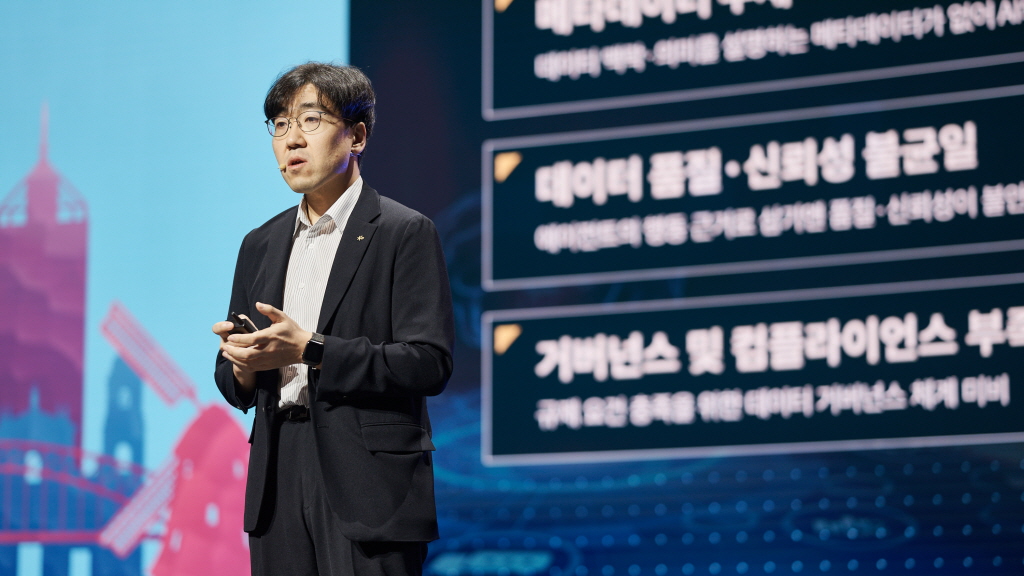
The key to spreading AI agents in the financial sector is establishing a trustworthy data system. KB Kookmin Bank is operating over 100 AI agents by 2025 and is promoting expansion to 300. AI is automating repetitive tasks across various areas such as consultation, risk management, wealth management, and relationship management. However, if data quality, governance, and semantic structuring are insufficient, errors and risks increase. KB is building an AI-Ready organization through a multi-model strategy of GPT, Gemini, and Claude, as well as a Snowflake-based data system. The bank emphasized that AI has entered a phase where it restructures not just simple automation but the entire work process and decision-making system.
2026.08.28by 배종인 기자











