



Tektronix Unveils Test Solution for ONFI Flash Memory Standard
 Published2016.11.08 16:38
Adoption of an effective probe using a Nexus interposer
Tektronix recently announced the industry's first test solution for the ONFI (Open NAND Flash Interface) standard.
The ONFI 4.0 test solution available on Tektronix high-performance oscilloscopes includes software for analyzing DDR2/3 modes on the ONFI bus and is combined with an effective interposer-based probe solution.
The ONFI standard is a standard announced by the ONFI Working Group to simplify the process of integrating NAND flash memory into consumer electronics and computing platforms. The ONFI 4.0 specification introduced the latest NV-DDR3 interface operating at VccQ=1.2V to increase performance and improve power efficiency, extended NV-DDR2 and NV-DDR3 I/O speeds to 667 MT/s and 800 MT/s, respectively, and added ZQ calibration capabilities.
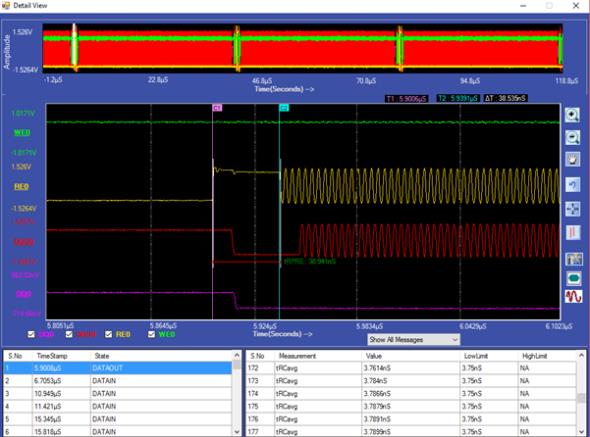
As speeds increased and voltage levels decreased, designers handling ONFI buses faced the challenge of resolving conformity testing and timing issues, as well as ensuring access to signals.
Using TEK-PGY-ONFI software, design and test engineers can test the conformity of ONFI bus timing parameters of the ONFI interface and provide automatic measurement functions for command, address, data input, and data output transactions. The detailed view function of the TEK-PGY-ONFI software helps solve timing problems by correlating analog waveforms with each electrical measurement of the ONFI waveform through annotation.
High-density packaging and high data rates are factors that make it difficult to ensure the stability of signal transmission characteristics for NAND flash devices. Tektronix supports various mechanical specifications, including socketed, direct-connected, and edge probe designs—a patented technology that meets high mechanical stability requirements. The S-parameter models of the interposer and probe allow for the self-generation and direct modeling of de-embedding filters to be applied to oscilloscopes.
The TEK-PGY-ONFI software runs on Tektronix MSO/DPO70000 series oscilloscopes with a bandwidth of 4 GHz to 33 GHz, and P7500 or P7300 series probes are recommended for testing. For some customers testing ONFI, signal access may be difficult or impossible, so Tektronix recommends Nexus’s ONFI 152 Ball NAND Flash Edge High-Fidelity Interposer to ensure signal access while maintaining signal integrity.
Brian Reich, General Manager of High Performance Oscilloscopes at Tektronix, said, “This ONFI test solution provides the capabilities necessary for customers to launch memory-based products more quickly and with confidence. Compared to manual testing, this solution significantly reduces compliance test time, simplifies debugging, and ultimately increases productivity.”
The new TEK-PGY-ONFI software is added to Tektronix's memory measurement solution portfolio, providing optimized features for memory engineers alongside existing eMMC, UFS, and DDRA.
Comments
Related news
Tektronix Strengthens Oscilloscope Market with Entry-Level Launch Featuring Latest Probe Interface
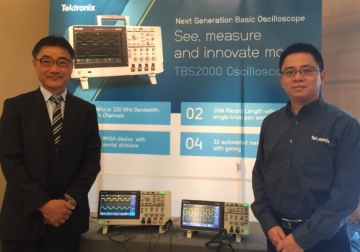
Tektronix has unveiled the next-generation entry-level oscilloscope TBS2000. The company stated that the newly introduced oscilloscope features class-leading longest record length and large display capabilities for faster signal evaluation and troubleshooting. Additionally, through this new model added to Tektronix's portfolio, the application range of Tektronix probes expands further, enabling design engineers and educators to access expanded functionality within budget constraints, the company explained. The new models, featuring 70MHz or 100MHz bandwidth and configured with 2 or 4 channels, provide 15 horizontal divisions (timebase) through a 9-inch WVGA display screen, allowing users to observe 50% wider signal range compared to equivalent competitors' equipment.
2016.08.09by 명세환 기자
Tektronix begins supplying wideband optical isolation measurement systems
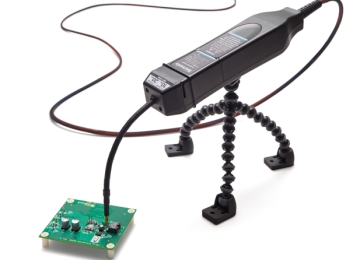
Tektronix announced that it will supply the IsoVu™ measurement system, which was showcased at the APEC2016 show this year, to customers worldwide. The IsoVu platform uses electro-optic sensors to convert input signals into optical modulation, electrically isolating the device under test from the Tektronix oscilloscope. The system is composed of four individual lasers, optical sensors, and five optical fibers, and incorporates sophisticated feedback and control technologies.
2016.08.17by 신윤오 기자
Tektronix Adds Features to Aurora Automated File-Based Quality Management Solution
Tektronix announced new features added to its Aurora automated file-based quality control (QC) solution, which is used by content creators, editors, distributors, and broadcasters to efficiently test and monitor the rapidly increasing volume of video content. Perceptual Video Quality (PVQ) measurement, an innovative technology for video quality measurement, has been added to Aurora. Using this feature, users can accurately understand summarized quality measurement results of file-based content. Additional enhancements include Aurora support for AWS (Amazon Web Services) cloud and support for AS-10 PAD transmission specifications, which are currently mandatory requirements in France.
2016.09.29by 홍보라 기자
.jpg)
SalePoint Signs Multi-Year Partnership Agreement with AWS… Promoting Identity Security that Integrates Even AI Agents
Sailpoint has entered into a multi-year strategic partnership agreement with AWS and is moving forward with establishing an integrated governance system that manages both human and non-human identities together. The plan is to consistently manage access permissions in an environment where AI agents are increasing as work execution entities, while applying the principle of least privilege and automated policy enforcement. The two companies plan to jointly expand capabilities to manage the identities of various entities, including AI agents, within a single layer in the AWS environment. This collaboration is interpreted as a move to design security and governance together in corporate environments where AI adoption is expanding.
2026.03.26by 배종인 기자
.png)
Databricks Unveils Open AI Security Monitoring 'Lakewatch'
Databricks entered the security market on March 24 by unveiling LakeWatch, an open-source agentic SIEM. The core functionality of this product is to integrate and analyze security, IT, and business data in a single environment to support AI-based threat detection and investigation. The company explained that it reduces the limitations of existing security operations centers, which have had to forgo some data due to high cost structures, and enables large-scale data analysis and automation based on open formats and ecosystems. LakeWatch is currently offered as a private preview, with Adobe and Dropbox mentioned as early customers. Databricks also announced an expanded partnership with Anthropic as well as the acquisition of Antimatter and SiftD.ai.
2026.03.26by 배종인 기자











