


New types of cybercrime, such as 'dronejacking' and 'connected car hacking,' are expected to emerge.
 Published2016.12.06 19:18
Symantec announced its top 10 security predictions for 2017, titled 'Security in 2017 and Beyond: Symantec's Predictions for the Year Ahead'.
As cybercriminals constantly evolve attack methods aimed at accessing corporate data, the security industry faces new types of security threats every year. With the emergence and proliferation of new IT technologies such as cloud computing, IoT, and connected cars, Symantec anticipates that security threats will intensify further in 2017 and has announced the following 10 security issues to watch out for in 2017.
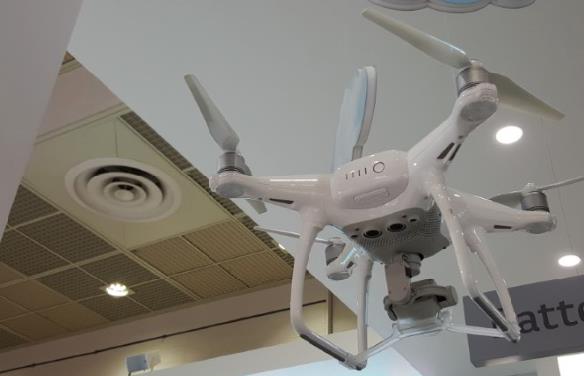
<Reference Photo: The photo shows a drone on display at the exhibition>
1. Security at a New Turning Point Due to Cloud Expansion
The transition to a smart work environment is expected to continue as companies adopt new technologies such as wearables, virtual reality, and IoT devices into their internal networks, and at the same time support their distributed workforce with cloud applications and solutions. As cloud environments become increasingly widespread, companies will need to shift the focus of their security activities from protecting endpoint devices to protecting users and information across all applications and services.
2. The Era of Connected Cars Becoming 'Hostages'
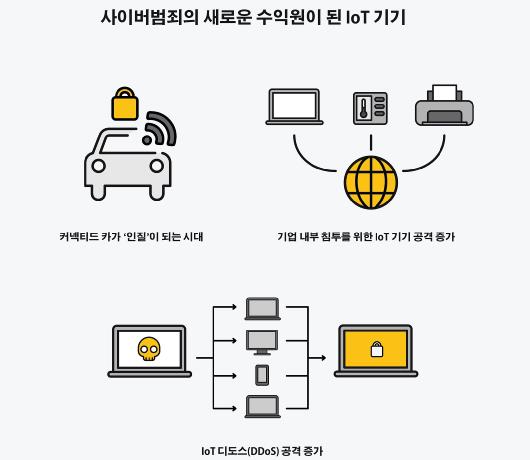
As connected features begin to be added to automobiles, large-scale automotive hacking is now only a matter of time. For example, new threats targeting vehicles could emerge, such as taking cars hostage and demanding ransom, hacking autonomous vehicles to determine their location for hijacking, unauthorized surveillance, and data collection. This could lead to legal liability issues between software vendors and automakers, which is expected to have a long-term impact on the future of connected cars.
3. Increase in IoT device attacks for corporate internal infiltration
IT security departments must go beyond simply checking for vulnerabilities in computers and mobile devices and carefully monitor thermostats and other connected devices, viewing them as means to infiltrate the corporate network. Just as printer servers were exploited in cyberattacks a few years ago, it is now urgent to establish security measures because almost everything within a company is connected to the Internet.
4. Increase in IoT DDoS attacks
The attack targeting the U.S. internet hosting service provider Dyn last October proved that many IoT devices lacking security features are significantly vulnerable to cyberattacks. As an increasing number of IoT devices are being installed on a large scale, the risk of security breaches is expected to rise. Once insecure IoT devices are distributed, it is nearly impossible to resolve the issue without recalling all devices or installing security updates. As the lack of security in IoT devices is expected to persist for the foreseeable future, attacks targeting these devices appear inevitable.
5. Ransomware that attacks the cloud
Given the large-scale transition to cloud-based storage and services, the cloud is becoming a lucrative target for attacks. Cloud security cannot be addressed solely by firewalls or traditional security policies. Consequently, there will be a shift in the direction of corporate security practices regarding where data should be protected. As cloud attacks can lead to millions of dollars in damages and the loss of critical data, the need to protect the cloud will continue to increase.
6. Increase in 'fileless' malware
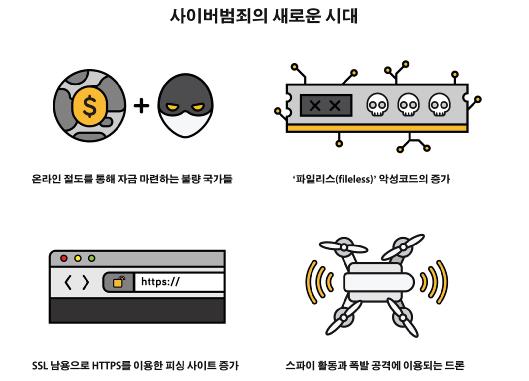
'Fileless' infections, which execute directly into a computer's RAM without using any files, are difficult to detect because they cleverly evade intrusion prevention and antivirus programs. This type of attack increased throughout 2016 and is highly likely to continue gaining notoriety in 2017, primarily through PowerShell attacks.
7. Advancement of Security Technology through Machine Learning
In 2017, the fields of machine learning and artificial intelligence (AI) are expected to continue growing within the IT sector. Forrester forecasts that AI investment will increase by a staggering 300% in 2017 alone. As AI grows and evolves, companies will gain new and powerful insights, and collaboration between humans and machines will increase. From a security perspective, this growth will impact enterprises across various aspects, including endpoints and mechanisms in cloud environments. With the continued market launch of new forms of machine learning and AI, companies must adopt solutions capable of collecting and analyzing information from numerous endpoints and attack sensors. The big data analytics capabilities of these solutions will play a key role in leveraging machine learning at the forefront of the real-time changing global market.
8. Increase in phishing sites using HTTPS due to SSL abuse
Coupled with Google's recent policy of labeling HTTP-only sites as unsafe, the popularity of free SSL (Secure Sockets Layer) certificates is expected to weaken security standards and enable spear phishing or malware programs resulting from malicious search engine optimization practices.

9. Drones used for espionage and explosive attacks
There is also speculation that drones could be used for espionage or explosive attacks. While such incidents could occur in 2017, they are more likely to happen thereafter. It is predicted that so-called "dronejacking," in which drone signals are intercepted and the drone's path is redirected as desired by an attacker, could occur by 2025. Considering these possibilities, it is expected that anti-drone hacking technology will also be developed to control the drone's GPS and other critical systems.
10. Rogue countries that fund themselves through online theft
Rogue nation states posing a threat through threats such as missile launches or terrorism will attempt to steal money online. As seen in the SWIFT attacks, there is a dangerous possibility that rogue states could link with organized crime for private gain. Consequently, situations are also anticipated that could disrupt a nation's political, military, or financial systems.
Yoon Kwang-taek, Senior Vice President at Symantec Korea, emphasized, “With the expansion of cloud environments and the emergence of new IoT devices and services, it will become inevitable for companies to revise their established cybersecurity response strategies to adapt. The cloud environment will demand changes in network perimeter defense strategies, and as IoT devices are expected to become new bridgeheads for attackers to infiltrate enterprises, it is necessary to establish security threat analysis and strategies suited to this new environment and to adopt new response technologies.”
관련뉴스
Security difficulties due to vulnerable security infrastructure, lax networks, and slow threat detection
시스코가 최근 보안 위협 동향과 해결책을 담은 ‘시스코 2016 중기 사이버 보안 보고서 (Cisco 2016 Midyear Cybersecurity Report)’를 발표했다. 보고서에 따르면 랜섬웨어(ransomware)가 수익 극대화를 위해 다양한 변종을 내놓으며 진화하는 것으로 나타났다. 많은 기업이 증가하는 랜섬웨어 변종에 어려움을 겪고 있는 주된 이유로 ▲취약한 보안 인프라 ▲허술한 네트워크 ▲느린 위협 탐지 속도를 꼽았다.
2016.09.05by 김수지 기자

Symantec Announces Next-Generation AI-Powered Endpoint Integrated Security Solution
시만텍코리아(대표 박희범)은 엔드포인트 보안의 새로운 미래를 제시하는 차세대 엔드포인트 통합보안 솔루션 ‘시만텍 엔드포인트 프로텍션 14(이하 SEP 14)’를 발표했다. SEP 14는 엔드포인트 및 클라우드에 인공지능(AI)을 적용해 강력한 다계층 보호를 제공하는 보안 솔루션으로, ▲머신러닝을 엔드포인트 보안 기술에 업계 최초로 통합 ▲제로데이 탐지를 위한 메모리 익스플로잇 공격 차단 기술 ▲실시간 지능형 위협 클라우드 조회 등 진화된 엔드포인트 보호 기술을 단일 에이전트에서 통합 제공해 고도의 지능형 보안 위협(APT)을 차단, 대응할 수 있다.
2016.11.16by 신윤오 기자
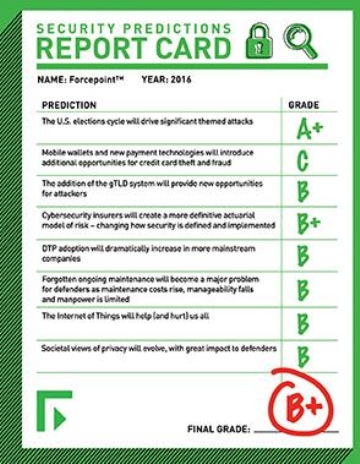
"2017 will see increased security risks due to the rapid integration of digital and physical domains"
포스포인트(한국지사장 이상혁)가 2017년도 사이버보안 전망 보고서를 발표했다. 이번 보고서는 기술적 영역과 물리적 영역의 통합 확대 현상을 주목하며, 이와 같은 새로운 디지털 에코 시스템이 전 세계 조직과 기관들에 미칠 장기적 영향에 대해 다루고 있다. 전망 보고서는 포스포인트와 레이시온(Raytheon)의 사이버보안 전문가들이 함께 참여하여 개발했다.
2016.12.01by 신윤오 기자
.png)
Databricks Unveils Open AI Security Monitoring 'Lakewatch'
데이터브릭스가 3월 24일 개방형 에이전틱 SIEM ‘레이크워치’를 공개하며 보안 시장에 진입했다. 이 제품은 보안, IT, 비즈니스 데이터를 단일 환경에서 통합 분석해 AI 기반 위협 탐지와 조사를 지원하는 것이 핵심이다. 회사는 고비용 구조 때문에 일부 데이터를 포기해온 기존 보안관제의 한계를 줄이고, 개방형 형식과 생태계를 바탕으로 대규모 데이터 분석과 자동화를 가능하게 한다고 설명했다. 레이크워치는 현재 프라이빗 프리뷰로 제공되며, 어도비와 드롭박스 등이 초기 고객으로 언급됐다. 데이터브릭스는 앤트로픽과 협력을 확대하고 안티매터, SiftD.ai 인수도 함께 발표했다.
2026.03.26by 배종인 기자
Kaspersky Unveils Revamped 'NEXT' Combining SOC Integrated Management and AI Analytics
기업들이 보안관제센터(SOC) 구축과 운영에서 통합 관리와 자동화 수요를 키우는 가운데, 카스퍼스키가 자사 B2B 보안 제품군 ‘카스퍼스키 넥스트’의 개편 내용을 공개했다. 이번 업데이트는 OSMP 기반 단일 콘솔로 EPP·EDR·XDR·SIEM 연계를 넓히고, DLL 하이재킹 탐지와 계정 탈취 의심 행위 식별 같은 AI 기능, 생성형 AI 보조도구 KIRA 연동을 담았다. 회사는 대규모 배포 환경에서 EDR Expert는 최대 30%, XDR Expert는 최대 60%까지 자원 요구량을 낮출 수 있다고 밝혔다.
2026.03.25by 배종인 기자











