


[2017 Outlook] Expansion of storage due to the proliferation of autonomous vehicles and artificial intelligence
 Published2017.01.02 19:07
Increased utilization of video content and expanded cloud usage also have an impact.
Quantum (Country Manager Lee Kang-wook) announced the '2017 Storage Market Outlook'.
Quantum stated that it will continue its sustained growth as key points to watch in the storage market this year, driven by: ▲ increased storage utilization due to the widespread adoption of autonomous vehicles and artificial intelligence technologies; ▲ the need for storage infrastructure for stable management as video usage in corporate businesses increases; ▲ increased utilization of object storage as private cloud services; and ▲ growing demand for tape storage and the management of large volumes of unstructured data requiring long-term storage.
In addition, it was cited that companies must engage in integrated management of various cloud storage systems they utilize, equip themselves with stable IT infrastructure and high-performance storage to meet the increase in large-capacity, high-resolution 4K video data, and that high-performance computing (HPC) providers must establish measures to manage all corporate data, including unstructured data.
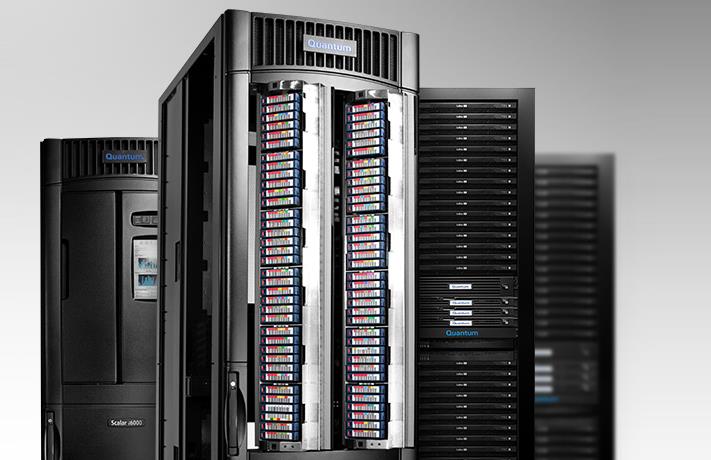
Quantum
The '2017 Storage Market Outlook' announced by Quantum is as follows.
Increased storage utilization driven by the widespread adoption of autonomous vehicles and artificial intelligence technologies
Market research firm Business Insider predicts that 10 million cars will be equipped with autonomous driving capabilities by 2020 due to the continuous advancement of IoT technology and artificial intelligence (AI). Autonomous vehicles require not only the application of AI technology along with AI applications, but also the ability to utilize and analyze vast amounts of camera and sensor data.
While processing capability was previously the biggest barrier to AI, storage is increasingly being cited as the primary obstacle. Existing general-purpose storage solutions fail to meet performance requirements and cannot support long-term data retention or the ability to access data when needed at a low cost. As a result, there is a growing trend among companies to adopt specialized storage and data management solutions capable of addressing these challenges.
As the use of video content in corporate business increases, storage infrastructure must be established.
Video will play a more significant role in corporate activities and business processes. For example, video can be utilized for video materials to prepare for medical accidents, to strengthen in-house training programs, to enhance quality control in manufacturing facilities, and to analyze buyer behavior in retail stores. In particular, with the trend of YouTube videos replacing written manuals, video will serve as a practical communication platform, as companies continuously produce videos as part of their training and service strategies. Therefore, to manage video content in the most effective and cost-effective manner possible, a stable data management infrastructure and storage must be established, and closer collaboration between the IT department and general business department personnel is required within the company.
Object storage is becoming more useful as a private cloud service
Object storage offers excellent scalability and durability, and supports access to large amounts of data at a lower cost than primary disk storage while avoiding the RAID rebuilding time delays associated with high-capacity disks. Unlike the hierarchical directory management system of existing file systems, object storage stores and manages data in units called 'objects,' which combine a 'data body' corresponding to a file with various 'additional information (metadata)' assigned by the user.
In other words, since data is managed as 'objects' composed of metadata instead of identifiers based on the physical location of the storage where it is stored (such as file names specified by full paths), data stored in multiple locations can be managed within a single namespace. Recently, such object storage has been serving as the foundation for public cloud services.
However, the prediction that it will become the market-dominant technology for large-scale data storage has not yet materialized. Users are aware that existing intelligent disk storage-based file systems and the latest tape storage technologies can provide performance equivalent to, or even better than, object storage at a lower cost. Accordingly, in the future, companies will use tape storage for long-term, cost-effective archiving (original storage and utilization) of large volumes of unstructured data, and object storage as a foundation for private clouds primarily built within the company.
Continued growth driven by increasing demand for managing large volumes of unstructured data
While the role of tape in backups is gradually diminishing, its function as a storage tool has not come to an end. As the volume and value of unstructured data continue to grow, attention is focusing on the importance of storing and protecting data in powerful yet affordable archives. As mentioned above, tape has made remarkable advancements over the years in performance, capacity, and ecosystem integration, becoming a technology optimized for long-term storage. This is precisely why many organizations handling large volumes of unstructured data—such as those in genomics, academic research, video surveillance, and entertainment—use tape as a critical part of their storage infrastructure.
Furthermore, this is also the reason why companies that intended to move data from tape have ended up taking the reverse course. Along with this, major public cloud providers are expanding their roles as key storage vendors and competing by lowering prices. These companies will likely increase their reliance on tape to fit their business models. Tape will continue to be used due to its economic advantages.
Companies must take action to integrate the management of the various cloud storage systems they utilize.
As the adoption of cloud services by enterprises continues to increase, it is expected that more companies will utilize multiple cloud storage services to prevent vendor lock-in and enhance system stability as more data is stored in the public cloud. However, a key challenge is enabling companies to freely move workloads between clouds when using a mix of various cloud services.
No one wants storage silos to exist or the management issues that arise from them. As a result, organizations will increasingly deploy storage and data management solutions that support not only multi-site but also multi-cloud environments. Furthermore, it is expected that data management tools capable of seamlessly supporting multi-site environments will also be introduced into cloud environments.
To keep up with the increase in large-capacity, high-resolution 4K video data, it is necessary to be equipped with stable IT infrastructure and high-performance storage.
4K video is nothing new. In 2011, theaters began screening 4K movies, and Netflix launched 4K streaming services for some programs two years ago. However, while the media and entertainment industry has moved to 4K and even turned its attention to higher resolution video, 4K adoption in other markets is proceeding relatively slowly. One of the main reasons for this is that companies are still struggling with how to manage this type of data.
4K video presents several challenges, not only due to its massive file size but also because it requires faster data transfer speeds. In other words, the ability to smoothly ingest and transmit 4K data without frame drops or distortion exceeds the capabilities of existing storage infrastructure. As video plays a larger role in the enterprise, organizations must address these challenges. To address these challenges without replacing the entire storage infrastructure, the best approach is to utilize a high-performance storage management solution that seamlessly integrates into the existing infrastructure and is optimized for image processing.
High-performance computing (HPC) providers must establish plans for managing entire enterprise data, including unstructured data.
As the use of cluster computing—configuring multiple connected PCs and servers—becomes more widespread among many companies, organizations are generating more data that can be strategically utilized for rapid and superior business decision-making, such as new investments, more efficient operations, higher product quality, and customer service. Consequently, companies place high expectations on high-performance computing providers to obtain best practices and technologies that deliver performance, capacity, and data management capabilities optimized for this scale.
Accordingly, HPC providers are supporting enterprises in integrating open-source initiatives, presenting optimal utilization strategies based on affordable hardware platforms, and simplifying their entire infrastructure by managing data in a single namespace through a single tier. Furthermore, HPC providers must now shift their focus from traditional binary data management to devising solutions to support overall enterprise data management in response to the rapid increase in unstructured data.
관련뉴스
Quantum Announces Cost-Effective Tape Backup and Archiving Storage
퀀텀(지사장 이강욱 )은 증가하고 있는 비정형 데이터의 저장과 관리하는데 최적화된 테이프 백업 및 아카이빙 스토리지인 ‘스칼라 스토리지 플랫폼(Scalar® storage platform)’을 출시한다고 밝혔다. 이와 함께 스칼라 스토리지 플랫폼을 기반으로 하는 기업 규모에 맞춘 ‘스칼라 i6(Scalar i6)’와 ‘스칼라 i3(Scalar i3)’ 테이프 라이브러리, 영상 미디어 작업에 최적화된 아카이브 어플라이언스인 ‘스토어넥스트 AEL6(StorNext AEL6)’를 발표했다.
2016.10.14by 홍보라 기자
Storage, servers, and virtualization solutions have come together as one.
델 테크놀로지스(회장 겸 CEO 마이클 델)는 18일(현지시각)부터 미국 텍사스 오스틴에서 열린 ‘델 EMC 월드 2016’에서 하이퍼 컨버지드 인프라(이하 HCI) 제품군에 ‘파워엣지(PowerEdge)’ 서버를 탑재한 신제품을 대거 공개했다. ?이번에 새롭게 선보인 ‘V엑스레일(VxRail)’과 ‘V엑스랙(VxRack)’은 서버와 스토리지, 가상화 분야에서 각각 정상을 차지고 있는 델과 EMC, VM웨어 3개 브랜드 기술이 모두 합쳐진 합작품으로, 보다 강력해진 성능과 경제성으로 다양한 워크로드를 지원한다.
2016.10.21by 신윤오 기자
New Data Center SSD and HDD Products Based on Next-Generation Storage Solutions
이번에 선보인 신제품은 HGST ‘울트라스타 SN200 SSD’, ‘울트라스타 SS200 SSD’, ‘울트라스타 He12 HDD’다. HGST 울트라스타 SN200 SSD 시리즈는 최대 120만 IOPS(초당입출력속도)라는 동급 최대의 랜덤 읽기 성능을 제공하는 NVMe PCIe SSD다. 울트라스타 SS200 SSD는 HGST 브랜드 내 최고 속도, 최대 용량의 SAS SSD다. 울트라스타 He12 HDD는 웨스턴디지털의 특허 기술인 헬리오씰(HelioSeal) 기술이 적용된 4세대 헬륨 기반 엔터프라이즈급 12TB HDD로, 향후 He12 플랫폼은 '기와식 자기 기록(SMR, Shingled Magnetic Recording)' 기술을 통해 14TB로 확장될 예정이다.
2016.12.28by 김수지 기자
ST Microelectronics and NUS Establish Joint Research Center 'HELIX' for Edge AI
ST Microelectronics and the National University of Singapore have established the 'HELIX' joint research center aimed at implementing embedded AI in edge environments. Over a four-year period, the center will conduct research across the entire technology stack from algorithms to silicon, focusing on memory-centric architecture leveraging ST's 18nm FD-SOI technology and embedded PCM. The core objective is to implement intelligence directly in physical devices such as robots and drones while minimizing energy consumption.
2026.08.28by 배종인 기자

ams, 디지털 포토닉스로 휴머노이드 로봇 감각·소통 기능 지원
ams OSRAM이 디지털 포토닉스 기술을 활용해 휴머노이드 로봇의 감각·소통 기능을 강화하는 솔루션을 공개했다. dToF 센서, 광학식 힘 센서, 구조광 이미터 등으로 주변 환경 인식과 정밀 조작을 구현하며, EVIYOS·ALIYOS 플랫폼으로 LED 기반 비언어 소통을 지원한다. 시장조사에 따르면 휴머노이드 로봇 시장은 2025년 6억 달러에서 2035년 510억 달러로 성장할 전망이며, 로봇의 감각 능력 향상이 핵심 성장 동인으로 작용할 것으로 예상된다.
2026.08.27by 배종인 기자











