


Decision to invest 17 trillion won in 12 new industries, including autonomous vehicles and IoT home appliances
 Published2017.01.05 16:48
Expanding Smart Factory Implementation to Create 30,000 New Jobs and Lead the Fourth Industrial Revolution
“We will lay the foundation for a robust economy through export recovery and the creation of new industries.”
The Ministry of Trade, Industry and Energy (Minister Joo Hyung-hwan) announced measures for export recovery and the creation of new industries in its 2017 annual work report. In the report, the Ministry announced nine key initiatives across four core areas: ▲ achieving positive export growth, ▲ accelerating structural adjustments and responding to the Fourth Industrial Revolution, ▲ building a growth ladder for small and medium-sized enterprises and boosting the vitality of small business owners, and ▲ ensuring energy safety and establishing an eco-friendly supply and demand foundation.
First, the plan is to achieve a positive turnaround in exports by accelerating innovation in the export structure and actively responding to trade issues. Accordingly, it is decided to achieve over $510 billion in exports this year by 'accelerating innovation in the export structure,' including export items, agents, markets, and methods. The plan is to attract over $20 billion in foreign investment for three consecutive years, centered on high-value-added and new industries, by stably managing risk factors resulting from the "rapid changes in the trade environment," such as the launch of the Trump administration and the strengthening of non-tariff barriers by China, and "qualitatively enhancing the attraction of foreign investment."
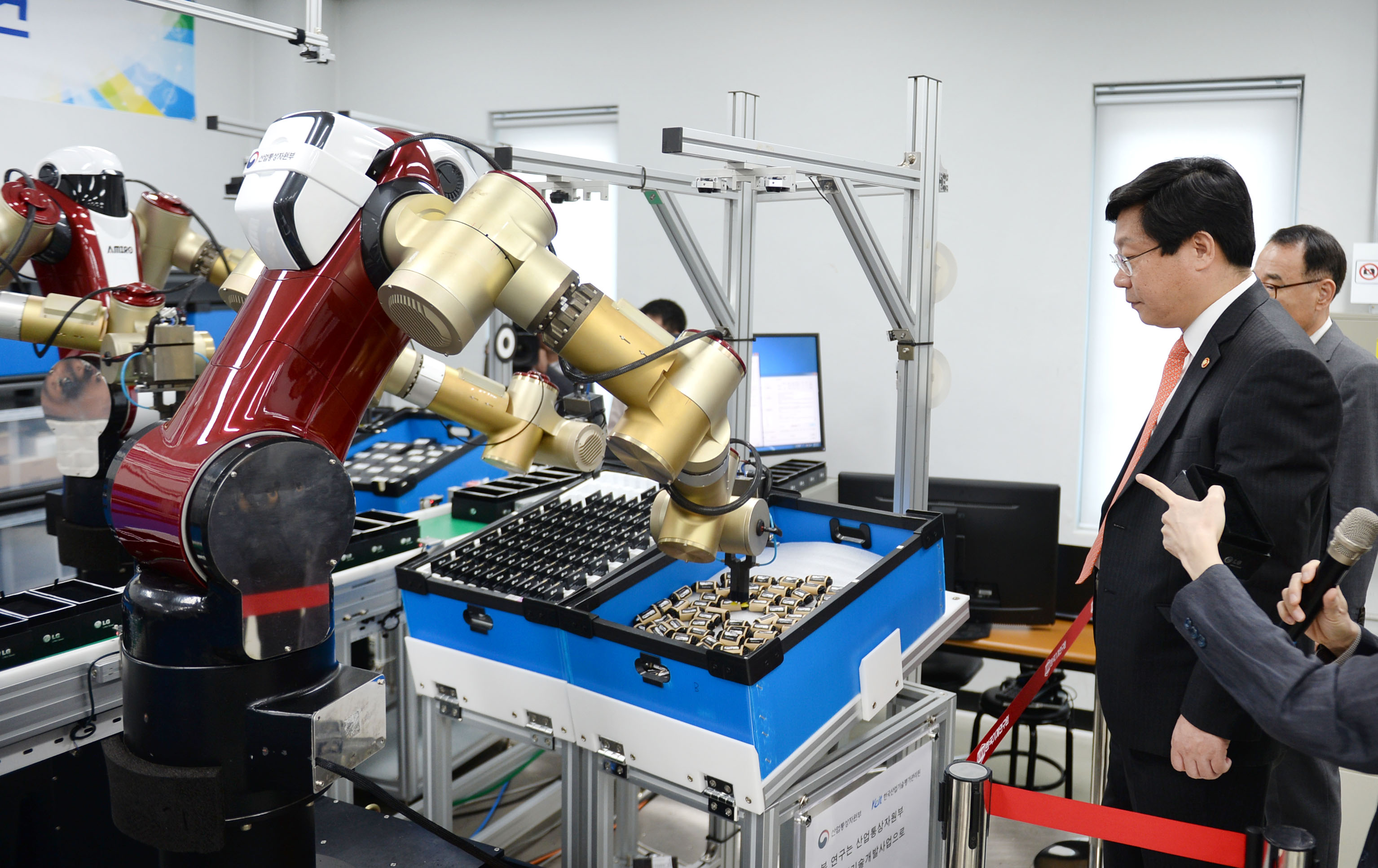
The government has decided to concentrate investment on 12 new industries, including robotics. The photo shows Minister of Trade, Industry and Energy Joo Hyung-hwan observing a demonstration of the Korea Institute of Machinery and Materials' (KIMM) dual-arm robot prototype, the first of its kind developed in Korea, and Eugene Robot's unmanned transport robot at the laboratory in Building 14 of the KIMM in Daejeon last October.
Attention is also drawn to the second key area, 'accelerating industrial restructuring and responding to the Fourth Industrial Revolution.' The Ministry of Trade, Industry and Energy has decided to promote 'rapid restructuring' in sectors such as shipbuilding, steel, and petrochemicals, and to actively support the industry's efforts for 'preemptive business reorganization and manufacturing innovation' through the utilization of the Corporate Vitality Act and the expansion of smart factory adoption.
In particular, to create future growth engines centered on 12 new industries, the public and private sectors will jointly invest 17 trillion won to strengthen four types of policy support, including regulatory improvements, intensive support, the establishment of convergence platforms, and the creation of initial markets. The 12 new industries include electric and autonomous vehicles, smart and eco-friendly ships, IoT home appliances, aviation and drones, robots, biohealth, and premium consumer goods (system industries), as well as advanced new materials, AR and VR, next-generation semiconductors, and next-generation displays (materials and components industries), and new energy industries.
Looking at this in detail, in the regulatory improvement sector, the plan is to expand the scope of 'negative regulatory review' to all 12 new industries, and in the intensive support sector, to expand R&D (from 3.3 to 3.7 trillion won), operate a 1 trillion won 4th Industrial Revolution Leading Fund (tentative name), and cultivate 6,500 creative talents through corporate-led industry-academia cooperation (30,000 by 2021).
To create an initial market, it was decided to utilize the PyeongChang Winter Olympics as a testbed and showcase for electric vehicles (300 units), hydrogen vehicles (25 units), and advanced service robots (50 units). For electric and autonomous vehicles and IoT home appliances, measures established last year will be further refined and continuously supplemented, while new strategies for next-generation semiconductors, distribution, and 3D printing will be formulated within the first half of this year. The plan is to create representative success stories for the 12 new industries early on through concentrated support, such as institutional improvements and incentives, for the rapidly growing new energy sector.
The third core area is "establishing a growth ladder for small and medium-sized enterprises (SMEs) and middle-sized companies, and revitalizing micro-enterprises and traditional markets." To this end, customized support tailored to the characteristics of each business stage will be strengthened to "establish a growth ladder for SMEs and middle-sized companies." Furthermore, comprehensive support including funding, infrastructure development, consulting, and education will be provided to "enhance the self-reliance of micro-enterprises, traditional markets, and small shopping districts."
The final key area is 'securing energy safety and stable supply' through measures such as strengthening the seismic performance of nuclear power plants and investing 15.6 trillion won in public enterprises for energy safety. It was decided to build a future-oriented energy supply system by significantly strengthening the safety standards of 'energy facilities,' such as nuclear power plants, and by establishing a foundation for eco-friendly energy supply and demand and improving the system.
Minister Joo Hyung-hwan stated, “Although domestic and international conditions are difficult, the Ministry of Trade, Industry and Energy will push forward with the four core sectors without wavering, with the attitude of ‘opening a path when encountering a mountain and building a bridge when encountering water.’”
Comments
Related news
Where is the concentrated R&D investment being spent until 2022?
The government has announced the Technology Roadmap 2022 (draft), which adds the top 10 ICT R&D technology sectors, recent core sectors, and artificial intelligence sectors. The announced Technology Roadmap 2022 (draft) includes 10 strategic industries such as 5G and intelligent information technology from the K-ICT strategy, as well as three next-generation leading industries including convergence displays. Additionally, recently emerging sectors such as artificial intelligence and intelligent semiconductors, as well as cross-industry diffusion sectors (ICT convergence) and smart factory technology based on ICT in Manufacturing Innovation 3.0, will receive concentrated R&D investments. To strengthen the interconnection between science, technology, and ICT selected by the Ministry of Science and ICT, and to develop new industries, the 10 major ICT R&D technologies include ▲convergence services ▲mobile communications ▲networks ▲broadcasting/smart media ▲radio frequency and satellite ▲foundational SW computing ▲software ▲digital content ▲information security ▲ICT devices. The budget for the comprehensive R&D implementation plan in the ICT sector is 984.6 billion won, which represents a 6.1% decrease compared to 1 trillion 48.3 billion won in 2015.
2016.07.18by 신윤오 기자
[Reporter's Notebook] Regulatory Improvements 'Boldly' Like Autonomous Vehicle Test Runs
What will Korea's industrial economy look like in 2017? In a situation where international conditions and economic circumstances are rapidly changing day by day, it is not easy to foresee even a step ahead. Next year is no exception. While Korea's key industries such as computers, displays, and wireless communication devices are facing difficulties, China is rapidly catching up or has already surpassed Korea in an increasing number of industries. What is concerning is the reality that the industries being fostered as new growth engines for the future are also losing competitiveness compared to advanced countries.
2016.12.12by 신윤오 기자
From semiconductors and sensors to artificial intelligence, the counterattack of 'IoT appliances' has begun
The intelligent home appliance industry, which plays a leading role in smart home or home IoT, is expected to expand in earnest in the new year. The global smart home market is anticipated to grow from $60 billion in 2015 to $133.6 billion in 2020, with IoT home appliances expected to grow from $5.2 billion in 2015 to $34 billion in 2020, representing an average annual growth rate of 48%. Last year, the domestic smart home market size was estimated at 10 trillion won, with IoT home appliances accounting for 3.3 trillion won.
2016.12.26by 신윤오 기자
Nvidia invests $5 billion in Intel
NVIDIA and Intel, leaders in global AI computing technology, are now forging ahead in providing cutting-edge solutions through NVLink-based architecture integration. NVIDIA and Intel have officially announced a strategic partnership and stated that they will jointly develop customized data center and personal computing products to accelerate diverse applications and workloads ranging from hyperscale to enterprise and consumer markets, thereby laying the foundation for the next generation computing era.
2025.09.22by 배종인 기자
.jpg)
Applied Materials Launches Environmental Protection Campaign to Mark World Cleanup Day
Applied Materials Korea (CEO Park Kwang-seon) is carrying out environmental cleanup activities with employees and their families around the Dongtan Sinricheon area on the occasion of World Cleanup Day, evolving into a company that engages with the local community beyond technological innovation.
2025.09.22by 명세환 기자











