

.png)

LG Uplus and Korea Electric Power Corporation Join Forces to Lead Smart Factory Deployment
 Published2017.01.06 11:22
Target Deployment of Over 2,000 Clean Energy Smart Factories
LG Uplus and Korea Electric Power Corporation announced they will jointly promote projects to improve energy efficiency and expand load management for energy-intensive factories and buildings.
To advance this joint initiative, Vice Chairman Kwon Young-soo of LG Uplus and President Cho Hwan-ik of Korea Electric Power Corporation signed a "Memorandum of Understanding (MOU) on Business Cooperation for Energy New Industry Investment Cooperation" with attendance by Minister of Trade, Industry and Energy Joo Hyung-hwan.
The two companies plan to combine core competencies and technologies that each company possesses in the smart grid energy management and ICT-based energy reduction fields to lead energy savings and greenhouse gas reduction.
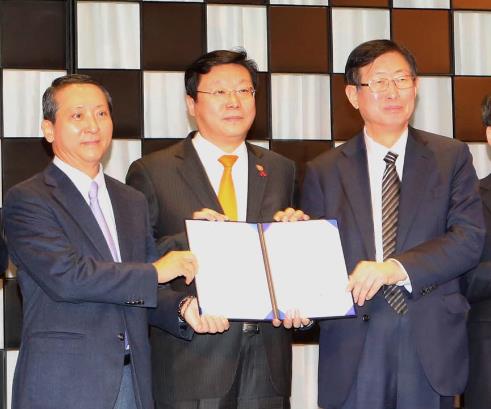
▲ After MOU signing, Vice Chairman Kwon Young-soo of LG Uplus, Minister Joo Hyung-hwan of the Ministry of Trade, Industry and Energy, and President Cho Hwan-ik of Korea Electric Power Corporation (from left)
By combining LG Uplus's ICT-based energy reduction solutions and communication solutions with Korea Electric Power Corporation's smart energy management system (FEMS/BEMS, Factory/Building Energy Management System), they plan to ▲actively promote energy efficiency improvement and load management projects for factories and buildings ▲provide information on energy efficiency improvement projects and jointly develop business models ▲operate working-level consultation meetings with participation from operational personnel on a monthly basis.
Anticipated 20% Energy Reduction and Over 3.1 Million Tons of Greenhouse Gas Reduction
The two companies said they aim to deploy over 2,000 clean energy smart factories in the future. Through this, a 20% energy reduction and reduction of over 3.1 million tons of greenhouse gas are expected, and the reduced greenhouse gas will be converted into greenhouse gas emission credits to support customers' utilization. When implementing the smart energy management system in factories or buildings, the installation costs will be provided as advance investment by both companies, and customers will pay back through energy cost savings over 4 to 5 years.
Additionally, factories and buildings implementing this system can monitor energy consumption, peak trends and operating status, and efficiency by floor/zone, production line, and major equipment in real-time, identify waste factors in a timely manner and improve them, making it expected to achieve significant cost savings and productivity improvements.
Related news
LG Uplus and Seoul Metropolitan Government Partner for "Energy Self-Sufficient City, Seoul"
LG Uplus and the Seoul Metropolitan Government announced that they have signed a Memorandum of Understanding (MOU) regarding "energy efficiency and social contribution cooperation" on the 2nd at Seoul City Hall, attended by LG Uplus Vice Chairman Kwon Young-soo and Seoul Mayor Park Won-soon.
2016.02.02by
LG Uplus and Korea Energy Agency Promote Energy Conservation Culture by Raising Awareness of Energy-Saving Ripple Effects
LG Uplus and the Chungbuk Regional Headquarters of the Korea Energy Agency announced on the 10th that they have signed a Memorandum of Understanding (MOU) to collaborate on joint energy conservation projects utilizing IoT (Internet of Things) technology.
2016.03.10by 명세환 기자
LG Uplus Sees Surge in Popularity of 'IoT Energy Meters' Due to Progressive Electricity Tax
With the continued heat wave this summer, cases of soaring electricity bills have increased, and subscriptions to IoT energy meters that provide real-time and monthly estimated electricity charges have surged significantly. LG Uplus announced on the 24th that due to the ongoing heat wave, public interest in electricity charges has increased nationwide, and August sales of its energy management service 'IoT Energy Meter' increased approximately 2.5 times compared to July. Subscriptions to the IoT Energy Meter increased 237% in August (as of 8/22) compared to July. At the current rate of increase, the subscriber growth trend by the end of August is expected to exceed approximately 4 times compared to the previous month. As of July, the cumulative number of IoT Energy Meter subscribers stands at approximately 12,000 households.
2016.08.25by 홍보라 기자
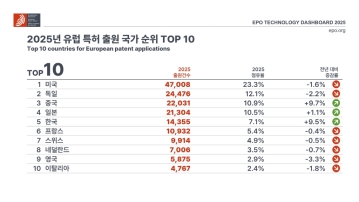
European Patent Applications Surpass 200,000 for the First Time… South Korea Maintains 5th Place, Led by Batteries and Telecommunications
According to the European Patent Office (EPO)'s 'Technology Dashboard 2025', European patent applications last year reached 201,974, surpassing 200,000 for the first time. Korean companies and inventors filed 14,355 applications, representing a 9.5% increase from the previous year and maintaining 5th place by country. Battery, digital communication, and semiconductor technologies led the growth, with Samsung ranking as the top EPO applicant for the second consecutive year and LG reaching 3rd place. The presence of major domestic cities such as Seoul, Suwon, and Yongin was also confirmed. It was also revealed that Korea's European patent strategy is expanding beyond individual technologies to span the entire industry.
2026.03.24by 명세환 기자
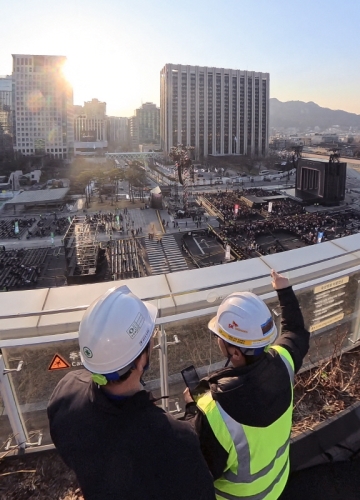
SK Telecom First Applies AI-Based Network Operations at Gwanghwamun K-Pop Concert
SK Telecom announced that it applied an AI-based network operation system for the first time at a large-scale K-pop concert held in the Gwanghwamun area of Seoul on March 21st, managing communication quality throughout the event. Mobile data usage during the three hours before and after the concert reached 12.15TB, approximately doubling compared to the same time slot the previous weekend. SK Telecom monitored traffic using the AI system 'A-One' in five-minute and 50-meter units to respond to potential overload situations, while also operating temporary communication facilities and on-site personnel in parallel. This case is interpreted as confirmation of the practical applicability of AI-based autonomous network operation in an environment where demand from dense events and foreign users increases simultaneously.
2026.03.23by 명세환 기자











