



Systems supporting data analysis generated from IoT and cloud environments will continue to increase
 Published2017.01.09 17:30
Tableau Software (hereinafter "Tableau") has released a report on the "Top 10 Big Data Trends for 2017," which forecasts major analysis and solution trends in the big data field for 2017 based on an analysis of the big data industry this year.
Through this report, Tableau forecasts that systems supporting analysis of all types of data formats generated from Internet of Things (IoT) and cloud environments will continue to increase. In particular, as enterprises increasingly adopt machine learning and smart systems, it analyzed that demand for self-service tools that enhance end-user accessibility to this data will increase.
Additionally, it is anticipated that self-service tools will emerge that can reduce the time and complexity required for data preparation, enabling business users to process various data types and formats on Hadoop.
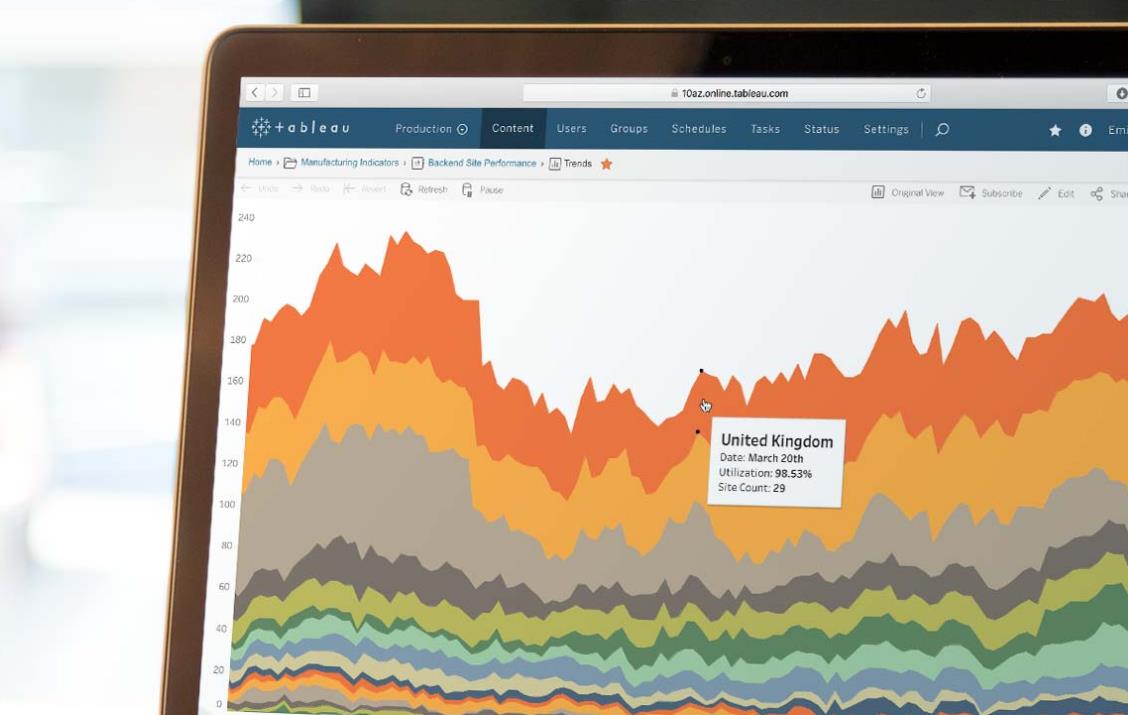
▲Tableau Software homepage.
According to the report, business users are identifying fast interactive SQL on Hadoop as a key element not only for faster and iterative KPI dashboard analysis but also for exploratory analysis. As a result, options such as databases for improving Hadoop speed, query acceleration technologies, SQL, and OLAP will continue to expand in the future. However, the data currently required for exploratory analysis in enterprises is dispersed across diverse environments ranging from Hadoop to record systems and cloud warehouses. Consequently, BI solutions isolated to Hadoop alone are predicted to evolve into platforms that are not restricted by data or sources.
The biggest reason companies invest in big data is the diversity of big data
Enterprises cite the diversity of big data as the primary reason for investing in big data, and this trend will be further reinforced as enterprises focus on analyzing various types of big data. Additionally, it is predicted that development of models and applications that process petabyte (PB)-level data for interactive applications or real-time stream processing will increase.
Accordingly, the capability of analytical platforms that provide live connections to heterogeneous data sources becomes important, and industry attention will focus on self-service analytics technologies that enhance accessibility to large volumes of real-time data. Moreover, increasingly large amounts of IoT device data are being provided to cloud services and stored in various database systems. Self-service analytics tools that support exploration and visualization of diverse data sources will increase enterprises' investment opportunities in the IoT field.
Agile self-service data preparation tools are improving business users' accessibility to Hadoop data. These tools are lowering the barriers to entry for enterprises that have adopted Hadoop late or are latecomers, and their use is expected to continue for easy and fast data exploration in the future.
Hadoop is establishing itself as a core component of the enterprise IT environment, and enterprises' investments in security and governance related to enterprise systems are expected to increase in the future while adoption barriers continuously diminish. Additionally, due to increasing demand for self-service exploration among enterprises seeking to find and understand data with analytical value, self-service analytics will expand further in the future.
Related news

SAS Korea Expects Expanding Supply of SAS Big Data Analytics Solutions to New Markets
SAS Korea, a business analytics company represented by Cho Sung-sik, announced that it has signed its first domestic reseller agreement with Koolong Benית on the 25th for big data analytics business collaboration. SAS Korea plans to leverage Koolong Benית's nationwide sales network and IT service organization to supply SAS business solutions including ▲SAS Visual Analytics ▲SAS Text Analytics ▲SAS Event Stream Processing to new markets related to big data analytics businesses.
2016.05.25by 명세환 기자
[ICT R&D In-depth Look] ⑩Rapidly Expanding Big Data, Core SW Technology Competitiveness Remaining Stagnant
SW-computing technology that provides large-scale, high-performance, real-time, and intelligent functions as a platform, commonly required for explosive growth in computing devices and data and hyperconnected smart services, is attracting attention. SW-computing technology includes four core areas: big data, cloud computing, computing systems, and artificial intelligence technology. Performance improvements of systems through SW technology innovation are being attempted, and with changes in the ICT paradigm, future SW computing technology is also developing in forms of convergence and intelligence.
2016.10.04by 홍보라 기자
Big Data Investment Increases, But Signs of Slowing Growth Appear
According to a recent survey released by Gartner Inc., while the scale of big data investments continues to increase, signs of contraction are also emerging. Gartner reported that 48% of surveyed companies (a 3% increase compared to the previous year) increased their big data sector investments in 2016. However, the percentage of companies that responded they plan to invest within the next two years fell to 25%, down 6% compared to 2015.
2016.10.07by 홍보라 기자
.jpg)
SalePoint Signs Multi-Year Partnership Agreement with AWS… Promoting Identity Security that Integrates Even AI Agents
Sailpoint has entered into a multi-year strategic partnership agreement with AWS and is moving forward with establishing an integrated governance system that manages both human and non-human identities together. The plan is to consistently manage access permissions in an environment where AI agents are increasing as work execution entities, while applying the principle of least privilege and automated policy enforcement. The two companies plan to jointly expand capabilities to manage the identities of various entities, including AI agents, within a single layer in the AWS environment. This collaboration is interpreted as a move to design security and governance together in corporate environments where AI adoption is expanding.
2026.03.26by 배종인 기자
.png)
Databricks Unveils Open AI Security Monitoring 'Lakewatch'
Databricks entered the security market on March 24 by unveiling LakeWatch, an open-source agentic SIEM. The core functionality of this product is to integrate and analyze security, IT, and business data in a single environment to support AI-based threat detection and investigation. The company explained that it reduces the limitations of existing security operations centers, which have had to forgo some data due to high cost structures, and enables large-scale data analysis and automation based on open formats and ecosystems. LakeWatch is currently offered as a private preview, with Adobe and Dropbox mentioned as early customers. Databricks also announced an expanded partnership with Anthropic as well as the acquisition of Antimatter and SiftD.ai.
2026.03.26by 배종인 기자











