


ams Launches Cost-Effective Compact Multispectral Sensor-on-Chip
 Published2017.01.17 10:50
ams has announced the launch of a cost-effective multispectral sensor-on-chip solution.
The ultra-low-power AS7262 visible range sensor and AS7263 NIR sensor, offered in a compact 4.5 x 4.4mm form factor in LGA package, each provide 6 calibrated spectral channels. Key solution areas include material and product authentication, product quality and integrity, as well as substance content analysis in the NIR (near-infrared) and visible light spectrums.
This multispectral sensor utilizes a new manufacturing technology that directly mounts nano-optical interference filters onto a CMOS silicon chip. The interference filter technology used in the sensor exhibits excellent precision and demonstrates stable characteristics against temporal and temperature variations. Additionally, it is smaller in size and more cost-effective compared to components commonly used in recent spectral analysis equipment.
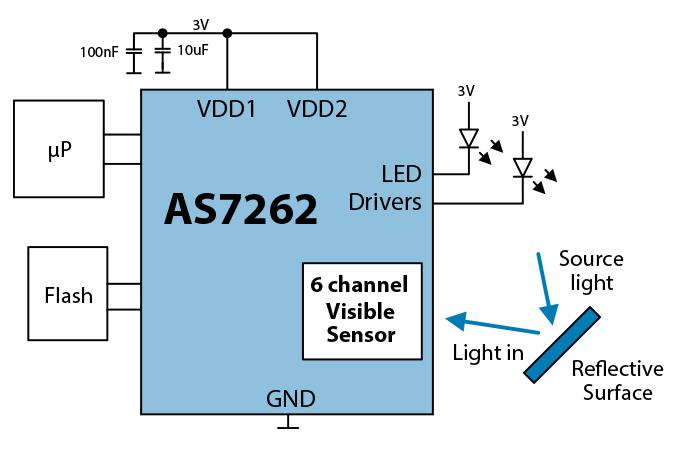
▲ AS7262 Block Diagram
The AS7262, a 6-channel visible light sensor with integrated intelligence functions, provides calibrated digital output through I2C or UART interface. This product measures light intensity at 6 wavelengths (450nm, 500nm, 550nm, 570nm, 600nm and 650nm) in the visible light spectrum. The AS7263 operates in the NIR spectrum, detecting infrared signals at 610nm, 680nm, 730nm, 760nm, 810nm, and 860nm.
Both devices include LED driving circuits and electronic shutters. The multispectral sensor enables measurement equipment manufacturers to leverage these differentiated advantages to develop new product forms.
Jean Francois Durix, Marketing Director for Emerging Sensor Systems at ams, stated: "Through our new spectral sensing solution, which significantly reduces not only size but also the cost of spectral analysis, capabilities that were previously only possible in laboratory settings can now be realized in actual sample products across a wide range of applications, from food safety and product authentication to routine testing."
Related news

ams Launches High-Precision Relative Humidity and Temperature Sensor IC Suitable for Portable Products
ams (Korea Representative Director Lee Jong-deok) has announced the development of ENS210, a single-die sensor IC. This product provides highly accurate and pre-calibrated measurement results for relative humidity and ambient temperature. ENS210 will be unveiled for the first time at the Electronica trade show held in Munich, Germany from November 8 to 11, 2016.
2016.11.09by 신윤오 기자

ams announces evaluation kit with built-in relative humidity and temperature sensors
ams (Korea Representative Director Jong-deok Lee) announced the introduction of two new evaluation kits designed for engineers who want to integrate compact, low-power IAQ (Indoor Air Quality) monitoring circuits into portable devices such as smartphones and wearables, or home/building automation devices such as thermostats and IP cameras. The CCS811-LG_EK_ST kit includes two environmental sensors from ams. The CCS811 gas sensor System-on-Chip (SSoC) detects volatile organic compounds (VOC) in indoor environments using low-power sensor technology. The CCS801-DF_EK_ST kit uses a CCS801 VOC gas sensor and an external MCU instead of the CCS811. The ENS210 is a relative humidity and temperature sensor IC, characterized by very high accuracy.
2016.11.15by 신윤오 기자

ams Announces High-Performance Analog Ultra-Low Noise CMOS Process Technology
ams (Korean Representative Director Jong-deok Lee) has announced "A30," a high-performance analog ultra-low noise CMOS process technology. The new A30 process delivers outstanding ultra-low noise performance and achieves a 0.9x optical shrink compared to ams's advanced 0.35μm high-voltage CMOS process product line.
2016.12.06by 신윤오 기자

Intel Unveils Next-Generation 'Core Ultra Series 3' and vPro Platform for Enterprise PCs
Intel has officially unveiled the "Intel Core Ultra Series 3" for next-generation enterprise PCs and the latest vPro platform, addressing a wide range of demands from enterprise notebooks to high-performance workstations.
2026.03.26by 배종인 기자

ROHM Launches ESD Protection Diode Compatible with High-Speed Interfaces of 10Gbps or Higher
Semiconductor specialist ROHM has developed the 'RESDxVx series' of ESD (electrostatic discharge) protection diodes capable of responding to next-generation high-speed data communication environments exceeding 10Gbps, simultaneously enhancing both signal quality maintenance required in high-speed interfaces and IC protection performance.
2026.03.26by 배종인 기자











