


Telit Focuses on NB-IoT Meter Reading Services and Automotive Market
 Published2017.02.06 16:40
Telit, a specialist in IoT (Internet of Things) modules and platform services, has presented a strategy to strengthen its presence in the IoT market.
Kim Hee-chul, General Manager of Telit's Korea Sales Division, stated, "Recently, mobile carriers are building nationwide NB-IoT networks and preparing for commercialization, so Telit is also developing NB-IoT modules based on various chipset solutions," and added, "Accordingly, we will pursue a win-win strategy that drives business growth by targeting gas, water, and electricity meter reading services and vehicle management fields, which are suitable for long-distance object communication with low power consumption."
Telit has presented its domestic market investment strategy, which includes launching LTE Cat 1 SKT modules, developing modules in preparation for NB-IoT (narrowband IoT) commercialization, and strengthening automotive business models. The company has announced plans to strengthen the remote meter reading (AMI) and fleet management (logistics management for ships, automobiles, and aviation) markets this year.
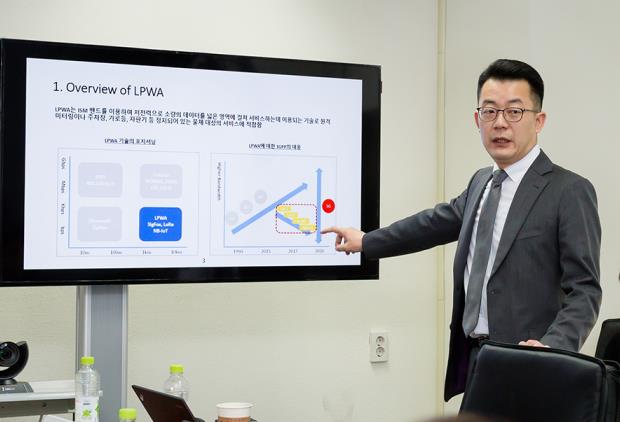
▲Kim Hee-chul, General Manager of Telit's Korea Sales Division
Telit obtained SK Telecom network interoperability certification for its LTE communication module LE910 in 2014. Recently, the LTE Cat 1 module 'LE866A1-KK' passed KT's network interoperability quality test (QAT), a communication network quality test for performance and stability, and is also preparing to complete SKT certification for LTE Cat 1 modules in the first half of 2017.
Additionally, after establishing the Automotive Business Division in 2014, Telit has built close cooperative relationships with domestic and international automobile manufacturers and has been supplying automotive-dedicated modules. In line with industry trends, continuous development and investment are planned to strengthen new business models. This year, the company is focusing on autonomous driving, eCall (automatic emergency call), and telematics (wireless internet technology for vehicles) and is targeting twofold growth compared to 2016.
Telit plans to drive IoT market expansion through cooperation with telecommunications carriers. In particular, the Korean subsidiary has an R&D center and expects mutual business growth by providing technical support to small and medium-sized development companies.
Comments
Related news
Global IoT spending to grow at an annual average of 15.6% through 2020, with China and the U.S. accounting for more than half.
According to a recent research report from IDC, an IT market analysis firm, global IoT spending reached $737 billion last year, representing 17.9% growth compared to the previous year, as investments in Internet of Things (IoT)-related hardware, software, services, and connectivity increased. Furthermore, the report (Worldwide Semiannual Internet of Things Spending Guide) indicates that global IoT spending is projected to reach $1.29 trillion by 2020, showing a compound annual growth rate (CAGR) of 15.6% during the 2015-2020 forecast period.
2017.01.16by 김수지 기자
LoRa semiconductors for IoT-exclusive networks launched successively, will endpoint devices expand?
Following the establishment of a LoRa network base dedicated to IoT centered on SK Telecom last year, as dedicated devices are spreading, interest in key semiconductor solutions is growing. STMicroelectronics (hereinafter ST) announced that it successfully demonstrated the world's first real-time, multi-target location tracking demo using the LoRaWAN LPWAN protocol together with IoT solution companies myDevices and Senet at CES 2017, which concluded on the 9th.
2017.01.16by 신윤오 기자
This year's video surveillance market continues to grow together with IoT trends
Quantum announced its 2017 video surveillance market outlook on the 17th. Quantum forecasts that the 2017 video surveillance market will continue to grow with not only security but also increases in distribution and traffic management applications, along with IoT trends. HIS projects that video surveillance-related data in 2017 will generate approximately 6,000PB of data capacity, and that by 2019, 3.3 trillion hours of surveillance video will be captured daily. Video data will see increased long-term retention due to growing demand for various advanced analytics including evidence adoption in law enforcement and analysis of retail customer purchase trends.
2017.01.17by 김지혜 기자
This year's government R&D will focus on investing in AI, IoT, and other areas to prepare for the Fourth Industrial Revolution.
The Ministry of Science, ICT and Future Planning and the Ministry of Trade, Industry and Energy held a briefing to announce their confirmed R&D investment strategy for this year. The Ministry of Science, ICT and Future Planning projects that the global ICT market will grow 2.9% this year, with software and IT services expected to grow centered on advanced and emerging countries. In particular, ICBM sectors such as IoT, cloud, and big data are expected to achieve high growth for two consecutive years due to expanded market demand. According to market research organizations, IoT is projected to increase 35.1%, cloud 18.2%, big data 32.6%, and mobile is expected to grow with smartphones and tablets at 6.1% and 3.2% respectively.
2017.01.23by 신윤오 기자

[Technical Contribution] Caltera: "Evolution of Precision Sensing, UWB Infrastructure Enhances Parking Safety"
Discussing new possibilities in parking assistance and precision sensing with UWB, Lee Sang-min, Korea Branch Manager at Caltera.
2026.10.23by 편집부











