

.png)

The global tablet market is declining, but the domestic market increased 20% year-over-year—why?
 Published2017.02.27 12:57
Continued tablet adoption as a language and private education learning support device
Why is the domestic tablet market growing contrary to the global market trend?
According to recent research from Korea IDC (CEO Hong Yoo-sook), 2016 tablet shipments in the domestic market reached 2.393 million units, a 19.6% increase compared to 2.001 million units in the previous year. This contrasts with the global tablet market, which declined 15.6% from 207 million units in 2015 to 175 million units in 2016, drawing attention to the factors behind the sustained growth of the domestic tablet market.
The domestic tablet market has solidified its purpose and formed a key segment by maximizing learning effectiveness through tablets in the specialized private education market. While slate tablets are losing market relevance in the global market, in Korea, tablet-linked educational methods that began to be introduced in the latter half of 2014 were formally adopted starting in 2015, expanding consumption across various learning fields.

▲LG Electronics' 'G Pad III 10.1 FHD LTE' launched in December
The analysis indicates that the creation of strong demand through audiovisual content and advanced and expanded educational methods, which implement optimal learning environments, allow learners to acquire educational benefits, and significantly improve consumer perception through word-of-mouth and promotion, continued in 2016.
Beyond the education market, diverse examples of tablets being utilized to enhance operational efficiency have recently emerged in the financial, manufacturing, and service sectors. Tablets can be conveniently used at customer touchpoints, enable cost savings and environmental protection through paperless operations, and prevent unauthorized disclosure and loss of customer information, leading to integration and application across various business areas. In fact, enterprise tablet shipments outside the education sector have been steadily increasing, reaching 11% of the total tablet market in 2016.

▲Domestic tablet shipments, 2014-2016 (thousand units)
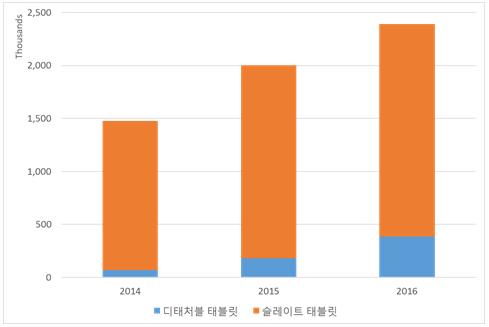
▲Domestic slate tablet and detachable tablet shipments, 2016 (thousand units)
Meanwhile, traditional PC and smartphone manufacturers are also expanding their product portfolios and introducing detachable tablets with removable keyboards in addition to slate tablets. In 2016, domestic detachable tablet shipments reached 387,000 units, more than doubling year-over-year and capturing 16.2% of the total tablet market. Detachable tablets are being compared in price and performance to convertible notebooks and even ultraslim notebooks, with market expansion underway.
Recent advances in OS and hardware have enabled tablets to perform identical tasks to PCs while providing superior mobility, differentiating them on these fronts. In 2017, consumers' options are expected to expand with an even greater variety of products.
Kim Ae-ri, Senior Research Manager at Korea IDC, stated, "The domestic tablet market has currently established its identity through specialization in the education market and is leading the sector, but in the future, tablets are expected to converge with other devices and combine with industry and personal solutions emerging from IoT, AI, and AR/VR, with their usability being re-established within an integrated ecosystem."
Related news

A tablet equipped with LTE communication capabilities that enables multimedia learning anytime, anywhere
LG Electronics will launch the 'G Pad Ⅲ 10.1 FHD LTE' on the 19th, featuring LTE communication capabilities and an enlarged screen to enhance multimedia learning functions. This product maintains the advantages of the 'G Pad Ⅲ 8.0' (8-inch), which is optimized for multimedia education including online lectures and reading, while adding LTE communication functionality to enable internet access anytime and anywhere.
2016.12.18by 신윤오 기자

LG Uplus Exclusively Launches 10.1-Inch Large-Screen Tablet
LG U+ will exclusively launch the 'G Pad Ⅲ 10.1 FHD LTE (LG-P755L)', a tablet in the 400,000-won range, on the 24th. The G Pad Ⅲ LTE is equipped with a 10.1-inch Full HD IPS display, allowing users to view videos and text in large, clear quality. Additionally, with a 16:10 aspect ratio, users can watch videos without any cropped portions.
2017.01.24by 김지혜 기자
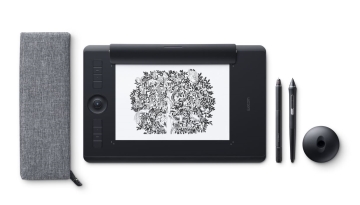
Wacom Korea Launches Creative Pen Tablet that Transcends Paper and Tablets
Wacom will officially launch the Wacom Intuos Pro, a new creative pen tablet that supports pen and touch, and the Wacom Intuos Pro Paper Edition, which supports both paper and digital work simultaneously. The next-generation Intuos Pro series is a creative pen tablet that provides features for 2D/3D artists, designers, photographers, and other professionals. It features a slimmer, more compact design compared to its predecessor and is equipped with the Pro Pen 2, which delivers 4 times higher pressure sensitivity and precision. It also supports 8 Express Keys, touch ring, and multi-touch functionality.
2017.02.20by 서아람 기자
.jpg)
SalePoint Signs Multi-Year Partnership Agreement with AWS… Promoting Identity Security that Integrates Even AI Agents
Sailpoint has entered into a multi-year strategic partnership agreement with AWS and is moving forward with establishing an integrated governance system that manages both human and non-human identities together. The plan is to consistently manage access permissions in an environment where AI agents are increasing as work execution entities, while applying the principle of least privilege and automated policy enforcement. The two companies plan to jointly expand capabilities to manage the identities of various entities, including AI agents, within a single layer in the AWS environment. This collaboration is interpreted as a move to design security and governance together in corporate environments where AI adoption is expanding.
2026.03.26by 배종인 기자
.png)
Databricks Unveils Open AI Security Monitoring 'Lakewatch'
Databricks entered the security market on March 24 by unveiling LakeWatch, an open-source agentic SIEM. The core functionality of this product is to integrate and analyze security, IT, and business data in a single environment to support AI-based threat detection and investigation. The company explained that it reduces the limitations of existing security operations centers, which have had to forgo some data due to high cost structures, and enables large-scale data analysis and automation based on open formats and ecosystems. LakeWatch is currently offered as a private preview, with Adobe and Dropbox mentioned as early customers. Databricks also announced an expanded partnership with Anthropic as well as the acquisition of Antimatter and SiftD.ai.
2026.03.26by 배종인 기자











