



LG Uplus and Nokia Develop 'Wireless Backhaul Base Station'
 Published2017.03.02 12:10
Plans to Apply to Commercial Networks Upon Completion of Performance Verification
LG Uplus and Nokia jointly developed the 'Wireless BackHole Node,' a key 5G equipment, and unveiled it at MWC 2017.
This equipment relays radio waves by bypassing obstacles to ensure seamless data reception when users are far from the 5G base station or when radio signals are blocked by obstacles such as buildings during the transmission of UHD videos and other content from 5G base stations to smartphones.
The wireless backhaul base station not only amplifies radio signals but also restores attenuated signals during transmission to their original state and transmits them, extending the coverage range and improving data transmission rates.
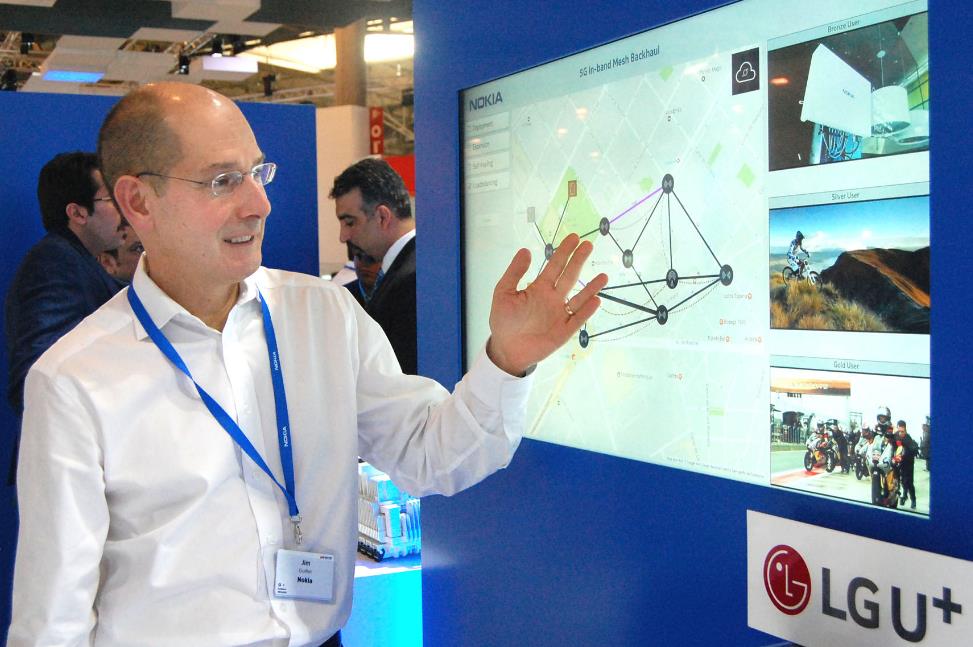
▲A Nokia employee explaining the functions of the wireless backhaul base station equipment jointly developed by LG Uplus and Nokia at the Nokia booth at MWC in Barcelona, Spain
Additionally, since radio signals are transmitted from other base stations, no separate wired cables are required, reducing construction costs. Compared to LTE base stations, it is lighter in weight and smaller in size, making it easy to install on traffic signals or telephone poles.
Meanwhile, Nokia unveiled the wireless backhaul equipment at the MWC event in Barcelona, Spain. LG Uplus plans to consider applying the equipment to commercial networks according to the 5G service schedule once performance verification is completed.
Park Song-chul, Senior Executive of LG Uplus's Network Technology Group, stated, "LTE base stations are built so densely nationwide and repeater prices are inexpensive, so the necessity for developing wireless backhaul equipment has not been high until now. However, with the advent of the 5G era, the utilization of this equipment, which enables efficient coverage acquisition, is expected to increase significantly."
Related news
LGU+ Holds Business Briefing Ahead of NB-IoT Commercialization
LG U+ held a business briefing session at its Yongsan headquarters on the 21st in advance of the commercialization of NB-IoT (NarrowBand-Internet of Things). The briefing was held for the purpose of enhancing business comprehension among partners through sharing of business promotion strategies and partner support plans, and to facilitate early establishment of the related ecosystem and market.
2017.02.22by 김지혜 기자
LG Uplus Launches IoT Multi-tap Controllable via App
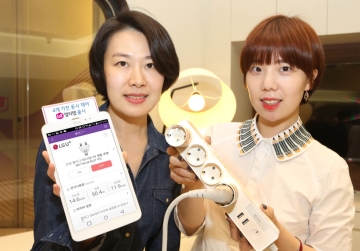
LG U+ is launching an IoT multi-outlet that enables users to control home appliance power via smartphone and cut standby power consumption without unplugging the plug. The product supports 3,520 watts, allowing simultaneous connection and use of various home appliances, and features two USB charging ports in addition to four outlet sockets, enabling smartphone charging as well.
2017.02.23by 서아람 기자
LG Uplus to Install Home IoT Systems in 10,000 Airline Co-op Apartments
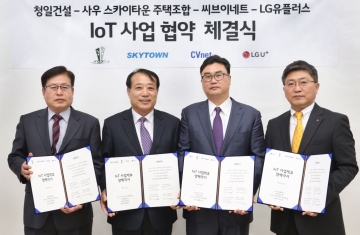
LG U+ Home IoT System to be Installed in Airline Employee Cooperative Apartment LG U+ announced on the 27th that it will establish a Home IoT system in 10,000 units of apartments being constructed and supplied by SkyTown Housing Cooperative, which is primarily composed of airline and airport corporation employees, in Gimpo-si, Gyeonggi Province. LG U+ signed a business agreement with Cheongil Construction, SkyTown Housing Cooperative, and CV Net, a home network system developer. The company plans to first supply the Home IoT system to 3,857 units including 1,600 units across 16 buildings of Gimpo Sau SkyTown located in Sau-dong and Gamjeong-dong in Gimpo-si, and 2,257 units of 'Gimpo Hangang SkyTown'. Subsequently, LG U+'s IoT system will be established in an additional approximately 6,100 units including 'Incheon Bullo SkyTown' to be constructed in this area.
2017.02.27by 서아람 기자
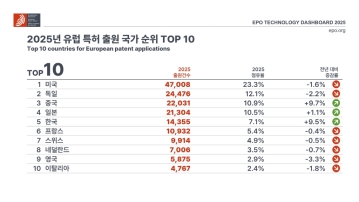
European Patent Applications Surpass 200,000 for the First Time… South Korea Maintains 5th Place, Led by Batteries and Telecommunications
According to the European Patent Office (EPO)'s 'Technology Dashboard 2025', European patent applications last year reached 201,974, surpassing 200,000 for the first time. Korean companies and inventors filed 14,355 applications, representing a 9.5% increase from the previous year and maintaining 5th place by country. Battery, digital communication, and semiconductor technologies led the growth, with Samsung ranking as the top EPO applicant for the second consecutive year and LG reaching 3rd place. The presence of major domestic cities such as Seoul, Suwon, and Yongin was also confirmed. It was also revealed that Korea's European patent strategy is expanding beyond individual technologies to span the entire industry.
2026.03.24by 명세환 기자

SK Telecom First Applies AI-Based Network Operations at Gwanghwamun K-Pop Concert
SK Telecom announced that it applied an AI-based network operation system for the first time at a large-scale K-pop concert held in the Gwanghwamun area of Seoul on March 21st, managing communication quality throughout the event. Mobile data usage during the three hours before and after the concert reached 12.15TB, approximately doubling compared to the same time slot the previous weekend. SK Telecom monitored traffic using the AI system 'A-One' in five-minute and 50-meter units to respond to potential overload situations, while also operating temporary communication facilities and on-site personnel in parallel. This case is interpreted as confirmation of the practical applicability of AI-based autonomous network operation in an environment where demand from dense events and foreign users increases simultaneously.
2026.03.23by 명세환 기자











