


[Reporter's Notebook] THAAD and Korean Startups' Survival in China
 Published2017.03.06 18:16
I'm beginning this 'Reporter's Notebook' with a title that sounds somewhat like a dry academic paper.
At a panel discussion of a 'Global Startup Forum' held last week, the moderator posed such a question to a China expert.
The China expert was cautious about it too. And no wonder—the question wasn't about THAAD's (Terminal High Altitude Area Defense) impact on the Korean economy, or its effects on Korean Wave culture, or even its influence on the international political landscape. Rather, it was about the relationship between THAAD and Korean startups' entry into the Chinese market.
Predicting the relationship between the international situation related to THAAD and the survival of domestic startups in China is not a simple matter. However, despite this difficulty in forecasting, it is undoubtedly an important issue. The undeniable fact is that for domestic startups, the Chinese market is clearly a large and attractive market. This becomes even more crucial if success in overseas expansion determines the success or failure of the business itself.
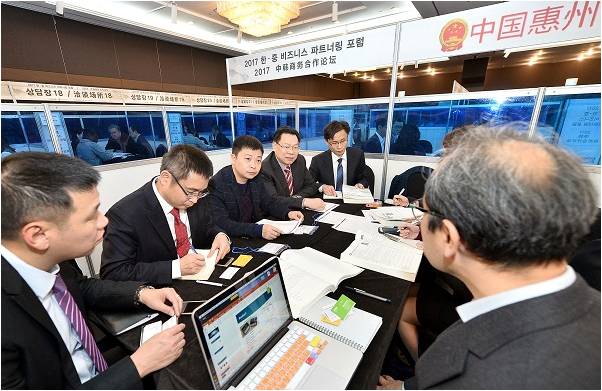
▲KOTRA (President Kim Jae-hong) hosted a '1:1 Partnering Consultation Meeting' on the 23rd of last month at The K Hotel Seoul in Yangjae-dong, inviting Chinese venture capital and promising technology partnership companies to secure business opportunities through Chinese market entry of promising domestic startups and Korea-China technology cooperation.
The 'Korea-China Startup Business Partnering Forum' held by KOTRA last month was a session that well illustrated this situation. Designed to support Korean startups in attracting Chinese VC investment, the event brought together 32 promising Chinese investors and companies seeking technology cooperation, 51 domestic startups, and 48 technology researchers, during which over 200 in-depth consultations proceeded on topics including technology transfer, joint research, product exports, and startup market entry.
From the event content alone, you can see how many factors domestic startups must consider when entering the Chinese market. The companies that participated in the 'Global Startup Forum' and the panelists in the discussion did not deviate from such topics either.
Haebora (CEO Shin Du-sik), a startup that entered China with 'ear-speaking earsets,' also could not help but challenge this 'continent' with growth potential and market appeal. Jang Hae-jin, Haebora's China operation head, emphasized that the most important factor in entering the Chinese market is 'finding a local partner company,' and without this, a small startup finds it difficult to survive. "It took a full two years to develop and upgrade products at a local factory, and remarkably, the Chinese company's representative waited for it. During that period, establishing a trust relationship with the Chinese company's representative became the foundation."
The startup Miro is expanding into the Chinese market with a washable IoT humidifier. Miro entered China only after completing analysis of regions and weather conditions requiring humidifiers, as well as competitor product analysis. Regarding the initial problem encountered, Cho Hong-kyung, division head, recalled that it was the trademark 'Miro.' "There was a registered trademark for a company with the same Chinese character marking, so we had to change the characters. To enter China, it's necessary to secure trademark rights first," and he pointed out that China is a country where provisional attachment requests for unused trademarks are not accepted.
Additionally, when establishing a distribution strategy, he noted that if a Korean company goes through the route of Korean distribution representative introduction → Chinese distributor → Chinese sales company, it becomes complicated and tariffs are added, so the method of going directly from the Korean corporation to the Chinese sales corporation should be chosen. This means that local corporation establishment is absolutely necessary for direct investment. For this, he said it's necessary to find regions that provide guidance on capital investment procedures, corporation establishment period, various tax benefits, and land support.
The panelists who appeared in the discussion also shared their accumulated advice. Lee Mi-kyung, executive managing director of global business at LeRobot, said "viewing China as a single country is the biggest mistake," and in response, Kim Sun-il, director of Winners Lab, explained, "China is not a single market. There exist multiple markets with diverse races and varied commercial sectors. You must first understand which commercial sector and which part of the Chinese market to target."
When attracting Chinese investment, you must also verify whether Chinese investors' capital is located overseas
Regarding investment attraction, Cho Kyu-hun, deputy director of the China division at SBI Venture Investment, noted, "If Korea has 126 venture capital firms, China has 10,000. Because there is a market and investors exist in that country, foreign companies pursue the Chinese market." He also stated, "In the past, Chinese investors would invest based solely on business plans, but circumstances have changed now, and moreover, due to the THAAD issue, everything is at a standstill. Chinese capital cannot flow out, so when attracting Chinese investment, you must also verify whether the Chinese investor's capital is located overseas."
Regarding interest in technology-related areas, Jang Sun, KOTRA specialist member (China crowdfunding), analyzed, "Although we often invite Chinese investors, their response was better to proprietary technologies such as high-tech, biotech, and robotics, rather than technologies where Chinese companies are already more advanced, such as VR and AR."
There was also a common statement made by participants at the end of their remarks. In a word, 'don't rush.' Jang Hae-jin, Haebora's China operation head, said, "When startups come to China, they lack capital, so they want to resolve things quickly, but like the saying 'tap even stone bridges before crossing,' they must be cautious." Kim Hee-chan, CEO of JD Sound, pointed out, "Until now, we've managed to get here by flying blind, but in the Chinese market, don't be impatient and have patience—you need to look at least three years ahead." Kim Sun-il, director of Winners Lab, also stated, "Chinese investors watch startups' evolving services. They watch products that, even if somewhat unstable, can quickly adapt through improvement. You can't approach it like Korean companies do, trying to finish everything at once."
Oh right, I haven't yet answered the question about what impact THAAD will have on Korean startups trying to enter China. Han Woo-deok, director of the Joongang Ilbo China Research Institute, said, "In the process of the THAAD issue, China's trust has been greatly damaged, so restoring it to previous levels won't be easy." However, he continued, "but it is certain that now we must prepare anew for the future. Despite many problems so far, both countries share the recognition that economic damage must be prevented. Companies that prepare for a relationship where mutual cooperation is possible will be able to grow significantly even after the THAAD crisis." What do you think?
Related news
What are the promising technologies for the future and business items advantageous for SMEs?
The Korea Institute of Science and Technology Information (KISTI), which has been announcing promising future technologies every year, unveiled technology sectors that will transform the coming future this year as well. KISTI also presented promising commercialization items that will open new opportunities for small and medium-sized enterprises and startup companies. The ten promising future technologies selected this time include ▲bioprinting ▲synthetic cell technology ▲body augmentation technology ▲medical virtual reality application technology ▲soft wearable technology ▲lightweight materials technology for automobiles ▲industrial internet ▲visible light-based next-generation communication technology (Li-Fi) ▲intelligent cyber security ▲chameleon environment-responsive materials, and others.
2016.09.19by 신윤오 기자
Globally Competitive Korean Startups Recognized at CES
The Ministry of Science, ICT and Future Planning (Minister Choi Yang-hee) announced that four domestic startups—Kremotech, Mango Slab Co., Ltd., Soltied Venture Co., Ltd., and Neofect—received 'Innovation Awards' at CES 2017. CES, which marks its 50th anniversary this year, will host approximately 3,800 companies from over 150 countries with thousands of products on display. Among these, a total of 446 products across 28 categories will receive 'Innovation Awards.' Additionally, 35 products have been selected for the 'Best of Innovations' award, which is presented only to the highest-scoring product in each category.
2017.01.05by 홍보라 기자
What are the government's proactive startup policies?
The Ministry of Science, ICT and Future Planning (hereinafter referred to as the Ministry) held a government business report meeting on future growth engine sectors on January 6th and announced the '2017 Ministry Work Implementation Plan.' To strengthen the startup ecosystem, the Ministry plans to establish 'customized specialized projects' that reflect regional demand and promote technology transfer from regional universities and government-funded research institutes. Additionally, the Ministry announced plans to diversify investment methods, provide close support to promising and venture companies, promote public technology-based businesses, and operate an 'Overseas Investor Support Center' to expand overseas contact points.
2017.02.21by 김지혜 기자
Nvidia invests $5 billion in Intel
NVIDIA and Intel, leaders in global AI computing technology, are now forging ahead in providing cutting-edge solutions through NVLink-based architecture integration. NVIDIA and Intel have officially announced a strategic partnership and stated that they will jointly develop customized data center and personal computing products to accelerate diverse applications and workloads ranging from hyperscale to enterprise and consumer markets, thereby laying the foundation for the next generation computing era.
2025.09.22by 배종인 기자
.jpg)
Applied Materials Launches Environmental Protection Campaign to Mark World Cleanup Day
Applied Materials Korea (CEO Park Kwang-seon) is carrying out environmental cleanup activities with employees and their families around the Dongtan Sinricheon area on the occasion of World Cleanup Day, evolving into a company that engages with the local community beyond technological innovation.
2025.09.22by 명세환 기자











