



ADI Announces Dual Differential Amplifier Offering 10GHz Gain Bandwidth
 Published2017.03.23 17:50
Low Noise and High Bandwidth Suitable for Diverse Applications
Analog Devices (ADI) has announced the LTC6419, a dual 10GHz gain bandwidth differential amplifier product. This product is characterized by very low input voltage noise density of 1.1nV/√Hz, providing excellent SNR performance for wideband signal amplification.
The LTC6419 offers 85dB SFDR (spurious-free dynamic range) at 100MHz with low distortion while driving 2VP-P signals. Four external resistors set the differential gain of each amplifier. The configuration range spans from unity gain with frequency response of 1GHz and above, to 100 gain with 100MHz bandwidth, and up to maximum 400 gain with 30MHz bandwidth.
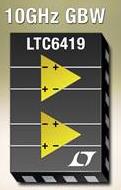
At these high frequencies, the LTC6419 provides significantly improved channel-to-channel isolation of 95dB at 100MHz compared to other similar-class dual amplifiers. Additionally, the wide DC common-mode voltage range (0V to 3.5V at input, 0.5V to 3.5V at output) is particularly useful in DC-coupled applications that interface between two different DC levels, such as from the output of an I/Q demodulator to the input of an AD converter.
The LTC6419 dual differential amplifier provides low noise and high bandwidth functionality, making it suitable for many diverse applications such as direct conversion receivers, high-speed sample rate ADC driving, high-speed data acquisition systems, test equipment, high-resolution radar systems, state-of-the-art image sensors, and LIDAR systems.
The LTC6419 has a supply voltage range of 2.7V to 5.25V. Each amplifier features a shutdown pin, allowing each amplifier to be enabled independently, with supply current consumption of only 52mA. When disabled, the supply current is reduced to 100μA per amplifier.
Related news

ADI Adds Improved Automotive Audio Bus A2B Transceiver Products
Analog Devices (ADI) has launched three automotive audio bus (A2B) transceiver products with enhanced performance. According to ADI, the newly released products are used to distribute audio and control data, clock, and power over a single UTP (unshielded twisted-pair) cable. The AD242x family of A2B transceivers provides versatile slave-to-slave communication capabilities and supports low-speed sampling modes.
2017.02.28by 김지혜 기자

ADI Completes Linear Acquisition, Now All-In on Integration
Analog Devices has received final approval from China's Ministry of Commerce to complete its acquisition of Linear Technology Corporation. The Ministry of Commerce approval represents the final regulatory step for the acquisition, and the companies announced that the acquisition will be completed on March 10.
2017.03.09by 김자영 기자

ADI Launches 28nm CMOS LiDAR Technology Platform
Analog Devices has launched the Drive360™ 28nm CMOS RADAR technology platform, which is built on its ADAS (Advanced Driver Assistance System), MEMS, and RADAR technology portfolio. Analog Devices is the first to provide automotive RADAR technology based on the latest 28nm CMOS process. The Drive360™ RADAR platform delivers best-in-class RF performance for the latest safety and autonomous driving applications. This RF performance is superior to the current class-leading SiGe (silicon germanium) based platform, enabling vehicles to gain time to recognize and avoid small objects at greater distances.
2017.03.21by 김지혜 기자

Intel Unveils Next-Generation 'Core Ultra Series 3' and vPro Platform for Enterprise PCs
Intel has officially unveiled the "Intel Core Ultra Series 3" for next-generation enterprise PCs and the latest vPro platform, addressing a wide range of demands from enterprise notebooks to high-performance workstations.
2026.03.26by 배종인 기자

ROHM Launches ESD Protection Diode Compatible with High-Speed Interfaces of 10Gbps or Higher
Semiconductor specialist ROHM has developed the 'RESDxVx series' of ESD (electrostatic discharge) protection diodes capable of responding to next-generation high-speed data communication environments exceeding 10Gbps, simultaneously enhancing both signal quality maintenance required in high-speed interfaces and IC protection performance.
2026.03.26by 배종인 기자











