



ADI launches two RF engineering learning modules
 Published2017.03.28 11:48
Analog Devices has launched two active learning modules. The ADALM2000 active learning module, used with graphical application software, enables real-time design and testing of analog circuits based on laboratory equipment-level performance. The widely applicable ADALM-PLUTO software-defined radio active learning module helps students learn fundamental concepts in Software-Defined Radio (SDR), radio frequency (RF), and wireless communication, and allows them to conduct experiments using full-duplex individual transmit and receive channels.
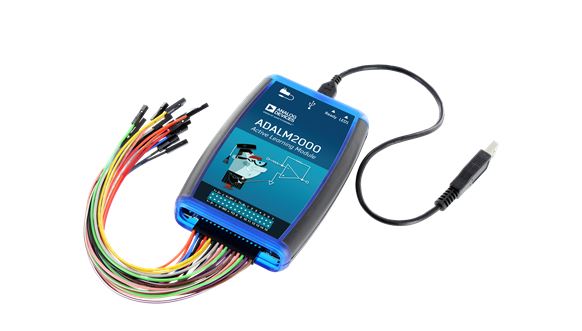
ADALM2000 Active Learning Module
When used with Analog Devices' Scopy graphical application software running on a computer, users can easily access high-performance measurement functions. The measurement functions include DC/AC voltmeter, 30MHz oscilloscope, +/- 5V power supply, 50MHz spectrum analyzer, 30MHz signal generator, 30MHz arbitrary waveform generator, 100MHz logic analyzer, protocol bus analyzer supporting more than 60 different protocols, and 100MHz digital pattern generator.
Scopy, an open-source application, supports all major platforms used by faculty and students including Windows, Linux, and OS X, and provides a plug-in architecture for support of user-developed instruments such as network analyzers.
ADALM-PLUTO Software-Defined Radio Active Learning Module
It helps electrical engineering students encounter practical operating scenarios in SDR, RF, and wireless communications. The individual transmit and receive channels provided by the active learning module operate in full-duplex mode and can generate or collect RF analog signals in the range of 325MHz to 3,800MHz at up to 61.44MSPS. It operates independently and can be powered via USB. Because access is available through the libiio library commonly supported on Windows, Linux, and OS X, students can learn and experience both x86 and ARM. Additionally, beyond communications, it can be used in RF laboratories supporting SDR signal processing or visualization frameworks such as MATLAB, Simulink, and GNU Radio, allowing students to use it without geographical constraints through online education or remote learning.
Alexander Wiglinski, Associate Professor in the Department of Electrical and Computer Engineering at Worcester Polytechnic Institute, stated, "Through ADALM-PLUTO, students were able to rapidly design actual wireless communication systems and perform over-the-air (OTA) experiments in just a few weeks."
Related news

ADI Partners with ARM to Enhance Security for IoT Connected Devices
Analog Devices (ADI) announced plans to launch an ultra-low-power microcontroller (MCU) developed in collaboration with ARM that can enhance security and improve energy efficiency for Internet of Things (IoT)-based devices. As demand for data security in IoT applications increases, ADI stated that it will address these challenges by combining its ultra-low-power mixed-signal technology with ARM's TrustZone technology-based new ARM® Cortex®-M33 processor.
2017.02.07by 김지혜 기자

ADI Adds Improved Automotive Audio Bus A2B Transceiver Products
Analog Devices (ADI) has launched three automotive audio bus (A2B) transceiver products with enhanced performance. According to ADI, the newly released products are used to distribute audio and control data, clock, and power over a single UTP (unshielded twisted-pair) cable. The AD242x family of A2B transceivers provides versatile slave-to-slave communication capabilities and supports low-speed sampling modes.
2017.02.28by 김지혜 기자

ADI Launches 28nm CMOS LiDAR Technology Platform
Analog Devices has launched the Drive360™ 28nm CMOS RADAR technology platform, which is built on its ADAS (Advanced Driver Assistance System), MEMS, and RADAR technology portfolio. Analog Devices is the first to provide automotive RADAR technology based on the latest 28nm CMOS process. The Drive360™ RADAR platform delivers best-in-class RF performance for the latest safety and autonomous driving applications. This RF performance is superior to the current class-leading SiGe (silicon germanium) based platform, enabling vehicles to gain time to recognize and avoid small objects at greater distances.
2017.03.21by 김지혜 기자
.jpg)
SalePoint Signs Multi-Year Partnership Agreement with AWS… Promoting Identity Security that Integrates Even AI Agents
Sailpoint has entered into a multi-year strategic partnership agreement with AWS and is moving forward with establishing an integrated governance system that manages both human and non-human identities together. The plan is to consistently manage access permissions in an environment where AI agents are increasing as work execution entities, while applying the principle of least privilege and automated policy enforcement. The two companies plan to jointly expand capabilities to manage the identities of various entities, including AI agents, within a single layer in the AWS environment. This collaboration is interpreted as a move to design security and governance together in corporate environments where AI adoption is expanding.
2026.03.26by 배종인 기자
.png)
Databricks Unveils Open AI Security Monitoring 'Lakewatch'
Databricks entered the security market on March 24 by unveiling LakeWatch, an open-source agentic SIEM. The core functionality of this product is to integrate and analyze security, IT, and business data in a single environment to support AI-based threat detection and investigation. The company explained that it reduces the limitations of existing security operations centers, which have had to forgo some data due to high cost structures, and enables large-scale data analysis and automation based on open formats and ecosystems. LakeWatch is currently offered as a private preview, with Adobe and Dropbox mentioned as early customers. Databricks also announced an expanded partnership with Anthropic as well as the acquisition of Antimatter and SiftD.ai.
2026.03.26by 배종인 기자











