


The fastest-growing sector in the global big data and analytics market this year is
 Published2017.04.18 15:48
Investments in banking and manufacturing sectors drive market growth and lead digital transformation
The global big data and analytics market is projected to grow by 12.4% year-on-year this year, reaching $150.8 billion.
According to a recent research report by IDC (www.idc.com), this market is also projected to reach $210 billion in 2020, with an expected compound annual growth rate (CAGR) of 11.9% through 2020. This includes BDA-related hardware, software, and services.
Dan Vesset, Vice President and Head of the Analytics and Information Management Research Group at IDC, explained, “By enabling decision support and automation, big data and analytics solutions have captured the attention of senior executives and established themselves in the mainstream,” adding that this field is one of the key drivers leading digital transformation regardless of industry or business processes.
The industries expected to account for a high proportion of investment in big data and analytics solutions in 2017 are banking, assembly manufacturing, process manufacturing, federal/central government, and professional services. These five sectors are projected to invest a total of 72.4 billion rubles in big data and analytics solutions this year, with the total expected to reach 101.5 billion rubles by 2020. The industry expected to show the fastest growth is the banking sector, with an estimated average annual growth rate of 13.3%. Next, the healthcare, insurance, securities and capital investment brokerage, and telecommunications sectors are expected to grow at an average annual rate of 12.8%.
Jessica Goepfert, Program Director leading Customer Insights and Analysis research at IDC, stated, “The three industries comprising the financial services sector—banking, insurance, and securities and investment services—demonstrate great potential for future investments in big data and analytics,” adding that “this technology can be applied to various key use cases for financial institutions, ranging from detecting accounting fraud and risk management to improving and optimizing customer management.”
He added, “There are notable opportunities in several other industries besides financial services,” stating that, for example, in the telecommunications market, big data and analytics are being applied to retain existing customers, attract new ones, and enable the planning and optimization of network capacity. He added that while the media industry has faced a very difficult situation in recent years due to the digitalization of content and large-scale consumption, big data and analysis have made it possible to understand and monitor readers' habits, preferences, and emotional aspects.
IT and business services account for more than half of the total market
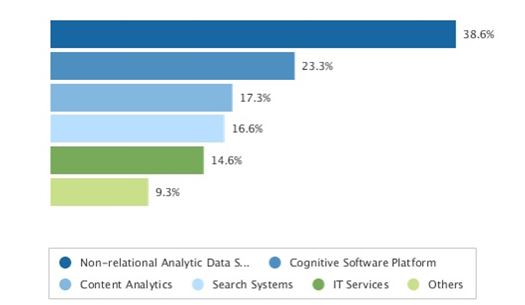
Investments in big data and analytics technologies are expected to be driven by IT and business services, which are projected to account for more than half of the total big data and analytics market during the forecast period starting from 2017. Investments related to services are expected to show the strongest growth, expanding at a compound annual growth rate (CAGR) of 14.4% over the next five years. Investments in the software sector are expected to exceed $70 billion in 2020, driven by the adoption of end-user queries, reporting and analytics tools, and data warehouse management tools. Non-relational analytics data stores and cognitive software platforms are projected to show high growth rates (CAGRs of 38.6% and 23.3%, respectively) as companies expand their big data and analytics activities. Purchases of servers and storage related to big data and analytics are expected to reach $29.6 billion in 2020, with a CAGR of 9.0%.
In terms of company size, large enterprises (with 1,000 or more employees) are expected to account for more than 60% of the total big data and analytics market during the forecast period, with the market projected to surpass $100 billion in 2018. Additionally, small and medium-sized enterprises (with 500 or fewer employees) are also expected to contribute significantly to the growth of this market, accounting for approximately one-quarter of total revenue.
Looking at the regional breakdown, the United States will be the largest market for big data and analytics solutions with an investment of $78.8 billion in 2017. The second largest market is Western Europe, with an expected investment of $34.1 billion this year, followed by the Asia-Pacific region (excluding Japan) with an investment of $13.6 billion. Latin America and the Asia-Pacific region (excluding Japan) are expected to show the fastest growth, with average annual growth rates of 16.2% and 14.4%, respectively.
The domestic Big Data and Analytics (BDA) market grew 9.9% year-on-year.
Meanwhile, the domestic big data and analytics market is projected to grow by 9.9% year-on-year this year, reaching 1.3116 trillion won. Furthermore, the market is expected to reach 1.7619 trillion won by 2020, growing at a compound annual growth rate (CAGR) of 9.4%.
"Do Sang-hyeok, a senior research analyst at IDC Korea, said, 'The domestic big data and analytics market is also expected to see continuous growth.' He added, 'Industries expected to have a high proportion of investment domestically are banking, assembly and process manufacturing, telecommunications, and the public sector. The total investment in big data and analytics solutions by these industries is expected to reach 724.6 billion won this year and 968 billion won in 2020.'"
관련뉴스
[ICT R&D 톺아보기] ⑩급팽창하는 빅데이터, 제자리인 핵심 SW기술 경쟁력
컴퓨팅 기기와 데이터의 폭발적 증대와 초연결 스마트 서비스를 위하여 공통으로 요구되는 대용량, 고성능, 실시간, 지능화 기능을 플랫폼으로 제공하는 SW-컴퓨팅 기술이 주목된다. SW-컴퓨팅 기술에는 4대 핵심분야인 빅데이터, 클라우드컴퓨팅, 컴퓨팅시스템, 인공지능 기술이 포함된다. SW기술 혁신을 통한 시스템의 성능향상이 시도되고 ICT 패러다임의 변화로 미래 SW 컴퓨팅 기술도 융복합화, 지능화 형태로 발전하고 있다.
2016.10.04by 홍보라 기자
Big Data Investment Increases, But Signs of Slowing Growth Appear
가트너(Gartner Inc.)에서 최근 발표한 설문조사 결과에 따르면, 빅데이터(big data) 투자 규모는 계속해서 증가하고 있지만, 위축 징후도 나타나고 있다고 밝혔다. 가트너는 설문에 응답한 전체 기업 중 48%(전년 대비 3% 증가)가 2016년에 빅데이터 부문 투자를 늘린 것으로 나타났다고 밝혔다. 그러나, 향후 2년 내 투자할 계획을 가지고 있다고 응답한 기업은 2015년 대비 6% 하락한 25%로 나타났다.
2016.10.07by 홍보라 기자

[토론 중계]“4차 산업혁명 변혁의 주체는 중소 기업, 디지털 역량과 리더십 역량 갖춰야”
소셜 네트워크, 모바일, 빅데이터, AI 등 새로운 디지털 기술의 발전으로 비즈니스 환경이 바뀌기 시작했다. 이제 기업의 능력은 디지털 기술을 활용하는 능력으로 가늠하기도 한다. 로아컨설팅에서는 '기존의 전통적 제조기업의 비즈니스 방식에서 새로운 가치 획득이 가능한 생태계 중심 플랫폼 비즈니스로 전환되는 현상을 통칭'한다고 정의한 디지털 트랜스포메이션(Digital Transformation)은 4차 산업혁명 시대의 해법으로 제시됐다. 한국정보산업연합회는 지난 24일 코엑스 컨퍼런스룸에서 '제4차 산업혁명, 디지털 트랜스포메이션이 해답이다'라는 주제로 2017년 IT 정책포럼을 개최했다. '디지털 트랜스포메이션 시대에 국내 기업의 역량과 국가의 정책 방향'을 주제로 열린 토론을 지상중계한다.
2017.01.31by 김지혜 기자
[기자 수첩] 빅데이터, 글로벌 플랫폼에 종속되나
내에도 숙박 플랫폼인 ’코자자’, IoT 데이터 플랫폼 ‘앵커스(ankus)’와 같은 플랫폼 업체가 있다. 오픈소스 커뮤니티라고도 불리는 앵커스는 내부에 보유한 센서 데이터와 기타 보유 데이터에 민간에서 공개된 공공데이터를 합산하여 머신러닝에 구현한다. 이와 같은 결과물은 2차 저작물 개발을 원하는 기업에 제공된다. 중소기업은 분석데이터를 통해 과정을 줄이고 총 소요 비용을 줄여 원가절감을 이룰 수 있다. 또한 데이터 재사용으로 총 생산 비용을 낮추기도 한다.
2017.03.27by 김자영 기자
.jpg)
SalePoint Signs Multi-Year Partnership Agreement with AWS… Promoting Identity Security that Integrates Even AI Agents
세일포인트가 AWS와 다년간의 전략적 협력 계약을 체결하고, 인간과 비인간 아이덴티티를 함께 관리하는 통합 거버넌스 체계 구축에 나선다. AI 에이전트가 업무 수행 주체로 늘어나는 환경에서 접근 권한을 일관되게 관리하고, 최소 권한 원칙과 자동화된 정책 집행을 적용하겠다는 구상이다. 양사는 AWS 환경에서 AI 에이전트를 포함한 다양한 주체의 아이덴티티를 하나의 레이어에서 관리하는 기능을 공동 확대할 계획이다. 이번 협력은 AI 도입이 확대되는 기업 환경에서 보안과 거버넌스를 함께 설계하려는 움직임으로 해석된다.
2026.03.26by 배종인 기자











