



System Semiconductor Industry Requires Close Collaboration Between Industry and Academia to Strengthen Competitiveness
 Published2017.06.16 14:53
A venue has been established to discuss the role of system semiconductors in the Fourth Industrial Revolution era and methods for cultivating human resources.
The "3rd System Semiconductor Industry-University Cooperation Forum," organized by the Korea Institute of Industrial Technology Evaluation and Planning (Keit), was held on the 24th at the Palace Hotel in Seoul. This year's third forum also included a technology exchange meeting for SMEs and universities to share manpower training and information.
Ha Sang-tae, head of the System Materials Industrial Technology Division at the Korea Institute of Industrial Technology Evaluation and Planning, opened the event with remarks stating, "The system semiconductor sector has limited market activation and low market share. This is because demand companies prefer overseas companies. Organic cooperation between fabless companies is insufficient, and technological capabilities are concentrated in a small number of products, resulting in limited market activation. To enhance our industrial competitiveness, close cooperation between SMEs/mid-sized companies and universities is necessary."
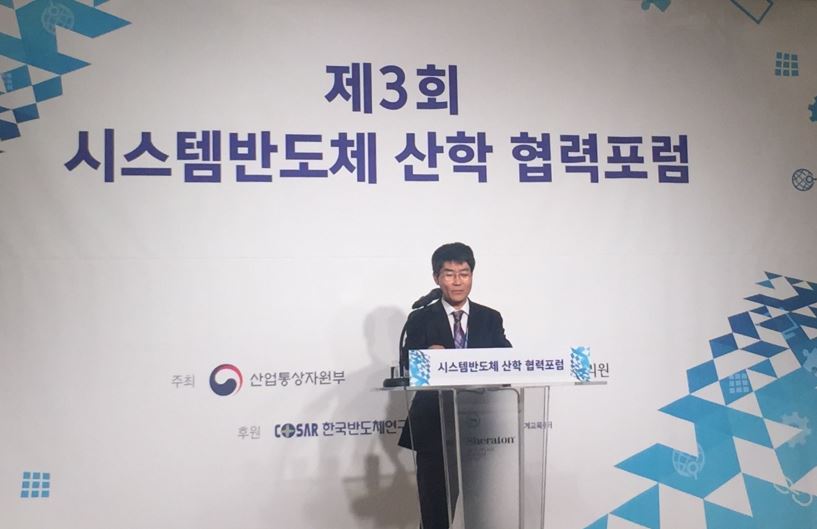
Heo Yeom, CEO of Silicon Meisters, stated, "Now is the time for Korea's fabless industry to undergo new changes. We need small volumes of chips with innovative ideas in new application fields, and fabless companies must play this role. Universities conduct a lot of preliminary research, so we need to create an environment where people can start businesses with ideas. Fabless companies will present technical exchange talks today—if there are good ideas, ask companies for help. We must build the ecosystem together."
Part 1 of the forum proceeded with keynote presentations. Lee Sun-hak, Senior Research Fellow at Hana Daewoo Securities, presented on "The Role of System Semiconductors in the Fourth Industrial Revolution," explaining the necessity of re-developing the fabless industry and the need to strengthen R&D capabilities in related industries through advanced post-process technology. He also explained that large enterprises should expand the scale of the domestic non-memory industry through M&A.
Lee Jong-hwan, professor of System Semiconductor Engineering at Sangmyung University, which accepted its first freshman class this year, stated, "The system semiconductor industry faces a shortage of over 500 personnel annually. By linking with fabless companies and design houses and conducting practice-oriented education, and through convergence between AI, IoT, and SW departments, we will work to cultivate creative talent."
Industry and Academia Exchange Technology and Share Cooperation Plans
Part 2 was held as a technology exchange meeting, divided into analog/power semiconductor fields and smart device/automotive fields. The analog/power semiconductor field included participation from Silicon Meisters, SiliconWorks, Dongwoon Anatech, Iron Devices, Dankook University, and University of Seoul. The smart device/automotive field featured ZINITIX, Silicon Hands, Samyoung S&C, KETI, Hanyang University, and Soongsil University.
Silicon Meisters, a company that manufactures PMICs, has developed products with embedded MCUs. Director Seo Han-su stated, "I believe the area we are working in has bright prospects. What we need is people. We are investing in schools and undertaking projects together to create an environment where students can take interest in the field and work with us," expressing that the company will develop into a specialized power analog company.
SiliconWorks, which possesses system semiconductor technology applied to various displays, also mentioned that the power semiconductor field has low manufacturing costs and enables product development with a small workforce, resulting in low barriers to entry, necessitating differentiated technology and emphasized the importance of cooperation with universities. Dongwoon Anatech introduced autofocus (AF) and optical image stabilization (OIS) IC technology, while Iron Devices presented smart power amplifier technology. Dankook University introduced ESD protection circuit design and high-efficiency DC/DC converter design technology for mobile applications, and University of Seoul explained analog semiconductor technology under development. All six companies and universities presented models where industry and academia could collaborate together.
Kim Gyeong-gyu, Executive Director of ZINITIX, stated, "Starting as an MCU manufacturer, we currently provide touch ICs for smartphones, home appliance groups, fintech product groups, and automobiles," introducing related cases. Jung Se-jin, CEO of Silicon Hands, presented ROIC technology for CMOS sensors, noting, "Recently, infrared sensor cameras are being considered as auxiliary means in medical and automotive applications," emphasizing the importance of sensors that detect even minute changes.
RF Field IP Technology Highlighted as IoT Demand Grows
In the automotive sector, Jo Hee-young, PD at the Korea Institute of Industrial Technology Evaluation and Planning, presented trends in domestic and international electric vehicles, while Lee Sung-soo, professor at Soongsil University, presented on Intra-Vehicle Networking technology and component development. Jo Hee-young, PD, noted, "Competition in battery development for domestic and international electric vehicles is intense," pointing out that the domestic production ratio for electric vehicle components such as batteries, motors, and inverters is lower compared to foreign countries.
Meanwhile, the event also held "Research IP Discovering 2017" focusing on RF field IP, which has become increasingly important as IoT market demand has grown recently.
Professor Lee Sang-guk from KAIST presented high-sensitivity ultra-low-power transceiver technology for IoT applications, while Professor Shin Hyun-chul from Kwangwoon University presented RF transceiver and Fractional-N frequency synthesizer technology. Additionally, Professor Hwang In-chul from Kangwon National University introduced "advanced RF all-digital design and analog IP in the ultra-sub-micrometer era," and Professor Choi Jae-hyuk from UNIST presented ultra-low noise high-frequency clock generator technology, while Professor Lee Kang-yoon from Sungkyunkwan University discussed "sub-gigahertz low-power RF transceiver."
관련뉴스
MCU Market Tectonic Shift, NXP Semiconductors No. 1… Samsung Surges
According to IC Insights, NXP Semiconductor, which acquired Freescale, has captured the number one position in the global MCU market share. According to data released by IC Insights, NXP Semiconductor recorded $2.914 billion in 2016, representing a 116% increase compared to 2015 ($1.35 billion). Renesas, which took second place, recorded $2.458 billion, down 4% from the previous year, while Microchip recorded $2.027 billion, showing a 50% increase from the previous year.
2017.05.04by 신윤오 기자
Semiconductor Industry Association Seeks Talent at Universities, Not Fairs
The Korea Semiconductor Industry Association will conduct a "Semiconductor Excellence Companies University Visit Roadshow" to reach undergraduate students and master's and doctoral students majoring in semiconductors at universities. This campus recruiting program has been designed to address labor shortages at semiconductor companies, facilitate the recruitment of master's and doctoral-level semiconductor professionals, and improve awareness of the semiconductor industry among youth. Despite being a representative national industry, there have been voices from the industry that semiconductor workforce supply and demand are not smooth. This is because talent tends to concentrate at a few large companies such as Samsung Electronics and SK Hynix. Additionally, while recruitment itself is challenging, approximately 39% of new hires leave within one year after joining, so the need for a more careful approach in the hiring process is increasing to minimize hiring mismatches. Rather than meeting job seekers at exhibitions, the Korea Semiconductor Industry Association will visit universities (and graduate schools) together with excellent small and medium-sized semiconductor companies. The Association will hold meetings with semiconductor companies, semiconductor department faculty advisors, and master's and doctoral students, and will embark on full-fledged industry-academia exchange. Nam Ki-man, Standing Vice President of the Korea Semiconductor Industry Association, said, "Samsung Electronics and SK Hynix are not the entirety of South Korea's semiconductors
2017.05.16by 김자영 기자
Promising semiconductor companies gain investment opportunities.
Promising domestic semiconductor mid-sized companies, ventures, startups, and mid-market enterprises will gather with investors in one place. The Korea Semiconductor Industry Association (Chairman Park Sung-wook) announced that it will host the "2017 Semiconductor IR Conference" on the 30th at the Financial Investment Education Institute in Yeouido, Seoul, together with 20 domestic semiconductor companies (10 unlisted companies, 1 KONEX-listed company, 9 listed companies) to discover blue chips in the era of the Fourth Industrial Revolution. The Semiconductor IR Conference has been prepared to inform investors of the participating companies' potential capabilities and to build networks and facilitate communication with investors. Major attendees include venture capitals (VC), investors in new technologies, private equity funds (PEF), accelerators, fund managers, and analysts. Semiconductors are showing a trend where growth potential is becoming increasingly prominent with the full-fledged arrival of the Fourth Industrial Revolution era. This is because in the Fourth Industrial Revolution era, which is centered on IoT (Internet of Things), autonomous vehicles, and AI (Artificial Intelligence), the production of diverse system semiconductors is essential. System semiconductors are a field requiring advanced semiconductor design technology capabilities. Therefore, significant progress by mid-sized companies, ventures, and startups is expected in fields such as semiconductor design, materials, components, equipment, sensors, and embedded software.
2017.05.29by 김지혜 기자

Intel Unveils Next-Generation 'Core Ultra Series 3' and vPro Platform for Enterprise PCs
Intel has officially unveiled the "Intel Core Ultra Series 3" for next-generation enterprise PCs and the latest vPro platform, addressing a wide range of demands from enterprise notebooks to high-performance workstations.
2026.03.26by 배종인 기자

ROHM Launches ESD Protection Diode Compatible with High-Speed Interfaces of 10Gbps or Higher
Semiconductor specialist ROHM has developed the 'RESDxVx series' of ESD (electrostatic discharge) protection diodes capable of responding to next-generation high-speed data communication environments exceeding 10Gbps, simultaneously enhancing both signal quality maintenance required in high-speed interfaces and IC protection performance.
2026.03.26by 배종인 기자











