



NVIDIA Selected as U.S. Department of Energy HPC Research Fund Recipient
 Published2017.06.19 16:34
NVIDIA announced that it has been selected as one of the recipients of funding from the U.S. Department of Energy's Exascale Computing Project (ECP), which was established to promote the development of next-generation supercomputers.
Through this project, a total of six companies, including NVIDIA, were awarded a total of $258 million (approximately 290 billion KRW) in high-performance computing (HPC) research funding.
ECP aims to implement at least two exascale computing systems and plans to implement at least one by 2021. Such a system is expected to provide performance approximately 50 times more powerful than the current Titan at Oak Ridge National Laboratory in the United States.

The ECP PathForward program aims to develop solutions that maximize the energy efficiency and overall performance of future large-scale supercomputers that will play a role in fields such as national security, manufacturing, industrial competitiveness, and energy research.
NVIDIA plans to focus R&D on key areas such as energy-efficient GPU architecture and resilience, and the research results will be incorporated into the next-generation architecture following Volta. Meanwhile, Volta is scheduled to be used for the Department of Energy's flagship supercomputers, Summit and Sierra, which will begin operation in 2018.
The U.S. Department of Energy has made supercomputer research a top priority. The Department’s PassForward technology requirements state: “The United States faces urgent and severe challenges to the economy, environment, and national security due to increasing energy, climate, and security threats. High-performance computing is essential for addressing these challenges, and the development of exascale computers with sufficient performance to solve these problems is required.”
Comments
Related news
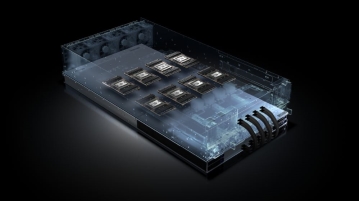
NVIDIA Announces AI Cloud Computing Collaboration Program with Server Manufacturer
NVIDIA announced the NVIDIA HGX Partner Program, a partner program with global ODM vendors, at Computex, a technology exhibition held in Taiwan. Through this new partner program, designed to respond more rapidly to demand in artificial intelligence cloud computing, NVIDIA plans to conduct close collaboration with Foxconn, Inventec, Quanta, and Wistron. First, NVIDIA plans to pre-disclose the NVIDIA HGX reference architecture, NVIDIA GPU computing technology, and design guidelines to each ODM vendor. The HGX is the same datacenter design used in Microsoft's "Project Olympus," Facebook's "Big Basin" system, and NVIDIA's DGX-1 artificial intelligence supercomputer. As overall demand for artificial intelligence computing resources increased rapidly last year, the performance and market adoption of NVIDIA's GPU computing platform also increased sharply. Currently, all of the top 10 global hyperscale companies are utilizing NVIDIA GPU accelerators in their datacenters.
2017.05.31by 김자영 기자
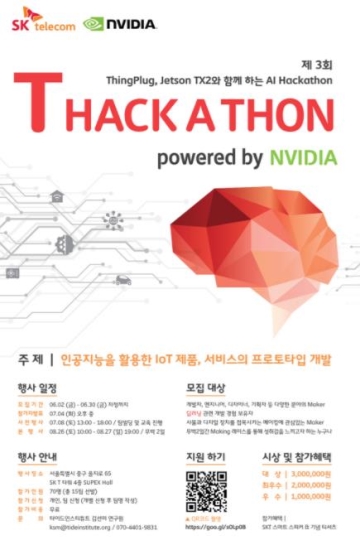
SKT-NVIDIA to Host 'T Hackathon' for Artificial Intelligence Ecosystem
SK Telecom will hold the '3rd T Hackathon (Hack-A-Thon)' competition on August 26-27 together with NVIDIA to revitalize the domestic artificial intelligence ecosystem. This year's 'T Hackathon,' marking the third edition since 2015, has its most distinctive feature in expanding the theme from existing IoT to artificial intelligence. In this competition, participants will compete in developing innovative ideas and prototypes that combine artificial intelligence and IoT by utilizing SK Telecom's 'T API (Application Programming Interface)' and IoT platform 'ThingPlug'. Participants will be provided with NVIDIA's 'Jetson TX2'. The 'Jetson TX2' is a compact supercomputer board developed by NVIDIA and is essential equipment for developing artificial intelligence-based services such as Deep Learning.
2017.06.02by 김지혜 기자
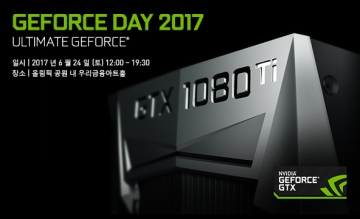
NVIDIA Holds 'GeForce Day 2017', Diverse Events Prepared Again This Year
NVIDIA announced that it will hold "NVIDIA GEFORCE DAY 2017" at Woori Finance Art Hall within Olympic Park in Songpa-gu, Seoul on June 24th. NVIDIA GEFORCE DAY is held annually to share immersive and thrilling gaming experiences through NVIDIA GeForce graphics cards with domestic game users. To commemorate this event, NVIDIA plans to present a variety of online pre-promotion campaigns along with abundant on-site programs where gamers can participate and engage enjoyably.
2017.06.15by 신윤오 기자
.jpg)
SalePoint Signs Multi-Year Partnership Agreement with AWS… Promoting Identity Security that Integrates Even AI Agents
Sailpoint has entered into a multi-year strategic partnership agreement with AWS and is moving forward with establishing an integrated governance system that manages both human and non-human identities together. The plan is to consistently manage access permissions in an environment where AI agents are increasing as work execution entities, while applying the principle of least privilege and automated policy enforcement. The two companies plan to jointly expand capabilities to manage the identities of various entities, including AI agents, within a single layer in the AWS environment. This collaboration is interpreted as a move to design security and governance together in corporate environments where AI adoption is expanding.
2026.03.26by 배종인 기자
.png)
Databricks Unveils Open AI Security Monitoring 'Lakewatch'
Databricks entered the security market on March 24 by unveiling LakeWatch, an open-source agentic SIEM. The core functionality of this product is to integrate and analyze security, IT, and business data in a single environment to support AI-based threat detection and investigation. The company explained that it reduces the limitations of existing security operations centers, which have had to forgo some data due to high cost structures, and enables large-scale data analysis and automation based on open formats and ecosystems. LakeWatch is currently offered as a private preview, with Adobe and Dropbox mentioned as early customers. Databricks also announced an expanded partnership with Anthropic as well as the acquisition of Antimatter and SiftD.ai.
2026.03.26by 배종인 기자











