


[Interview] "How to Select the Best ADC for Your Application"
 Published2017.07.10 15:07
Low SNR and Voltage Reference Must Be Considered…ADC Front-End Design is Critical
Is an ADC a good product just because it has high resolution and fast sampling speed? And if the price is also cheap, can we call it the most ideal ADC?
Park Sun-hwa, Manager of Field Application Engineering at Analog Devices (ADI), says "not necessarily." "Rather than pinpointing just one condition as ideal, the best ADC is the one that fits the application you're designing."
For example, it works like this. Depending on what signal you detect—light, sound, video, etc.—the sensor differs, and according to the type of signal, the sensor stage used before the ADC also changes. What's important in a sensor is sensitivity and dynamic range. If the sound you're trying to detect is sometimes loud and sometimes quiet, the detection range must be wide.
Accordingly, if the signal sent from the sensor doesn't match the acceptable range of the ADC, you've made the wrong choice. But does that mean having a wider acceptable range is always better? On this point, Manager Park says definitively, "that's not the case."

From a cost perspective, three factors must be considered: how precise it needs to be, how fast it needs to be, and what dynamic range is required. According to the Nyquist sampling theorem, which states "for signals with limited bandwidth frequency, if sampling is performed at more than twice the maximum frequency of the analog signal, the reconstructed digital signal can faithfully reproduce the original signal," speed need only be more than twice the required rate, not necessarily as fast as possible. Generally, speeds are divided into high-speed and low-speed based on a 10 Mbps benchmark.
While the input dynamic range of the converter itself varies by application, if the waveform is large, there are limits to processing speed. Converters that handle high-speed applications have a fixed peak-to-peak voltage difference of 2V.
To evaluate precision, bit resolution must be considered. This is a matter of how many codes represent a single point in one cycle of a sine wave of an analog signal, and as the number of bits increases, resolution improves. This means the output is closer to the original signal.
While it varies by application, when asked what conditions are basically ideal for an ADC, Manager Park states, "if we exclude speed and input dynamic range since these can be selected, it's best to have ideal static performance. ADC is fundamentally a device whose performance changes depending on noise," and "from a system noise perspective, the ADC's signal-to-noise ratio (SNR) must be lower than the noise in the system without exception."
He added that voltage reference must be considered for proper ADC operation. Voltage reference is the maximum range value of all signals expressed by the converter. For example, if you want to improve bit resolution, you must lower the voltage reference. However, if you lower the voltage reference indefinitely, the converter's acceptable signal range itself becomes narrower, so caution is required.
Manager Park stated, "the capabilities of an ADC are limited. From a cost perspective, investing heavily in the ADC is not necessarily a good approach. Efficiency varies depending on how you design the front-end stage before the ADC."
Related news

[Interview] Accurate Data Collection Depends on Which ADC You Choose
As the importance of data grows, engineers face increasingly difficult decisions when selecting ADCs (analog-to-digital converters). This is because ADCs, which are essential components in electronic devices across various industries and fields, significantly impact speed and precision. Engineers must carefully evaluate multiple types of ADCs and products from specific manufacturers, considering resolution, precision, speed, and response to environmental changes. Currently, the most widely used ADCs are SAR (successive approximation register) ADCs and delta-sigma ADCs. SAR ADCs offer fast speed but have the disadvantage of lower resolution at around 10-12 bits, whereas delta-sigma ADCs reduce errors through oversampling and provide an average resolution of 24 bits, though they are noted for their slower sampling speed. For example, as the importance of more precise digital multimeters (DMMs) increases in factory automation and robot development, the role of ADCs becomes more critical. In such cases, it is appropriate to use delta-sigma ADCs with high precision and signal-to-noise ratio (SNR) performance.
2017.05.16by 김자영 기자
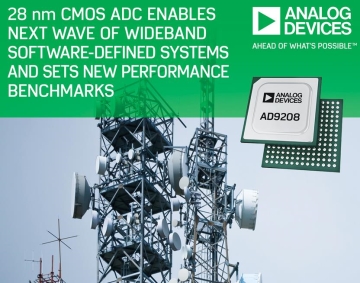
ADI Responds Communication Base Station Requirements with 28-nanometer CMOS ADC
Analog Devices has newly launched the AD9208, a high-speed ADC product family. Designed for applications utilizing the gigahertz band, this new product was developed to meet the spectral efficiency requirements of 4G/5G multi-band wireless communication base stations. Using this new product can shorten the target execution time for manufacturing measurement instruments compliant with multiple standards, and can further enhance the detection range and sensitivity of defense electronic devices. Based on 28-nanometer CMOS technology, the AD9208 delivers industry-leading bandwidth and dynamic range to process the maximum number of signal bands. Additionally, while providing low-noise spectral density suitable for diversity ratio and I/O demodulation systems, power consumption is only half that of other solutions.
2017.06.22by 김지혜 기자

[Interview] “Significantly reducing size and power loss with high-speed ADC adopting RF sampling”
As data rate and bandwidth requirements grow to meet high-bandwidth communication systems, interest in fast RF sampling is also increasing. The problem is that many obstacles must be overcome to achieve fast and distortion-free RF sampling. For example, in conventional RF receivers, the RF frequency must pass through a mixer stage to down-convert to the IF band, and a quadrature demodulator must be used. This inevitably introduces unnecessary latency and physical space, as well as signal distortion.
2017.06.23by 김자영 기자

Intel Unveils Next-Generation 'Core Ultra Series 3' and vPro Platform for Enterprise PCs
Intel has officially unveiled the "Intel Core Ultra Series 3" for next-generation enterprise PCs and the latest vPro platform, addressing a wide range of demands from enterprise notebooks to high-performance workstations.
2026.03.26by 배종인 기자

ROHM Launches ESD Protection Diode Compatible with High-Speed Interfaces of 10Gbps or Higher
Semiconductor specialist ROHM has developed the 'RESDxVx series' of ESD (electrostatic discharge) protection diodes capable of responding to next-generation high-speed data communication environments exceeding 10Gbps, simultaneously enhancing both signal quality maintenance required in high-speed interfaces and IC protection performance.
2026.03.26by 배종인 기자











