



ADI Launches Transceivers Suitable for Harsh Environments
 Published2017.07.13 15:43
Can Be Used Across Wide Temperature Ranges
Analog Devices (ADI) has launched two new 50 Mbps-class RS-485/RS-422 transceivers that can be used in harsh environments such as industrial automation, motor control, defense, and aerospace electronics.
The ADM3065E and ADM3066E transceivers provide IEC6100-4-2 Level 4 ESD protection, high-speed data communication, and 1.8 VIO logic supply (ADM3066E) in a compact, space-saving package and can be used across a wide range of industrial temperature ranges. These features enable flexible design, simplify implementation, and enhance the performance of standard RS-485 communication links.
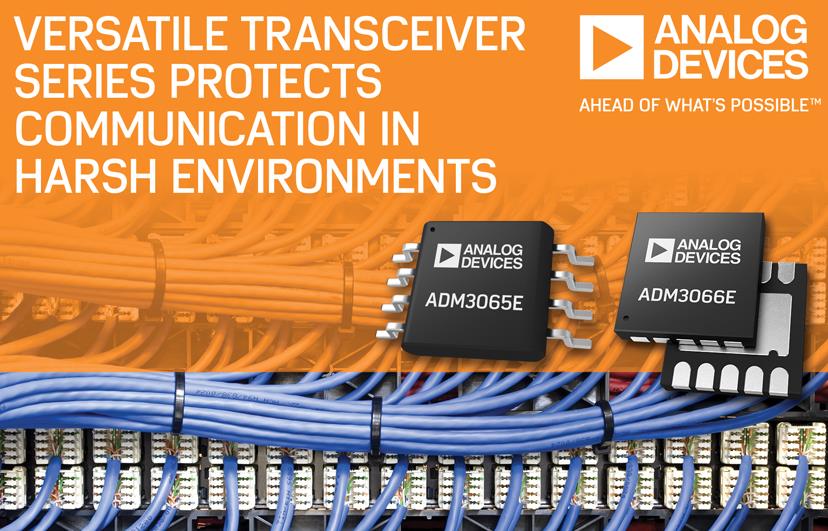
System-level IEC ESD threats have higher peak discharge current and voltage compared to HBM (Human Body Model) ESD. The IEC ESD rating protection function of ADM306xE provides a robust solution for customers who want to operate in industrial environments. The ADM306xE transceiver series has receiver fail-safe applied, which can prevent fault issues such as wiring errors that occur in real-world environments and cause open or short circuits. The receiver fail-safe function maintains the existing state on the data bus.
Glitch-free hot-swap capability enables error-free data operations when circuit boards are inserted into a backplane for proper motor control, accurate instrument reading, and smooth machine operation based on valid data. Additionally, the RS-485 transceiver complies with widely used protocols such as Profibus, BACnet, and Modbus, and supports various network topologies.
The operating voltage range of the ADM306xE transceiver series is 3~5.5V at VCC. The ADM3066E integrates VIO logic supply, enabling variable digital interface operation even at a minimum of 1.62V, and can be directly connected to low-power processors and FPGAs operating at 1.8V. The entire ADM306xE transceiver series provides, in addition to IEC61000-4-2 ESD protection provided on bus pins, receiver short-circuit, open-circuit, and floating input fail-safe protection functions.
Related news

[Interview] "How to Select the Best ADC for Your Application"
Is an ADC a good product just because it has high resolution and fast sampling speed? And if the price is also cheap, can we call it the most ideal ADC? Park Sun-hwa, Manager of Field Application Engineering at Analog Devices (ADI), says "not necessarily." "Rather than pinpointing just one condition as ideal, the best ADC is the one that fits the application you're designing." For example, it works like this. Depending on what signal you detect—light, sound, video, etc.—the sensor differs, and according to the type of signal, the sensor stage used before the ADC also changes. What's important in a sensor is sensitivity and dynamic range. If the sound you're trying to detect is sometimes loud and sometimes quiet, the detection range must be wide.
2017.07.10by 김지혜 기자
ADI Releases Operational Amplifier with Low Noise Characteristics via Zero Drift Application
Analog Devices announced the launch of LTC2063, a new zero-drift operational amplifier that typically consumes 1.3μA (maximum 2μA) at 1.8V input voltage. This micropower amplifier is characterized by exceptionally high precision. Thanks to high-precision input characteristics, large-value feedback network resistors can be used, and power consumption can be reduced while maintaining accuracy in high-temperature environments. Rail-to-rail input and output characteristics enable single-supply operation and support enhanced dynamic range. The integrated EMI filter provides 114dB EMI rejection performance at 1.8GHz. Due to the unique 1/f low-noise characteristics of the zero-drift architecture applied to this product, the LTC2063 is well-suited for amplification and conditioning of low-frequency sensor signals not only in portable and wireless sensor network applications, but also in high-temperature industrial and automotive systems.
2017.07.11by 김지혜 기자

ADI Launches Step-Down DC/DC Converter for Precise LED Current Control
Analog Devices has announced the release of the LT3932, a monolithic synchronous step-down DC/DC converter with an integrated 36V, 2A power switch and PWM generator. The new product operates using fixed-frequency peak current mode control and precisely controls LED current within ±1.5% for LED strings up to 2A maximum. The integrated PWM generator provides a dimming ratio of up to 128:1. For applications requiring a dimming ratio of 5,000:1, the LT3932 can be used together with an external PWM generator. The LT3932 has a very wide input voltage range of 3.6V to 36V, enabling its use in a broad range of applications including automotive, industrial, and architectural lighting. The proprietary Silent Switcher® topology combined with spread spectrum frequency modulation technology minimizes EMI issues. The LT3932 can drive up to 8 white LEDs at 2A with a nominal input voltage of 32V, delivering over 50W of power.
2017.07.12by 김지혜 기자

Intel Unveils Next-Generation 'Core Ultra Series 3' and vPro Platform for Enterprise PCs
Intel has officially unveiled the "Intel Core Ultra Series 3" for next-generation enterprise PCs and the latest vPro platform, addressing a wide range of demands from enterprise notebooks to high-performance workstations.
2026.03.26by 배종인 기자

ROHM Launches ESD Protection Diode Compatible with High-Speed Interfaces of 10Gbps or Higher
Semiconductor specialist ROHM has developed the 'RESDxVx series' of ESD (electrostatic discharge) protection diodes capable of responding to next-generation high-speed data communication environments exceeding 10Gbps, simultaneously enhancing both signal quality maintenance required in high-speed interfaces and IC protection performance.
2026.03.26by 배종인 기자











