


Satellite 'Flying Laptop' Launch Using OnSemiconductor Image Sensor
 Published2017.07.19 09:10
After Satellite Enters Orbit, Institute Plans to Send Images to Own Ground Station
The Institute of Space Systems (IRS) at the University of Stuttgart participated in the design, development, and construction of an orbital satellite. Students and faculty were involved in everything from hardware to software used in a satellite that operates once in space. Very recently, as part of this program, the first satellite to be completed, 'Flying Laptop,' was launched.
After entering orbit, Flying Laptop will participate in Earth observation and space weather monitoring. However, more importantly, it is to enhance the quality of university education through direct satellite development project experience, including all infrastructure necessary to support the mission and all systems to demonstrate orbital validation of satellite operations.
During the development process of Flying Laptop, over 120 student theses and over 20 doctoral dissertations were mobilized, and after the launch, students who participated in this project have been involved in the satellite's operations at the institute's own ground station.
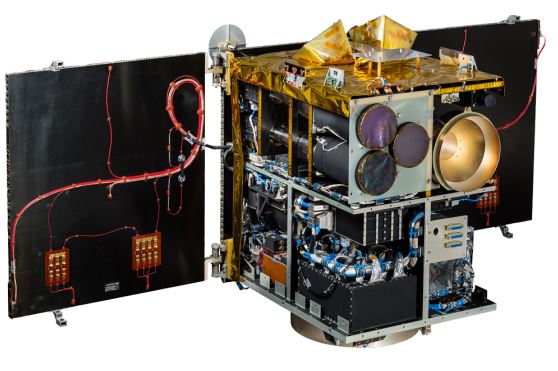
OnSemiconductor's KAI-1003 image sensor was adopted in the Multi-Spectral Imaging Camera System (MICS), the primary payload of this satellite. This system consists of three cameras operating in different spectral bands such as green (530 – 580 nm), red (620 – 670 nm), and near-infrared (835 – 885 nm), providing highly detailed spectral information about observed objects either individually or in combination.
When selecting the image sensor to be used in this system, the following various characteristics were essential to confirm and adopt. The project team required (1) an area array imager capable of capturing an entire image at once, (2) very high sensitivity providing excellent signal-to-noise ratio, (3) good sensitivity in the target spectral band, and (4) an electronic shutter.
The KAI-1003, with 1 megapixel large 12.8 µm pixels per element, 170 ke full well capacity, and 72 dB dynamic range, meets all these requirements and continues to function properly since its adoption in this system.
Because it takes several weeks after launch before the satellite system becomes fully operational, the timing for Flying Laptop's camera system to capture and transmit its first image is expected to be possible only after August. However, the satellite has already been updating its launch progress through Twitter and plans to continue sharing the satellite's mission progress thereafter.
Related news
ON Semiconductor Unveils Latest Synchronous Rectifier Controller
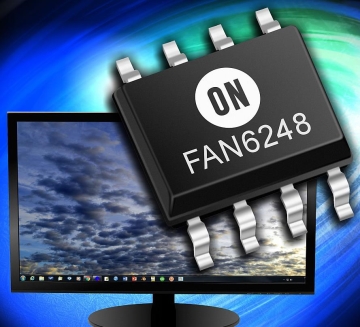
On Semiconductor has introduced its latest synchronous rectifier (SR) controller optimized for LLC resonant converter topology. The new FAN6248 delivers high efficiency with minimal additional components while simplifying thermal management and improving overall system reliability. In addition, it simplifies the design of LLC power supplies. The FAN6248 is an ideal solution for modern high-performance power supply units (PSUs) that require high reliability and efficiency in compact spaces. Typical applications include servers and desktop computers, gaming, large-screen LCD TVs and OLED TVs, networking, telecommunications, and LED lighting. The device integrates an advanced hybrid SR control method that senses instantaneous drain voltage along with previous switching cycle information. Through a dedicated 100V rated sensing input, it accurately monitors drain and source voltages across two SR MOSFETs while accommodating asymmetric or poor coupling in the secondary winding.
2017.05.16by 김지혜 기자
On Semiconductor Improves Imaging Performance for High-Resolution Industrial Applications
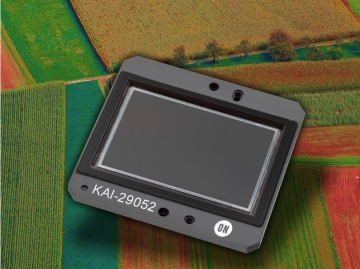
On Semiconductor has enhanced performance for industrial imaging applications requiring high-quality image capture and maximum image uniformity. The newly released 29-megapixel KAI-29052 image sensor delivers up to 2x greater imaging sensitivity compared to the existing KAI-29050 across the 500 nanometer (nm) to 1050 nm wavelength range. This enhanced performance is particularly useful for applications operating at near-infrared (NIR) wavelengths such as 850 nm. The improved pixel design isolates charge from one photodiode to another, allowing for enhanced sensitivity without reducing image sharpness.
2017.06.08by 김자영 기자
OnSemi Maintains Data Even Under Automotive Stress Environments to Achieve 'Grade 0'
In the automotive industry, safety is paramount, and safety standards become increasingly stringent over time. Features such as Electronic Stability Control (ESC) and Tire Pressure Monitoring Systems, which were once optional add-ons or limited to premium vehicles, have now become mandatory in nearly all vehicles. For automotive ICs, there is a growing trend in demands for reliability and robustness. The automotive environment is one of the most challenging for ICs, as it is not only noisy but also subject to a wide range of temperatures. Even in applications with less temperature variation, such as steering, OEM companies demand high-reliability and high-durability components certified by AEC. Non-volatile storage media such as EEPROM offers two key advantages. It operates properly even under stress environments and retains data even when the system is powered down. While other ICs experience stress only during operation, EEPROMs for data retention are constantly in use. Due to these characteristics, they are ideal for applications where robustness and reliability are critical, such as engine control, transmission electronics, steering, braking, and airbag systems.
2017.06.22by 김자영 기자

Intel Unveils Next-Generation 'Core Ultra Series 3' and vPro Platform for Enterprise PCs
Intel has officially unveiled the "Intel Core Ultra Series 3" for next-generation enterprise PCs and the latest vPro platform, addressing a wide range of demands from enterprise notebooks to high-performance workstations.
2026.03.26by 배종인 기자

ROHM Launches ESD Protection Diode Compatible with High-Speed Interfaces of 10Gbps or Higher
Semiconductor specialist ROHM has developed the 'RESDxVx series' of ESD (electrostatic discharge) protection diodes capable of responding to next-generation high-speed data communication environments exceeding 10Gbps, simultaneously enhancing both signal quality maintenance required in high-speed interfaces and IC protection performance.
2026.03.26by 배종인 기자











