



EWBM Changes the Internet of Things Security Landscape with SoC Chips
 Published2017.07.26 09:20
Extract RGB images and depth information with one camera
These days, with the security of the Internet of Things (IoT) in the spotlight, there is a company that makes a security SoC with SE (Secure Element) function built into the terminal.
eWBM (www.ewbm.co.kr) is a fabless semiconductor company established in 2009. It develops IoT security semiconductors and 3D imaging semiconductor products.
The method used by existing companies to secure the Internet of Things is to use a microcontroller (MCU) without security in the terminal together with a security chip called Secure Element (SE). This method provides advanced security functions compared to general MCUs, but increases terminal costs due to system complexity.
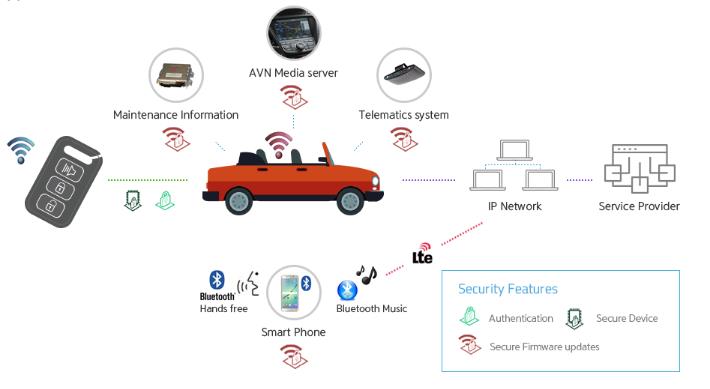
To this end, EWBM has come up with a complete solution: a secure SoC solution with built-in SE functionality in the terminal. The secure SoC must have functions such as secure boot, storage, unique keys per terminal, code signing updates, and a secure key storage device.
EWBM is mass producing three products: MS300, MS500, and MS1000. It provides solutions that satisfy the requirements of the IoT Common Security Guide published by the Korea Internet & Security Agency (KISA) and do not incur additional costs. Among these, the MS500 is a flagship product, an SoC with a 100MHz ARM Cortex-M0 core that features both hardware-based symmetric and asymmetric encryption engines.
It also supports real-time encryption, user and device authentication functions, and secure boot, which was only applied to some high-performance application processors such as smart devices. It includes advanced security functions such as real-time integrity monitoring and support for a secure operating system. It implements security functions in a proprietary chip, so it does not burden the central processing unit (CPU), and it also supports security services for IoT devices equipped with CPUs with performance limitations.
Mutual authentication between devices can be easily implemented at higher levels of device-to-server and device-to-device (end-to-end), and data streams between the end points can be protected by encrypting/decrypting them using high-speed symmetric cryptographic engines. These advantages overturn the idea that it is difficult to provide sufficient security for the Internet of Things due to price and power consumption issues.
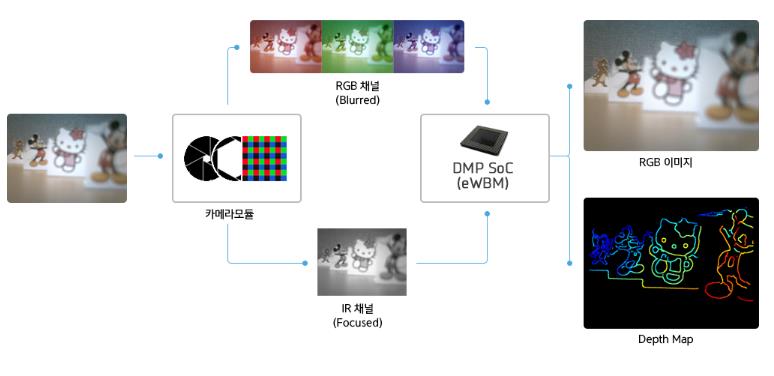
The 3D imaging semiconductor 'DR1152' is a chip that simultaneously extracts color photos, infrared photos, and distance information with one lens and one sensor. The most suitable field for application is AR. AR does not have much information that people can input. There must be a device to recognize hand gestures in front, and distance (Depth) information up to 1m in front of the nose is required. Also, since most cases use glasses, power consumption must be less than 100mW.
The existing method required multiple cameras, could not extract RGB images, was difficult to miniaturize, and was expensive, but this was solved by extracting RGB images and depth maps simultaneously using only one camera. Since it does not use reflected IR, it can be extracted even in outdoor environments. It can be applied to AR, VR, distance-sensitive CCTV, collision avoidance systems, driver drowsiness monitoring devices, and hand gesture control devices.
EWBM CEO Oh Sang-geun said, “We are planning to release the MS1200 and DC2000 next year. We have other release plans in the works,” and added, “Our goal is to shake up the market with a technology that has never existed before. This year, we will fully enter the market with IoT security chips and video chips.”
Comments
Related news

Sundol drones, leave the pesticide spraying to us.
As drone technology advances, agriculture has become the most widely utilized field. According to the Association for Unmanned Vehicle Systems International (AUVSI), forecasts indicate that agricultural drones will account for 80% of the future commercial drone market. By equipping drones with cameras, it is possible to acquire crop growth information in real-time, conduct surveys to analyze soil conditions, and scan the ground surface to adjust altitude and apply precise quantities of pesticides. Sundol Drone is an agricultural drone used for spraying pesticides and fertilizers. Featuring a fully automatic system, it performs automatic flight, directional changes, spraying, and return operations automatically. Should the spraying be interrupted due to pesticide depletion mid-operation, it automatically detects this and returns home. After replenishing the pesticide, the detection system guides the drone back to the interrupted location without manual adjustment, preventing duplicate spraying.
2017.07.04by 김지혜 기자
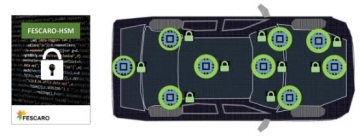
Pescaro Gains Recognition for Automotive Security Technology Through Startup Investment
Germany's automotive association ADAC announced the results of testing 24 automobiles produced and sold by 19 global automakers, finding that most vehicles were vulnerable to hacking. The method involves manipulating and amplifying radio frequencies within the vehicle to hack the engine or door lock, tricking sensors into thinking the car owner is nearby. As increasingly more electronic equipment is being introduced into automobiles, exposure to external hacking risks is growing, and interest in automotive security is rising. Pescaro is a domestic automotive security startup established by automotive security module developers from Hyundai Motor and security experts from white hacker backgrounds.
2017.07.11by 김지혜 기자
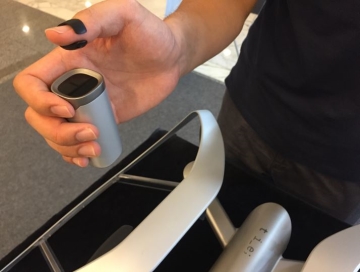
This Is Engineering is working on an easy-to-control drone controller.
Operating a drone is not an easy skill. You grip the remote controller with both hands and your head is set on "straight ahead," yet the aircraft barely moves forward. Since you've already bought it, it's too early to give up. You tell yourself that "the practice process is also fun." At this point, there's good news that an intuitive controller operable with just one hand has been developed. By moving a ring equipped with sensor functionality over the main controller, you can control the drone's takeoff, landing, and direction. DisDisEngineering plans to launch a toy drone in the second half of this year and a professional drone extension in the first half of next year.
2017.07.19by 김자영 기자
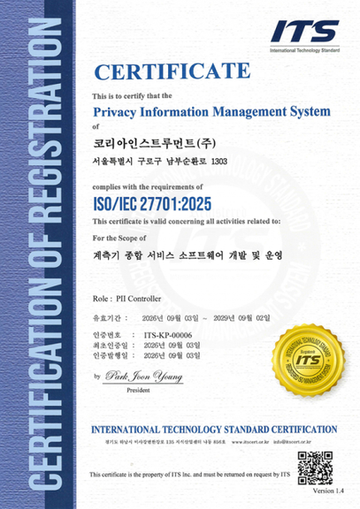
Korea Instrument, KOLAS Accredited Calibration Agency First to Simultaneously Acquire ISO/IEC 27,001·27,701
Korea Instrument has become the first among KOLAS accredited calibration agencies to simultaneously acquire ISO/IEC 27,001 and ISO/IEC 27,701 certifications. Through its proprietary platforms CWIZ Enterprise and CWIZ Partners, the company has embedded information security and personal data protection requirements across all business processes including customer information, equipment data, and calibration reports, with plans to continuously advance its management system through regular audits and security inspections.
2026.10.12by 배종인 기자

TeamViewer One, IT Incident Automation Workflow and Resolution Center Enhanced
TeamViewer has added IT incident automation capabilities and an advanced Resolution Center to its integrated digital workplace management platform 'TeamViewer ONE'. Recurrent service disruptions, configuration errors, and capacity shortages are automatically handled according to preset policies, and device status verification through script deployment can be managed in a unified interface, significantly reducing repetitive tasks for IT teams.
2026.10.12by 배종인 기자











