



Nvidia Donates Tesla V100 to AI Researchers
 Published2017.07.26 15:46
Latest Volta Architecture-Based Nvidia Tesla V100
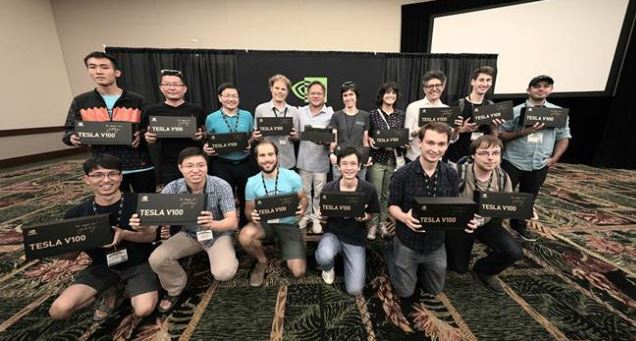
Nvidia presented the latest Volta architecture-based Nvidia Tesla V100 (NVIDIA Tesla V100) to 15 researchers participating in Nvidia's Artificial Intelligence (AI) Lab Program at 'CVPR (Computer Vision and Pattern Recognition) 2017', a computer vision and pattern recognition conference related to artificial intelligence held in Honolulu on the 22nd.
Attending the conference where over approximately 150 leading artificial intelligence researchers gathered, Nvidia introduced the performance of the Tesla V100 GPU accelerator to representatives from 15 participating research institutions and presented the devices directly to them.
Volta, Nvidia's 7th generation GPU architecture used in Tesla V100, delivers up to 5 times improved teraflops performance compared to the previous generation Pascal architecture. Compared to the Maxwell architecture announced just 2 years ago, it reaches approximately 15 times the performance. Such powerful performance surpasses the 4 times performance improvement predicted by Moore's Law.
The Tesla V100 GPU accelerator is breaking through the 100 teraflops barrier that had been a challenge in deep learning performance. V100 is composed of 21 billion transistors, includes 640 Tensor Cores, delivers 120 teraflops of deep learning performance, features NVLink (NVLink) ultra-high-speed interconnect and HBM2 DRAM at 900GB per second speed, boasting 50% faster memory bandwidth than previous generation GPUs. Additionally, it receives support from all Volta-optimized software that can be easily utilized for acceleration work in artificial intelligence and various research in frameworks and applications such as CUDA, cuDNN, and TensorRT (TensorRT).
Associate Professor Silvio Savarese, Associate Professor of Computer Science at Stanford University and Director of the Toyota Center for Toyota-funded AI Research at Stanford's Artificial Intelligence Research Institute (SAIL), who received the Tesla V100 GPU, said, "Deep learning is making possible what was previously impossible," and added, "Tesla V100 will be utilized in new research, particularly in autonomous driving and virtual reality (VR) fields among various sectors."
Nvidia CEO Jensen Huang stated, "Nvidia is aware of challenges in the field of artificial intelligence and is also working to develop Nvidia GPUs in forms more suited to artificial intelligence based on this awareness."
Related news
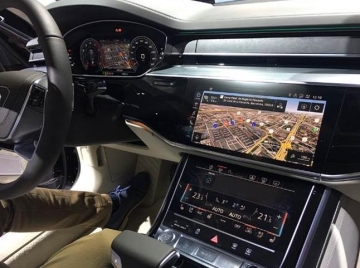
Nvidia equips Audi's new A8 with autonomous driving technology
Nvidia announced that it has equipped its transportation sector innovation technologies in Audi's new model 'A8'. The 2018 A8 equipped with Nvidia technology is Audi's flagship model, which was unveiled through the first Audi Summit held in Barcelona, Spain. The most notable feature of the A8 was the 'AI Traffic Jam Pilot'. Completed based on Nvidia technology, this system provides an unprecedented level of autonomous driving capability on congested highways.
2017.07.13by 김지혜 기자
NVIDIA Supports Grid Virtualization Platform on AWS Workstations
NVIDIA announced that Amazon Web Services (AWS) has equipped its newly launched EC2 G3 with NVIDIA GRID virtualization platform and NVIDIA Tesla M60 GPU accelerators. Amazon EC2 (Amazon Elastic Compute Cloud) G3 is a new GPU-optimized instance that enables architects, artists, product designers, and other professionals to handle complex tasks required for high-performance desktop workstations. It is designed to easily provide a powerful combination of CPU and RAM for workloads such as 3D rendering, 3D visualization, graphics-intensive remote workstations, video encoding, and virtual reality applications.
2017.07.18by 김자영 기자
New to deep learning? NVIDIA will show you.
Nvidia provides free online foundational lectures on the latest deep learning theory and practical techniques for domestic deep learning-related developers, industry professionals, and students as part of its global educational program, the Deep Learning Institute. The Deep Learning Institute is a global educational program that Nvidia is conducting to meet the growing worldwide demand for expertise in the artificial intelligence field. At the GPU Technology Conference held in May, Nvidia announced plans to train 100,000 deep learning developers through this program this year. Domestically, Nvidia has been holding the Deep Learning Institute monthly to conduct offline education, leading the acceleration of deep learning technology, which is regarded as a key pillar of the fourth industrial revolution, and taking the lead in building a deep learning technology ecosystem in Korea.
2017.07.25by 김자영 기자

ST Microelectronics and NUS Establish Joint Research Center 'HELIX' for Edge AI
ST Microelectronics and the National University of Singapore have established the 'HELIX' joint research center aimed at implementing embedded AI in edge environments. Over a four-year period, the center will conduct research across the entire technology stack from algorithms to silicon, focusing on memory-centric architecture leveraging ST's 18nm FD-SOI technology and embedded PCM. The core objective is to implement intelligence directly in physical devices such as robots and drones while minimizing energy consumption.
2026.08.28by 배종인 기자

ams, Enhancing Humanoid Robot Sensing and Communication with Digital Photonics
ams OSRAM has unveiled solutions that leverage digital photonics technology to enhance the sensing and communication capabilities of humanoid robots. The company implements environmental awareness and precision manipulation through dToF sensors, optical force sensors, and structured light emitters, while supporting LED-based non-verbal communication through the EVIYOS and ALIYOS platforms. According to market research, the humanoid robot market is projected to grow from $600 million in 2025 to $51 billion in 2035, with improvements in robot sensing capabilities expected to serve as a key growth driver.
2026.08.27by 배종인 기자











