


ADI Launches Ultra-Wideband 3GHz to 20GHz Mixer
 Published2017.08.16 11:06
Compact 3mm x 2mm Package
DC to 6GHz IF and 0dBM LO Drive Support
Analog Devices has announced the launch of the LTC5552, a new double-balanced mixer (DBM) that provides matched bandwidth characteristics from 3GHz to 20GHz. It can be used as an up-converter or down-converter.
The LTC5552 features a differential IF port capable of DC input, allowing the LO (Local Oscillator) frequency to be set nearly identical to the RF frequency, making it particularly useful for up-conversion applications.
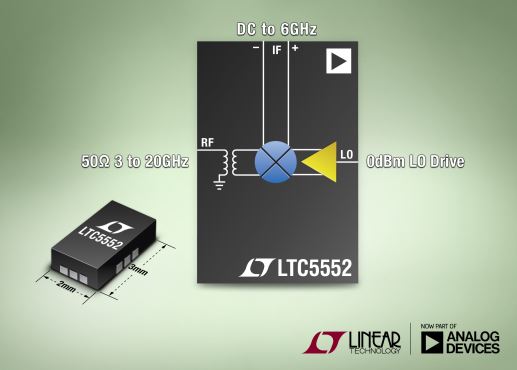
The new product exhibits leakage between LO and RF of -25dBm or less, significantly relaxing external filter requirements. This mixer delivers excellent linearity with 20.1dBm IIP3 at 14GHz and 18.3dBm at 17GHz. It integrates a wideband LO buffer requiring only 0dBm input drive, eliminating the need for external high-power LO amplifier circuits.
Additionally, the RF port integrates a wideband balun transformer, enabling single-ended 50Ω matching operation across specific frequency ranges. This minimizes the number of external components, simplifies the design, and reduces solution size.
The wide bandwidth can be applied to a broad range of applications including 5G wideband wireless access, microwave backhaul, satellite broadband wireless, radar systems, active antenna arrays, X, Ku, and Ka-band transceivers, RF test equipment, spectrum analyzers, and satellite communications.
The LTC5552 is supplied in an ultra-compact 12-pin, 3mm x 2mm plastic QFN package. It operates at case temperatures from –40°C to 105°C, with an expanded ambient operating temperature range.
This mixer operates from a single 3.3V supply voltage and typically consumes 132mA of current. Shutdown is possible via a single enable pin. When disabled, the maximum standby current is 100μA.
The enable pin can drive the device to switch on and off within 0.2μs, supporting TDD (time-division duplex) or burst-mode type transmitters and receivers.
Related news

ADI Launches Small Broadband GaN Power Amplifier
Analog Devices (ADI) has launched the HMC8205, a best-in-class broadband gallium nitride (GaN) power amplifier delivered in a compact package. The highly integrated HMC8205 supports frequencies from 300MHz to 6GHz and provides key features required by system application designers, including wireless infrastructure, radar, public mobile radio, and general-purpose amplification test equipment that requires pulsed or continuous wave support. The HMC8205 GaN MMIC amplifier is offered in a compact package that minimizes the use of external circuitry, providing high integration, gain, efficiency, and wide bandwidth, thereby reducing overall component count and board space.
2017.07.27by 김지혜 기자

ADI Releases DAC Supporting Wired Communication Systems
Analog Devices (ADI) has introduced a pair of highly integrated 16-channel DACs that significantly reduce the footprint of wired communication systems without compromising performance. The 12-bit AD5767 and 16-bit AD5766 are fully integrated devices that support full-band bias for medium to long-distance optical communication systems. These devices integrate an extensive array of discrete components, providing the required voltage range and additional system functions in a very compact space. The AD5767 and AD5766 are suitable for electro-optic functions such as bias control, including Mach-Zehnder modulator-bias control, or for optical modules.
2017.08.01by 김지혜 기자

ADI Launches Broadband Synthesizer for Difference-Free RF Output Across Frequency Range
Analog Devices has launched the ADF5356, a next-generation wideband synthesizer operating at 13.6GHz with an integrated voltage-controlled oscillator (VCO). The product was developed for applications such as wireless infrastructure, microwave point-to-point links, electronic test and measurement, and satellite terminals. It offers similar performance to the well-known ADF4356, which has a 6.8GHz operating range. The ADF5356 can be utilized as a multi-band synthesizer because it generates RF output from 53.125MHz to 13.6GHz without any gaps within the frequency range. This eliminates the need to use multiple VCO/synthesizer products for different bands, thereby reducing the number of components, board space, and power consumption.
2017.08.10by 김지혜 기자

Intel Unveils Next-Generation 'Core Ultra Series 3' and vPro Platform for Enterprise PCs
Intel has officially unveiled the "Intel Core Ultra Series 3" for next-generation enterprise PCs and the latest vPro platform, addressing a wide range of demands from enterprise notebooks to high-performance workstations.
2026.03.26by 배종인 기자

ROHM Launches ESD Protection Diode Compatible with High-Speed Interfaces of 10Gbps or Higher
Semiconductor specialist ROHM has developed the 'RESDxVx series' of ESD (electrostatic discharge) protection diodes capable of responding to next-generation high-speed data communication environments exceeding 10Gbps, simultaneously enhancing both signal quality maintenance required in high-speed interfaces and IC protection performance.
2026.03.26by 배종인 기자











