



NI Accelerates 5G Research with Multi-Antenna Support in MIMO Application Framework
 Published2017.08.18 16:24
Supporting Massive MIMO Prototyping to Realize 5G Deployment
National Instruments (NI) announced support for multi-antenna user equipment (UE) in the LabVIEW Communications MIMO Application Framework. With this enhancement, the MIMO Application Framework establishes itself as the world's only commercial physical layer reference design, enabling not only desktop simulation but also Massive MIMO prototyping to realize fully functional 5G deployment.
Wireless researchers can pair the MIMO Application Framework with NI software-defined radio hardware to conduct real-time OTA experiments that broadly address MIMO research topics including multi-user MIMO, single-user MIMO, and Massive MIMO.
This multi-FPGA physical layer reference design is fully reconfigurable and modifiable, delivered with LabVIEW Communications source code, and supports building networks composed of multi-antenna devices while minimizing system integration and design work.
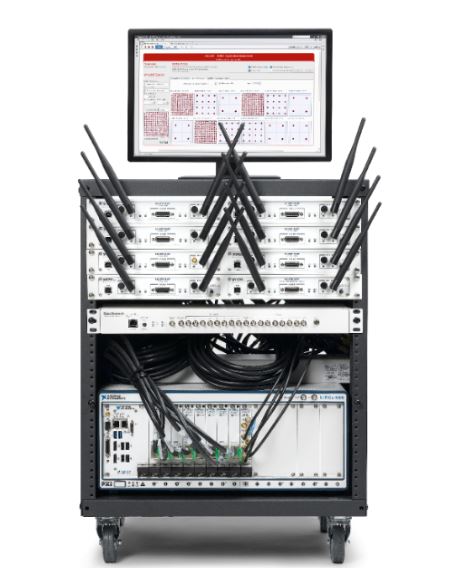
Researchers can now employ beamforming techniques not only at base stations but also at UEs, further enhancing overall network throughput, expanding cell coverage, and reducing interference.
The MIMO Application Framework supports maximum network throughput exceeding 1.5 Gb/s and flexible, reconfigurable time-division duplex (TDD)-based frame structure. Additionally, it provides bidirectional communication links that enable seamless integration of custom signal processing algorithms in shorter timeframes compared to other approaches and support conducting Massive MIMO experiments.
Wireless researchers at Lund University in Sweden have participated in NI's RF/Communications Lead User Program and have been using NI's flexible prototyping platform for 5G research. Recently, they demonstrated the availability of Massive MIMO in mobile scenarios for both pedestrian and vehicular users.
Fredrik Tufvesson, professor of wireless systems at Lund University and IEEE member, stated, "Massive MIMO has emerged as a leading 5G technology. It will play an important role in supporting wireless devices that can transition online within years," and added, "The MIMO Application Framework provides the necessary hardware and software capabilities to implement beamforming techniques not only in Massive MIMO base stations but also in multi-antenna UEs that further enhance the overall system performance of 5G networks."
Related news

NI Releases Test Toolkit Compliant with IEEE 802.11ax Standard
National Instruments (NI) has announced WLAN Test Toolkit 17.0, which supports the IEEE 802.11ax standard draft 1.1. WLAN Test Toolkit 17.0, combined with NI's second-generation vector signal transceiver (VST), supports 802.11ax waveform generation as well as characterization, validation, and production test analysis for products implementing IEEE 802.11ax standard draft 1.1, such as RF front-end components, wireless modules, and user devices. WLAN Test Toolkit 17.0 provides designers and engineers with the capability to generate and analyze a comprehensive range of 802.11ax standard-compliant waveforms, including extended single-user, per-user configurable, and multi-user OFDMA and MIMO (Multiple Input, Multiple Output) with measurement results support.
2017.07.12by 김지혜 기자
NI Launches Oscilloscope Based on High-Density Design Instrument Technology
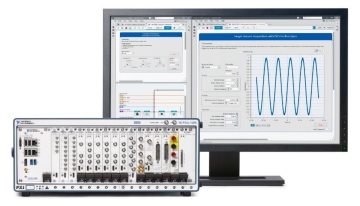
National Instruments (hereafter NI) has announced the launch of the latest 100 MHz, 8-channel oscilloscope based on NI's PXI high-density software-designed instrumentation technology, along with a new family of PXI arbitrary waveform generators featuring up to 2 channels and 80 MHz analog bandwidth in a single slot. Engineers can generate high-performance signals and measure complex waveforms through these affordable and compact mixed-signal instruments mounted in a modular form factor. The new PXIe-5413, PXIe-5423, and PXIe-5433 arbitrary waveform generators support -92 dB SFDR (Spurious-Free Dynamic Range) and 435 fs integrated system jitter, while providing precise waveform adjustment capabilities when used with a dedicated standard waveform generation engine.
2017.07.17by 김지혜 기자
NI Updates System for Wireless Device Testing
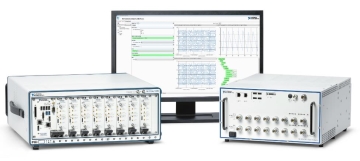
National Instruments (NI) announced an update to its Wireless Test System (WTS), a solution for multi-site automated testing of wireless devices. WTS version 1.3 includes support for 8x8 multi-channel configuration with Device Under Test (DUT) control functionality and custom 802.11ax test steps to enable efficient parallel testing of new connected devices based on the IEEE 802.11ax standard (draft 1.1). Additionally, WTS 1.3 improves parallel testing of Bluetooth 5 and low-power Internet of Things (IoT) standards such as Zigbee and Z-Wave. The new 802.11ax standard includes major changes to the physical layer (PHY) that deliver higher average data throughput per user in complex environments. Due to these changes, characterization, design verification, and production test efforts have become more complex. However, engineers can leverage WTS to automate 802.11ax measurement solutions that are accurate and suited for the expanded new design test scope.
2017.07.20by 김지혜 기자
.jpg)
SalePoint Signs Multi-Year Partnership Agreement with AWS… Promoting Identity Security that Integrates Even AI Agents
Sailpoint has entered into a multi-year strategic partnership agreement with AWS and is moving forward with establishing an integrated governance system that manages both human and non-human identities together. The plan is to consistently manage access permissions in an environment where AI agents are increasing as work execution entities, while applying the principle of least privilege and automated policy enforcement. The two companies plan to jointly expand capabilities to manage the identities of various entities, including AI agents, within a single layer in the AWS environment. This collaboration is interpreted as a move to design security and governance together in corporate environments where AI adoption is expanding.
2026.03.26by 배종인 기자
.png)
Databricks Unveils Open AI Security Monitoring 'Lakewatch'
Databricks entered the security market on March 24 by unveiling LakeWatch, an open-source agentic SIEM. The core functionality of this product is to integrate and analyze security, IT, and business data in a single environment to support AI-based threat detection and investigation. The company explained that it reduces the limitations of existing security operations centers, which have had to forgo some data due to high cost structures, and enables large-scale data analysis and automation based on open formats and ecosystems. LakeWatch is currently offered as a private preview, with Adobe and Dropbox mentioned as early customers. Databricks also announced an expanded partnership with Anthropic as well as the acquisition of Antimatter and SiftD.ai.
2026.03.26by 배종인 기자











