

.png)

[Issue] Industrial IoT Security: Thinking of IT and OT Separately Will Leave You 'Vulnerable'
 Published2017.08.21 11:48
Expertise Strong, But Integrated Ecosystem Needed to Lead Market
"As interest in industrial IoT has grown, companies have focused on IoT's core functionality while security has been neglected. When IoT brings IT and OT together, dividing responsibility creates security difficulties. How to build partnerships and form an ecosystem will be the key to leading the market," said Choi Seung-hwan, Senior Director at Frost & Sullivan, in his outlook on Asia-Pacific industrial control systems at an industrial control systems security conference.
"Security-related business has a lifecycle. Fear of the unknown, distinguishing between fiction and reality, educational consulting services emerge. After verification institutions for these services are established, actual revenue is generated. Currently, ICS (Industrial Control Systems) security appears to be in the educational consulting phase."
He cited government legislation, uncertainty regarding hacking, and solution awareness as reasons to accelerate ICS security adoption. He also predicted that ICS security will grow differently from IT.
"Until last year, I thought it would grow similarly. Looking at each vendor's technical approach this year, the security domain is expanding beyond software to hardware as well. It's a much larger scope than IT. It's a competitive landscape where industrial workers with various technologies are vying."
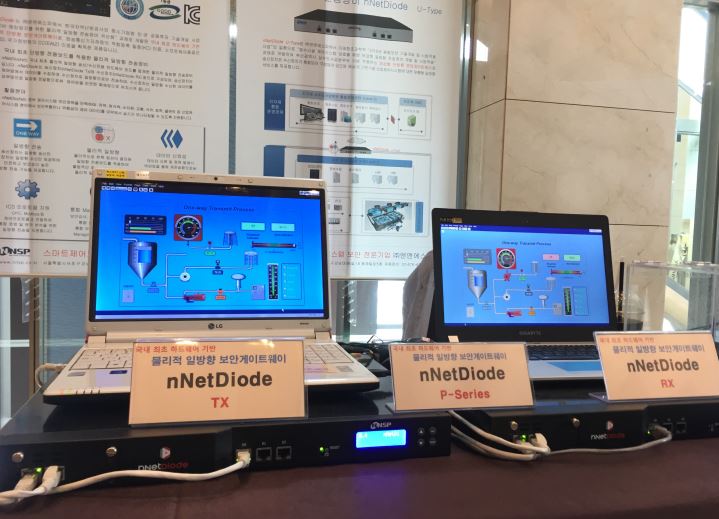
N&NS demonstrated a unidirectional security gateway at the industrial control systems security conference
Yoon Sam-soo, Senior Executive at FireEye, introduced actual hacking cases and emphasized systematic ICS security strategy.
"Manufacturers are well-equipped with firewalls, IPS, APT and other solutions, but intrusion paths typically start from simple routes such as USB from related companies or employees' web browsing and emails."
Hackers prefer methods with high "value for effort"—good effectiveness relative to effort—rather than seeking ways to penetrate firewalls. Most cases involve viruses infiltrating through emails and USBs that employees inadvertently accessed.
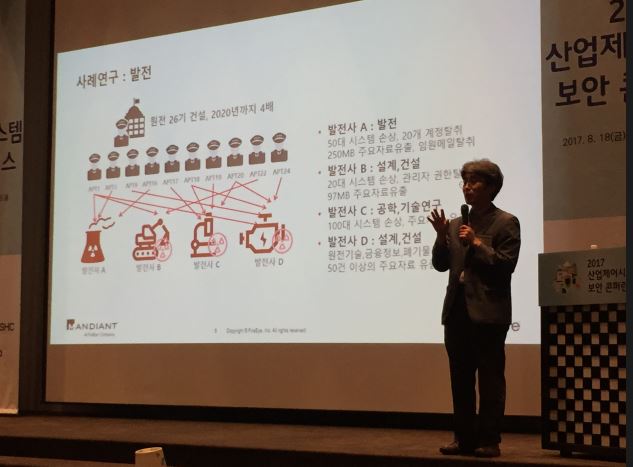
According to him, while not publicly disclosed, hacking incidents have occurred in manufacturing, nuclear power plants, and piping operations, resulting in confidential data leaks, and domestic companies have been attacked by automobile manufacturers and parts suppliers. Not only control-related personnel but all employees must recognize vulnerabilities, suspect network connections and processor management operations, and visualize security to manage issues.
"Attacks typically occur at stage 2, the control stage. Attackers will always get in 100%. However, you only realize it when the scenario unfolds. If you don't identify it beforehand, problems will emerge."
Related news
KISA Accepts Reports of IoT Device Vulnerabilities to Prepare for Security Threats
The Korea Internet & Security Agency (KISA) announced that it will operate an 'IoT Security Vulnerability Intensive Reporting Period' for two months starting in August, focusing on receiving and processing vulnerabilities in IoT devices in preparation for emerging security threats to IoT devices. As part of the 'Software New Vulnerability Reporting Reward Program (Bug Bounty)', newly discovered security vulnerabilities that could affect the latest version software (firmware, etc.) of smart home devices, drones, AI speakers, and other IoT devices frequently used in everyday life are subject to reporting. Any Korean residing both domestically and internationally can participate.
2017.08.04by 김지혜 기자

Schneider Partners with Claroty to Address Security Challenges
Schneider Electric announced that it has established a partnership to address safety and cybersecurity challenges in global industrial infrastructure. According to the contract terms, Claroty will provide its real-time OT/ICS network monitoring and detection solutions to customers through the Collaborative Automation Partner Program (CAPP). The Claroty platform proactively protects industrial control systems and continuously monitors cyber threats in industrial networks. Asset owners can adopt policies through secure remote access to control access by remote employees and third parties to critical systems and record sessions. The continuous threat detection capability identifies anomalies indicative of malware presence by creating detailed inventories of industrial network assets, identifying configuration errors, and monitoring traffic between assets. The alerting function provides actionable insights to plant and security personnel, enabling efficient investigation, response, and recovery.
2017.08.09by 김자영 기자
[Talking about Industrial IoT ③] Emerson: “Recently Significantly Changed Perception of IIoT Will Accelerate Growth”
When instrumentation communication became smarter, the company launched the HART (Highway Addressable Remote Transducer) digital communication protocol. This protocol, which is compatible with existing systems and communicates with 4-20 milliamperes without collision, has been internationally standardized and continues to be used to this day. The same applies to the Ovation Foundation Fieldbus, which enhances diagnostics and predictive maintenance through unique input/output modules. This is the story of Emerson Automation Solutions (hereinafter Emerson), which has been at the forefront of standardization that forms the foundation of industrial IoT. Emerson underwent both major and minor changes last year. It acquired Pentair Valves and Controls, adding safety valve automation solutions to Emerson's portfolio. It reorganized five subsidiaries into two categories: automation solutions and commercial and residential solutions. For process automation technology, it was renamed Automation Solutions, which includes Emerson Electric and portions of industrial automation solutions.
2017.08.14by 김자영 기자

Ecolab and K-water Discuss Innovation Collaboration in Advanced Industry Water Management
Ecolab and the Korea Water Resources Corporation jointly discussed cooperation directions for maximizing water use efficiency in advanced industries such as semiconductors and data centers and establishing sustainable water circulation. The two companies agreed to gradually develop a long-term cooperation model that combines water resource infrastructure and water management technology to promote water efficiency optimization, water reuse, and carbon reduction.
2026.08.28by 명세환 기자

H.Energy Obtains Green Technology Certification…SolarOnCare Operating at 99.82% Uptime
H.Energy has obtained green technology certification from the Small and Medium Business Administration for solar power generation forecasting and I-V curve anomaly diagnosis technology. The AI-based asset management platform SolarOnCare is deployed across more than 3,000 power plants nationwide, achieving a system uptime of 99.82% and a 3.7% improvement in power generation performance. Through real-time data analysis, it protects power generation revenue by detecting and managing minor losses such as module degradation and partial shading early on.
2026.08.25by 명세환 기자











