



[Issue] The 'coding' for elementary school students that fosters creativity is not C and C++
 Published2017.09.14 16:03
"Coding," another term for computer programming, will be made mandatory in the elementary, middle, and high school curriculum starting next year, as it is said to foster logic and creativity. The skepticism of "Elementary students coding?" was resolved at RoboWorld 2017. There was a variety of coding options available at the teacher's discretion. Fortunately, it was not C or C++.
'TIMBO' (Topobo Korea), coding movement with movement
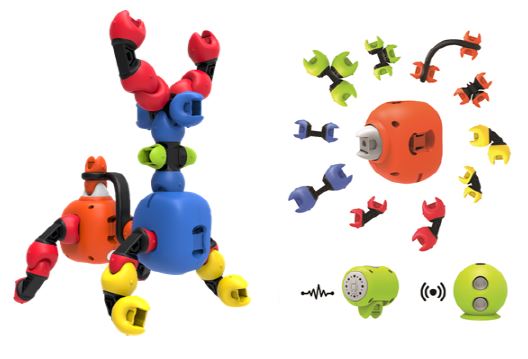
Coding is entered simply by moving blocks around, without the need for a keyboard, mouse, or monitor. Pressing the block's red button moves a joint about the size of two finger joints, and pressing the green button makes the block move according to the code. This is motion coding designed for toddlers who love blocks and robots. You can play a frog running game that mimics a hopping frog, or combine two blocks to recreate the motion of a deer moving back and forth. A Timbo robot official stated, "We have built in a kinetic memory device invented at MIT." "Robot blocks designed by angle and length can foster children's creativity," he said.
From English Study to Programming, 'TYCHE' (AI Brain)
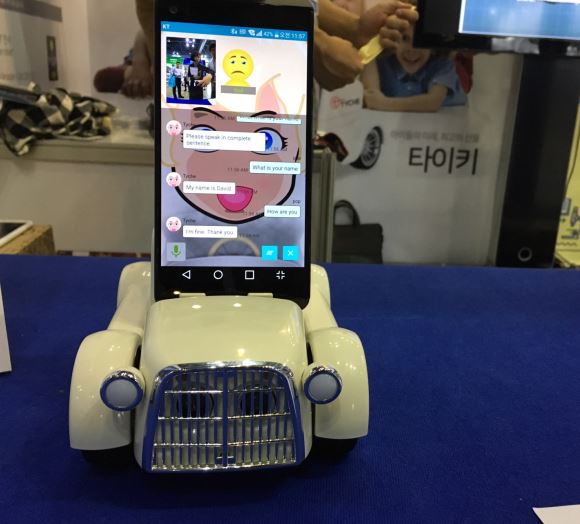
A mobile phone is 'riding' in a toy car. A character is smiling on the smartphone screen. It is a robot capable of conversation like a voice assistant, and you can input conversations directly. For example, if you say 'Hello,' it should respond with 'Hello.' You can also add actions, movements, and facial expressions. Using the smartphone's camera and sensors on the vehicle, you can move the device's body and project images through the camera. This is coding designed for lower grades, from 2nd to 4th grade.
A Taiki official stated, “Children with fast learning abilities find program input so easy that they finish simple coding before the explanation is even finished and ask to be taught other functions.” "In particular, children were interested in the 'mode where the device moves when you clap,' as the device responds to clapping or touch," he said.
'MUBO' (RoboDivine) that codes music and movement
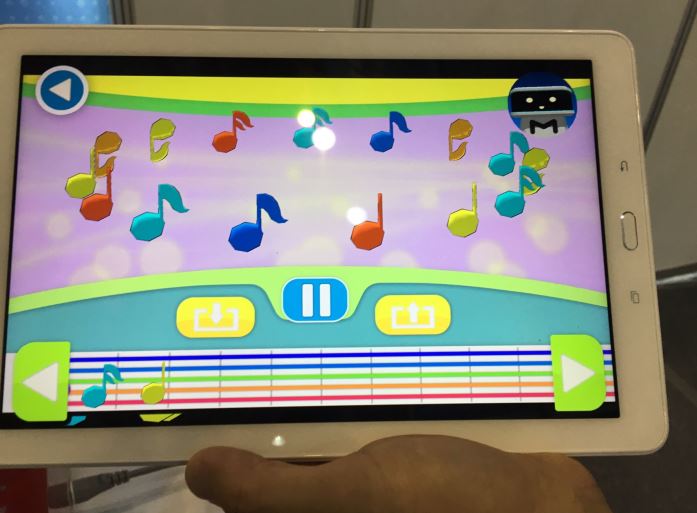
There is also Mubo, which sings songs when children create them. Mubo, a robot with a square face and body, has seven joints that allow it to move and sing. There are two ways to code Mubo: one for ages 5-6 by arranging 'cards,' and another for lower grades by connecting 'blocks' identical to Scratch.
When coding music, attach notes containing melodies and beats, and adjust the speed and volume. Movements can also be created by arranging their sequences. The entered code can be controlled or actions can be invoked using a remote app. It supports Korean, English, and French.
'Robotron' (Robotami) solving the mission of the story of the rabbit and the turtle
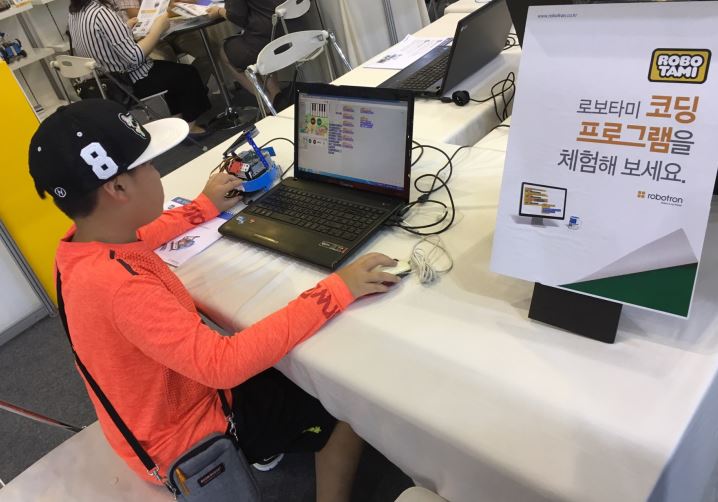
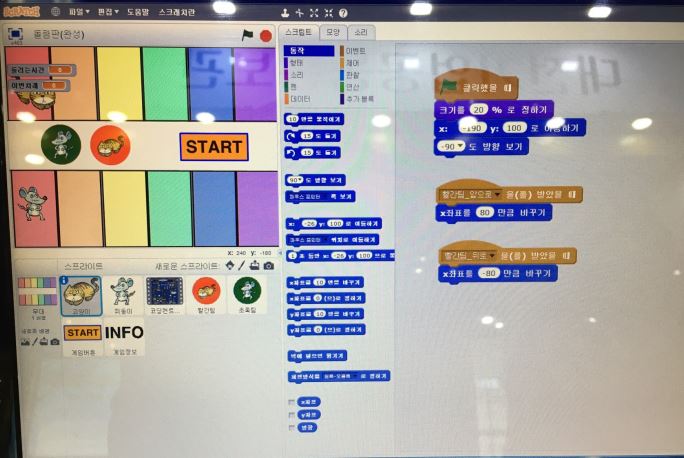
It's a battle between a rabbit and a turtle. "Choose the red or green team, and spin the roulette wheel to move forward or backward," the teacher explains the story to the children beforehand. This is intended to pique their interest and explain the structure of the coding education before it begins. Not only is the process conducted on the screen, but the rabbit and turtle on the screen also move when the children press a button to spin the roulette wheel. A representative from Robotron explained, "As children study commands, they naturally come into contact with the sensors and other components of the teaching aids," adding, "We added a story to keep things from getting boring."
관련뉴스
The reason the open source software community emphasizes open online courses, 'MOOCs', is
The fourth industrial revolution is expected to create substantial job opportunities in the software industry. While demand for software talent is increasing, it is difficult to enter the field without competency, making newly created jobs ineffectual. Consequently, there are efforts to open educational programs and introduce certification systems, but voices are emerging that practical competency in the field remains insufficient. Ko Gun, distinguished professor at Ewha Womans University, stated, "Open source is the core of the fourth industrial revolution. As we move toward a hyper-connected society, there is a trend toward opening source code," and added, "Since open software is becoming important, talent development requires source code availability and free licensing," discussing the issues in software education. In software education, theoretical instruction has sufficient resources through textbooks and teaching materials. New theories do not emerge frequently and are semi-permanent, which is advantageous in terms of paper count. Conversely, practical training requires establishing practice environments, creating course materials directly, and is disadvantageous in terms of paper count. Unlike the past where one or two coding languages were learned, the need to learn diverse languages has resulted in an increase in the number of courses. The shortage of professors relative to the number of subjects is also one of the difficult issues in domestic software practical education.
2017.07.18by 김지혜 기자
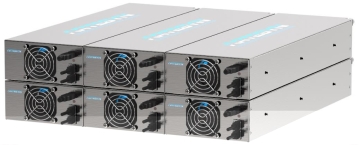
Artesyn Announces Cost-Effective Acceleration Platform with Built-in Server Card
Artesyn Embedded Technologies has unveiled a new compute and acceleration platform in a compact form factor. This platform can be used for a wide range of applications, from small cell baseband processing, scalable video streaming and encoding, video surveillance and bump-in-the-wire monitoring, to industrial computing. MaxCore Micro is an embedded host server card housed in a cost-effective enterprise-class chassis, and it is also equipped with additional slots for PCI Express add-in cards. These add-in cards can be supplied by Artesyn. Additionally, customers can use third-party off-the-shelf cards to provide functionality specialized for individual applications and build a complete application platform.
2017.08.08by 김지혜 기자
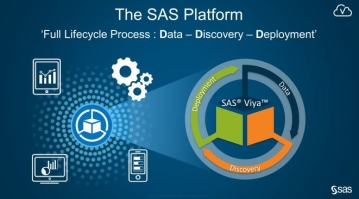
SAS, 인공지능 활용 엔터프라이즈 분석 플랫폼 발표
SAS(쌔스)코리아는 13일 전체 분석 라이프사이클을 통합, 최적화하는 ‘SAS 플랫폼(The SAS Platform)’ 전략과 그 핵심 엔진인 인공지능(AI) 활용 엔터프라이즈 분석 플랫폼 ‘SAS 바이야(SAS Viya)’를 발표했다. SAS는 기업의 모든 분석 요소와 기술을 전체 분석 라이프사이클에 통합, 최적화하는 ‘SAS 플랫폼(The SAS Platform)’을 발표하고, 애널리틱스 이코노미 시대에 요구되는 분석 소프트웨어의 표준화를 제시했다. ‘SAS 바이야’와 ‘SAS 9.4’를 모두 포함하는 SAS 플랫폼은 컴퓨팅 환경에 관계없이 데이터로부터 인사이트를 빠르게 도출하고, 분석 라이프사이클의 모든 단계(데이터-분석-배치)를 지원하는 기반을 제공한다. 특히 인공지능 분석 기능이 강화돼 데이터의 규모와 속도, 문제의 복잡성, 배포 전략에 관계없이 유연하게 IT 인프라를 적용할 수 있다. 기업은 SAS플랫폼에서 SAS 뿐 아니라 다른 프로그래밍 언어로 코딩된 모든 분석 자산과 활동을 효율적으로 관리할 수 있다.
2017.09.13by 김자영 기자
.jpg)
SalePoint Signs Multi-Year Partnership Agreement with AWS… Promoting Identity Security that Integrates Even AI Agents
Sailpoint has entered into a multi-year strategic partnership agreement with AWS and is moving forward with establishing an integrated governance system that manages both human and non-human identities together. The plan is to consistently manage access permissions in an environment where AI agents are increasing as work execution entities, while applying the principle of least privilege and automated policy enforcement. The two companies plan to jointly expand capabilities to manage the identities of various entities, including AI agents, within a single layer in the AWS environment. This collaboration is interpreted as a move to design security and governance together in corporate environments where AI adoption is expanding.
2026.03.26by 배종인 기자
.png)
Databricks Unveils Open AI Security Monitoring 'Lakewatch'
Databricks entered the security market on March 24 by unveiling LakeWatch, an open-source agentic SIEM. The core functionality of this product is to integrate and analyze security, IT, and business data in a single environment to support AI-based threat detection and investigation. The company explained that it reduces the limitations of existing security operations centers, which have had to forgo some data due to high cost structures, and enables large-scale data analysis and automation based on open formats and ecosystems. LakeWatch is currently offered as a private preview, with Adobe and Dropbox mentioned as early customers. Databricks also announced an expanded partnership with Anthropic as well as the acquisition of Antimatter and SiftD.ai.
2026.03.26by 배종인 기자











