



[Issue] Doosan and Hanwha Unveil Large Number of New Products, Collaborative Robot Market Heats Up
 Published2017.09.18 10:03
No regulations on collaborative robots, classified as 'industrial robots'; international certification body says Doosan 'still'
Following Hanwha TechOne's collaborative robot in March of this year, Doosan Robotics unveiled four types of collaborative robots at RoboWorld 2017, drawing attention to the collaborative robot market.
In 2015, ABI Research reported that the collaborative robot market share was 18% in the Asia-Pacific region, but would grow to up to 58% by 2020. Large corporations such as Hanwha and Doosan have announced new collaborative robot products, leveraging their proprietary technology that covers everything from planning and R&D to production, in a market previously dominated by small and medium-sized enterprises.
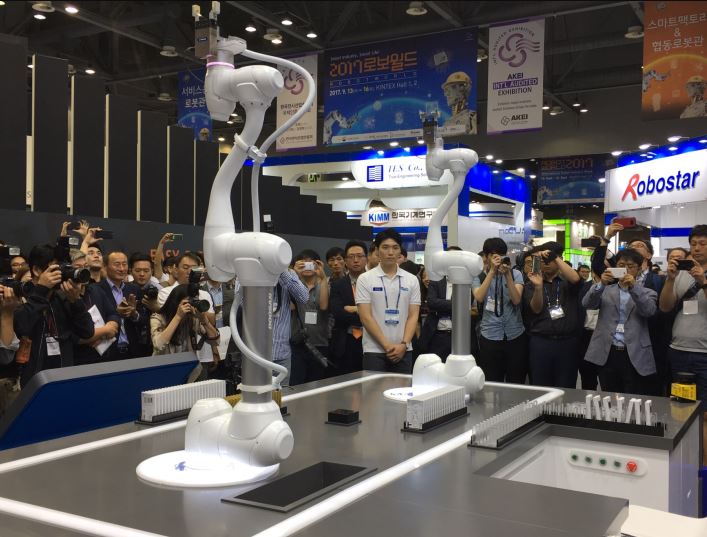
Reporters are taking photos as Doosan unveils its new product.
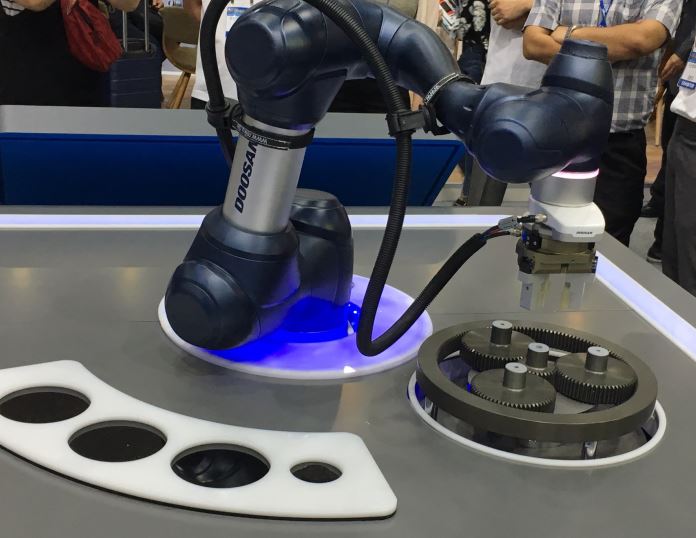
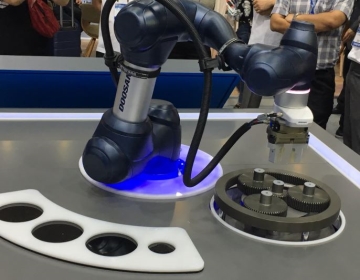
Doosan's collaborative robot demonstrating planetary gear assembly
The collaborative robots unveiled by Doosan Robotics (hereinafter Doosan) consist of a total of four models: the M0609, optimized for fast repetitive tasks with light objects; the M1509, effective for handling heavy objects up to 15 kg; the M1013, a basic model suitable for all work processes; and the M0617, which demonstrates efficiency during long-distance work.
Doosan emphasizes "precise sensing capability and stability based on torque sensors." While other companies adjust movement based on the amount of force transmitted to the motor upon contact with a person, the torque sensor directly detects this. Furthermore, they highlighted the convenience of providing intuitive software tools when the collaborative robot is integrated with mobile devices or tablets. Users can directly move and program the collaborative robot, but the robot also recommends and informs them of the functions that can be implemented.
A Doosan official explained, “Prior to the RoboWorld exhibition, we deliberated on eight different process steps to showcase our technology,” adding, “We even recreated press technology directly using our own robots, but at the exhibition, we focused our demonstrations on technologies that show robots can work safely alongside humans.” Furthermore, in response to customer requests, the official stated, “We are preparing to provide a program that views robots as just another piece of factory machinery and allows for the analysis and monitoring of abnormal signs and production volume.”
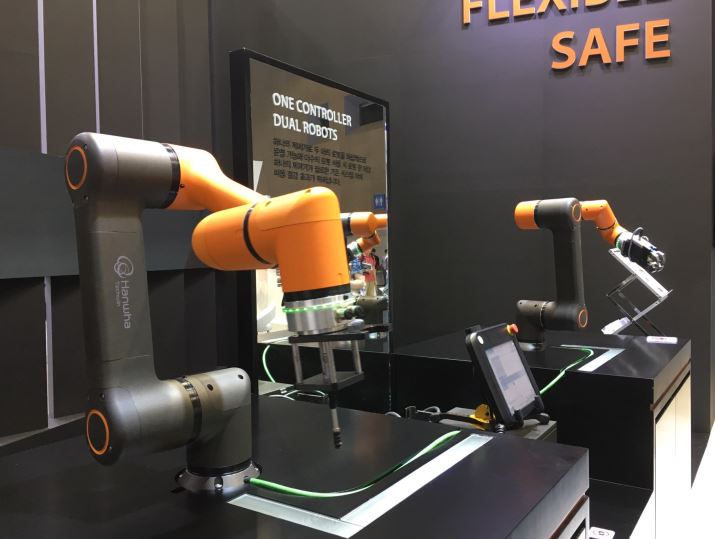
A controller unveiled by Hanwha Techwin that manages two collaborative robots with a single controller
The new products unveiled by Hanwha TechWine (hereinafter Hanwha) are the HCR3 and HCR12. At the event, Hanwha also unveiled a controller that can reduce costs by up to 30% by managing two robots with a single controller.
In response to a reporter's question asking, "Isn't it difficult to detect problems when an issue occurs in the system, unlike with individual controllers?", a Hanwha official explained, "As long as the controller's power does not go out, there is no disruption because the control system is designed with redundancy."
Universal Robots Triples R&D Investment in 2016
Currently, collaborative robots follow the regulations for industrial robots as there are no regulations specifically for them. Since the fields in which robots are introduced and the products manufactured vary by factory, the equipment cannot be evaluated separately. A Hanwha official stated, "When the Ministry of Employment and Labor conducts on-site inspections prior to robot introduction, we evaluate potential threats and issue certificates. We are actively advocating for legal improvements regarding collaborative robots by participating in public hearings and other forums."
Universal Robots, which debuted in the industrial robot market in 2008 and is known as a pioneer of the collaborative robot market, also announced plans in 2016 to triple its investment in R&D and expand support for overseas expansion. Regarding the strengths of Universal Robots, an official from a distributor stated, “It has received the highest rating among current collaborative robots from the German TUV certification body.”
The certification obtained by Universal Robots is ISO 13849-1, which reflects the fact that equipment and machinery ensure a certain level of safety and the probability of equipment failure. Universal Robots' Performance Level (PL) is Grade d. Hanwha Techwin also has a Grade d rating.
A Doosan official said, “We are still waiting for the certification body’s review.”
Comments
Related news
Illisis-Hanwha Techwin, Collaboration on Intelligent CCTV Solution Development
Illisis has entered into a partnership with Hanwha Techwin's Security Business Division, a leading manufacturer in the CCTV camera field, for "strategic product development and marketing cooperation in CCTV solutions" to discover diverse business opportunities and actively pursue global new businesses. The two companies plan to create synergy effects based on Illisis's AI video analysis technology and Hanwha Techwin's global marketing capabilities, thereby discovering diverse business opportunities and actively promoting global new businesses. Illisis is a promising mid-sized enterprise that has recently concentrated investment not only in video analysis but also in deep learning and big data research.
2017.06.29by 김자영 기자
[RoboWorld 2017] "High Growth Potential Across All Robotics Sectors; Focus on SI Firms"
The 2017 RoboWorld, where you can see manufacturing robots and robot components, smart manufacturing, 3D printing, and service robots all in one place, will be held for four days starting September 13th at KINTEX in Ilsan. This event, with participation from 230 companies across 25 countries, is hosted by the Ministry of Trade, Industry and Energy and organized by the Korea Robotics Industry Association, Korea Robotics Industry Promotion Agency, and the Institute of Control, Robotics and Systems. This year's event theme is "Smart Industry, Smart Life!" and it will present directions for smart factories in the era of the Fourth Industrial Revolution. In particular, Hanwha Q Cells and Doosan Robotics participated in the manufacturing robot pavilion and each unveiled collaborative robots.
2017.09.13by 김자영 기자
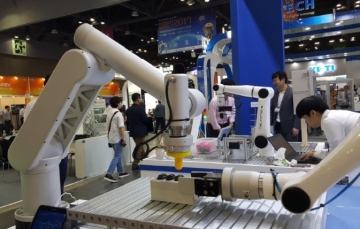
What is included in the next 15-year plan for robot technology, a future growth engine?
As artificial intelligence technology has become a major focus, the robotics industry is experiencing a new wave of change. The influence of robots is expanding throughout society to such a degree that the simple definition of machines that autonomously operate by imitating humans has become obsolete. In response, the Ministry of Trade, Industry and Energy, along with approximately 80 experts from industry, academia, and research institutions, developed the 'Republic of Korea Robot Industry Technology Roadmap' through sector-specific subcommittee operations from January to June of this year. A public hearing was held in early June to review the draft and discuss future improvement measures. The completed 'Republic of Korea Robot Industry Technology Roadmap' was announced at '2017 Roboworld' held at Kintex in Ilsan on the 15th. The roadmap is divided into six categories: manufacturing robots, professional service robots, personal service robots, robot components, software and intelligence, and standardization, with each chapter containing current status, market, demand and prospects, challenges, and periodic target tasks.
2017.09.18by 김지혜 기자
Hilscher Launches 'comX 90CN' Embedded Module Without Connector Integration
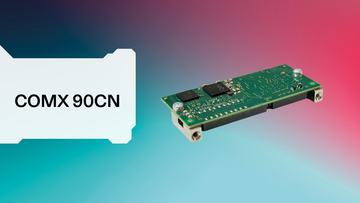
Hilscher has launched the 'comX 90CN' embedded communication module without connector integration. Designed in a compact 30×70mm form factor, this module features a structure where network connectors are separately connected to the baseboard, enabling flexible mechanical design for industrial equipment. Based on netX 90, it supports major industrial Ethernet protocols including PROFINET, EtherCAT, and EtherNet/IP, and incorporates security features such as hardware-based encryption and secure boot.
2026.10.19by 배종인 기자
Korea Institute of Machinery and Materials, Duwon University of Science and Technology, and Duwon Heavy Industries Sign MOU on Manufacturing AI Transformation Industry-Academy-Research Collaboration
The Korea Institute of Machinery and Materials has partnered with Duwon University of Science and Technology and Duwon Heavy Industries to establish an industry-academy-research collaboration system in response to AI transformation in the manufacturing sector. An industry-academy-research collaboration center will be established at the Anseong Campus, joint research in the mobility, aerospace, and defense sectors will be promoted, and specialized workforce development tailored to field demands will be pursued through the establishment of the AI Mobility Machinery Department starting in the 2027 academic year.
2026.10.19by 배종인 기자











