



On-site temperature sensor calibration: 'This one device handles it all'
 Published2017.09.21 09:06
Temperature calibration sensors should be calibrated once a year
In field measurement of physical values such as temperature, pressure, and electrical conductivity, the most critical aspect of measuring instruments is the reliability of measured values. Measured values can vary depending on environmental changes, but they also vary depending on the condition of the measuring instrument.
In measurement technology, calibration refers to placing a test unit and reference equipment that measures the same physical quantities under identical conditions and comparing their values with each other. If the test unit value deviates from the required accuracy, calibration of the unit itself is necessary.
When calibrating temperature measuring instruments, dry well, liquid constant temperature bath, and electric furnace equipment are used. Among these, a dry well is a temperature generation device used to calibrate platinum temperature sensors. Without using liquid medium, it has the advantage of quickly implementing and maintaining desired temperatures by controlling solid heat conduction and air flow through heating and cooling. Its compact size makes it suitable for field use.
When using a dry well, errors in the heat source can occur depending on the usage method. Due to the structural design of the dry well where the temperature sensor is located at the bottom, the sensor to be calibrated must be inserted to the bottom to obtain accurate values. It is also important to align the sensing areas of the standard sensor and the sensor under calibration.
If the temperature sensor to be calibrated is long, the portion not immersed in the calibrator is affected by atmospheric conditions, causing errors. The thicker the diameter of the temperature sensor, the more thermal conductivity can affect measurements. To reduce this error, the immersion depth should be approximately 20 times the diameter of the temperature sensor.
As the set temperature of the dry well increases, the deviation from atmospheric conditions widens, increasing the error rate in axial temperature. While it is ideal to immerse the sensor close to the dry well's control sensor, if the sensor to be calibrated is short, uncertainty regarding uniformity must be considered.
So what factors should be considered when selecting a temperature calibrator? The most important factor when selecting a calibrator is the measurement range of the temperature sensor. Due to the characteristics of the medium, liquid constant temperature baths can measure from -100°C to 500°C. Electric furnaces are mainly used to calibrate high-temperature sensors exceeding 1000°C. Dry wells, composed of materials such as aluminum and copper internally, have a range of approximately -40°C to 600°C.
Field temperature calibrators must also consider performance and portability. Generally, larger equipment can provide higher stability and uniformity but is difficult to transport. Conversely, lightweight and portable dry wells have inferior performance.
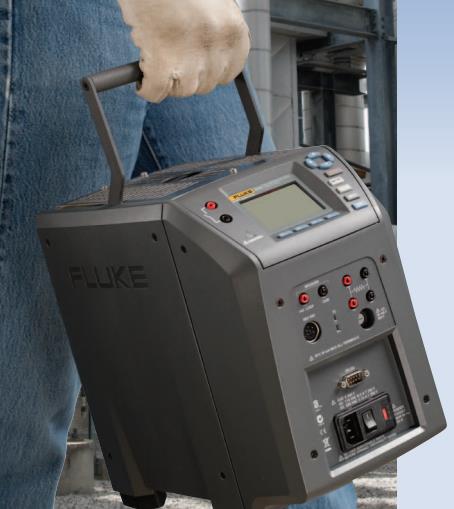
Fluke's field dry well, the 914X series, is divided into three models depending on temperature range. With a weight of 7kg, it is easy to transport and allows input of resistance thermometer standard temperature coefficient values. It comes equipped with a basic switch test function to measure temperature contacts, and once the desired set temperature is reached, the stabilization status is displayed after internal stabilization is achieved. Dual zone control enables fast temperature control speed, and the insert section can be customized.
Kim Sung-hoon, manager at Korea Fluke, explained: "If temperature sensors are not calibrated, oxidation or impurities in the product itself attach to the sensor, changing its characteristics. Values measured this way are difficult to rely upon," adding "while it varies depending on the temperature sensor accuracy of the calibrator used, the application, and management methods, it is generally recommended to perform calibration once a year."
관련뉴스
Fluke Captures Both “Portability and Precision” in Industrial Pressure Calibrator
산업 현장에 쓰이는 아날로그 게이지, 디지털 게이지, 트랜스미터 및 트렌스듀서와 같은 다양한 센서들을 교정하기 위해서는 그에 맞는 적합한 교정기를 사용해서 빠르고 정확한 검교정을 마쳐야 한다. 이를 위해 분동식 압력계, 압력 비교 펌프기, 압력 컨트롤러와 피스톤 게이지와 같은 교정기기들을 이용한다. 이 중에서 플루크의 압력 수동형 펌프는 AC 전원이 제대로 공급되지 않은 산업 현장에서 적합한 방식으로 채택됐다.
2017.03.13by 신윤오 기자

[Interview] Bluetooth 5.0, “Widely applicable from Home IoT to Advertising”
Discussions are ongoing about which field—home, factory, building, or automotive—will first adopt Bluetooth 5.0, which offers lower power consumption and extended reception distance. There is no predetermined answer. If we prioritize convenience that touches everyday life, it would likely enter Home IoT first, just as the Galaxy S8 quietly adopted Bluetooth 5.0. When Bluetooth 5.0 is integrated into door locks that previously operated on a 1:1 Beacon method through a gateway, the intermediate step is eliminated. Users can control and monitor door locks from anywhere in the home using their mobile phones. This Bluetooth connection list method reduces retransmission frequency and current consumption, enabling operation even with coin cell batteries. Then, what is the barrier to overcome for IoT activation using Bluetooth? Currently, there are no established standards for IoT applications.
2017.07.25by 김자영 기자

"Complete Autonomous Vehicle Safety with Professional ADAS Testing"
자율주행차는 운전자와 탑승자, 보행자의 안전과 직결되 신뢰성이 강조되는 분야다. 최소 10만 키로 미터 이상을 주행해야 하지만 실제 주행은 어렵다. 첨단운전자 지원시스템(ADAS)에서 실제와 가장 유사하게 시뮬레이션 할 수 있는 HIL(Hardware-in-the-Loop) 테스트가 중요한 이유다. 특히 테슬라S의 사망 사고 이전까지는 레이더를 활용한 시뮬레이션이 이뤄지지 않았다. CAN통신을 활용해 브레이킹과 각 유닛이 제대로 작동하는 지 메시지 모사형으로 검사하는 오토파일러 기능이었다. 사고 이후, 실제 주행조건과 동일한 테스트가 이뤄져야 한다는 목소리가 높아진 것.
2017.09.12by 김자영 기자

Intel Unveils Next-Generation 'Core Ultra Series 3' and vPro Platform for Enterprise PCs
Intel has officially unveiled the "Intel Core Ultra Series 3" for next-generation enterprise PCs and the latest vPro platform, addressing a wide range of demands from enterprise notebooks to high-performance workstations.
2026.03.26by 배종인 기자

ROHM Launches ESD Protection Diode Compatible with High-Speed Interfaces of 10Gbps or Higher
반도체 전문 기업 로옴(ROHM)이 10Gbps를 넘어서는 차세대 고속 데이터 통신 환경에 대응할 수 있는 ESD(정전기 방전) 보호 다이오드 ‘RESDxVx 시리즈’를 개발하며, 고속 인터페이스에서 요구되는 신호 품질 유지와 IC 보호 성능을 동시에 끌어올렸다.
2026.03.26by 배종인 기자











