


Challenging Transceiver Testing Solved with Integrated VST
 Published2017.09.21 09:14
Supporting Various Test Applications including 5G Testing
There are several factors to consider when measuring signals with instruments. For experienced engineers working with mixers, receivers, amplifiers and similar components, matching levels and taking measurements with lower-performance instruments may seem straightforward, but it is not an easy task. Experts emphasize that frequency, bandwidth, and average noise sensitivity are particularly important.
Consider another example: measuring 6GHz or 10GHz RF signals, where ADCs operating at 100MHz or 200MHz are sometimes used. The question arises: "If the sampling rate is 6GHz, 12GHz or higher, why is the ADC only 100MHz?" NI's RF Systems Engineer Jae-Il Ko states that "bandwidth is as important as frequency in measurement instruments."
"Wireless devices are interconnected, and wireless communication test platforms are needed to ensure high-speed data transmission and low latency. To address this, ultra-wideband data analysis capabilities such as 500MHz or 800MHz based on LTE-A Carrier Aggregation and Digital Pre-Distortion (DPD) will be required."
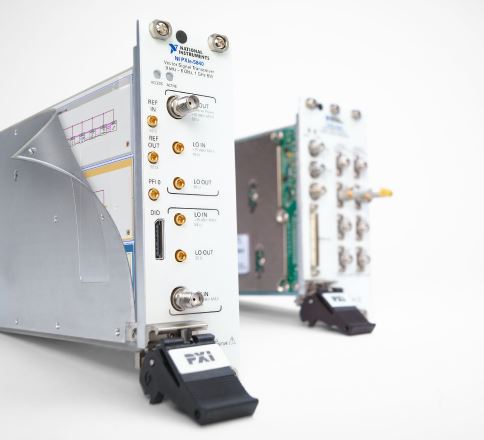
VST 2.0 PXIe-5820
NI has launched the VST (Vector Transceiver) 2.0, an integrated device combining both transmitter and receiver capabilities. It features wide bandwidth, demanding RF front-end modules, and supports transceiver test applications such as ET (Envelope Tracking), DPD, and 5G testing.
Engineer Jae-Il Ko explains, "DPD improves linearity by extending distortion points compared to an ideal curve. In particular, by integrating DPD algorithms into the IP, applications can be implemented quickly using real-time FPGA."
Depending on the approach, it can handle radar characterization and testing, performing traceable RF measurements and system simulation. VST advances NI's existing software-defined architecture. Optimized across nearly all areas from thermoelectric to digital signal processing, it delivers 1GHz complex I/Q bandwidth in a compact modular form factor.
Based on mmWave front-end technology and VST 2.0, NI provides ADAS (Advanced Driver Assistance Systems) technology and 76–81 GHz range communication testing. At the University of Texas at Austin testbed, VST 2.0 with integrated up-converters and down-converters is designed to test 76-81GHz radar bandwidth using 1GHz real-time bandwidth.
Related news

NI, Automotive Components and Development Engineers, Come Here, 'Automotive Day 2017'
National Instruments announced that it will hold 'NI Automotive Day 2017' at the AT Center in Yangjaedong on the 25th (Tuesday). 'NI Automotive Day' is Korea's largest automotive electrical component engineer conference that shares new technologies through real-world case studies on the theme of reliable automotive components and vehicle development. At this conference, NI plans to introduce the latest technologies that can reduce development costs and time for automobiles while ensuring reliability. To this end, NI will share technical case studies implemented with NI solutions according to themes reflecting automotive industry trends, and conduct educational and hands-on seminars. Additionally, participants will have the opportunity to experience NI solutions firsthand at booths. In sessions with domestic and international experts, case studies related to autonomous vehicles, ADAS, infotainment, and V2X will be introduced, actively reflecting the needs of electrical component engineers. Featured presentations include ▲ the radar simulation implementation case for Audi vehicles from German company Konrad and NI's infotainment testing technology ▲ 5G/LTE-based V2X technology currently under development with SK Telecom's participation ▲ technical presentations on V2X wireless communications using NI's system design software LabVIEW and requirements for automotive component standard mass production inspection platforms. Alongside the sessions, educational and hands-on training will include a CAN seminar on vehicle communication networks for autonomous vehicles. Additionally, the automotive solutions booth prepared by NI and partner companies will exhibit and demonstrate more than 15 solutions to support new customers to NI products in acquiring useful knowledge and information. Kim Jong-woo, head of strategic marketing at Korean NI, stated, "Through this event where real-world cases are shared, automotive developers will be able to confirm the latest trends and technologies in the automotive industry. We hope that these innovative technologies will be widely applied to the development of increasingly intelligent and complex automobiles."
2017.04.20by 김자영 기자

NI Releases Test Toolkit Compliant with IEEE 802.11ax Standard
National Instruments (NI) has announced WLAN Test Toolkit 17.0, which supports the IEEE 802.11ax standard draft 1.1. WLAN Test Toolkit 17.0, combined with NI's second-generation vector signal transceiver (VST), supports 802.11ax waveform generation as well as characterization, validation, and production test analysis for products implementing IEEE 802.11ax standard draft 1.1, such as RF front-end components, wireless modules, and user devices. WLAN Test Toolkit 17.0 provides designers and engineers with the capability to generate and analyze a comprehensive range of 802.11ax standard-compliant waveforms, including extended single-user, per-user configurable, and multi-user OFDMA and MIMO (Multiple Input, Multiple Output) with measurement results support.
2017.07.12by 김지혜 기자
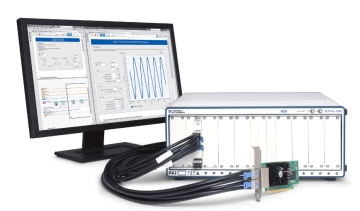
NI Launches High-Performance PXI Remote Control Family, Boosting Throughput
National Instruments (NI) has announced the launch of a new high-performance PXI remote control and bus expansion module family incorporating PCI Express Gen 3 connectivity. PCI Express Gen 3 technology provides wide bandwidth, which is essential for data-intensive applications such as 5G cellular research, RF recording and playback, and multi-channel data acquisition. Luke Schreier, Marketing Director of NI Automated Test, stated, "As technology focuses on smarter devices under test (DUT), there is a need to build smarter test and measurement systems that leverage the latest processing and data movement capabilities to reduce test costs and improve coverage. With this new remote control module family, we have enhanced our existing PCI Express Gen 3 chassis and embedded controller portfolio, and increased the throughput of multi-chassis systems by more than double."
2017.08.28by 김지혜 기자
.jpg)
SalePoint Signs Multi-Year Partnership Agreement with AWS… Promoting Identity Security that Integrates Even AI Agents
Sailpoint has entered into a multi-year strategic partnership agreement with AWS and is moving forward with establishing an integrated governance system that manages both human and non-human identities together. The plan is to consistently manage access permissions in an environment where AI agents are increasing as work execution entities, while applying the principle of least privilege and automated policy enforcement. The two companies plan to jointly expand capabilities to manage the identities of various entities, including AI agents, within a single layer in the AWS environment. This collaboration is interpreted as a move to design security and governance together in corporate environments where AI adoption is expanding.
2026.03.26by 배종인 기자
.png)
Databricks Unveils Open AI Security Monitoring 'Lakewatch'
Databricks entered the security market on March 24 by unveiling LakeWatch, an open-source agentic SIEM. The core functionality of this product is to integrate and analyze security, IT, and business data in a single environment to support AI-based threat detection and investigation. The company explained that it reduces the limitations of existing security operations centers, which have had to forgo some data due to high cost structures, and enables large-scale data analysis and automation based on open formats and ecosystems. LakeWatch is currently offered as a private preview, with Adobe and Dropbox mentioned as early customers. Databricks also announced an expanded partnership with Anthropic as well as the acquisition of Antimatter and SiftD.ai.
2026.03.26by 배종인 기자











