



ETRI Increases Autonomous Vehicle Processor Cores to 9
 Published2017.09.21 10:24
The Electronics and Telecommunications Research Institute (ETRI) announced that it has developed a chip to process data collected from all sensors in autonomous vehicles.
It is a processor chip that executes image recognition and control functions required by autonomous vehicles with low power consumption around 1 watt (W).
This processor was named "Aldebaran" last year. It is one of the first-magnitude star designations. The core processor that determines autonomous vehicle performance had previously relied on overseas technology, but with domestication, there is no longer any need for overseas dependence.
In this research, following last year, the field where performance was improved is that processor cores were increased from 4 last year to 9. As the number of processing cores increased, processing speed accelerated, enabling clearer and larger image implementation.
Recognition capabilities also significantly improved. Currently, it supports real-time ultra-high-definition (UHD) image processing along with pedestrian, vehicle, lane, and motion recognition. Of course, radar and GPS signal processing recognition experiments were also successful. In the future, it is planned to be applied to Lidar and ultrasonic as well.
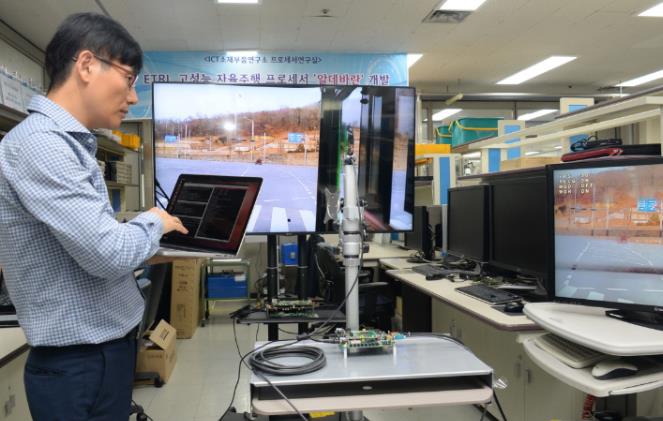
In particular, ETRI integrated the processor chip into a single chip (one-chip). The research team incorporated camera image processing functions and strengthened driver assistance systems to enable motion recognition on the chip.
Additionally, the chip also includes a black box function that can save and playback driving footage for vehicle security and accident evidence preservation. It supports UHD-level resolution compliant with the High Efficiency Video Coding (HEVC) standard.
ETRI, by fabricating it as a single chip (one-chip) to enable image processing, has been able to reduce the unit cost of the chip. The size of the chip developed by the research team is 7.8 x 6.7mm, smaller than a fingernail. The chip manufactured in this way is embedded in an electronic control unit (ECU) board (10cm x 10cm), passes through housing, and is embedded in the vehicle console area.
ETRI developed an autonomous vehicle-dedicated processor last year and transferred the technology to NextChip Co., Ltd., a semiconductor design specialist company. The newly developed chip is also planned to be transferred to relevant companies in the second half of this year, achieving mass production and commercialization next year.
ETRI explained that the performance of the Aldebaran chip developed this time is at the global level, and while the module prices of discrete chips offered by global competitors are in the hundreds of thousands of won range, these can be reduced to the tens of thousands of won range, demonstrating price competitiveness.
In the future, the research team plans to utilize neural network technology to incorporate high-performance artificial intelligence technology into the image recognition engine and achieve chip implementation.
ETRI's Kwon Young-soo, head of the Processor Research Group, also stated, "Our future goal is to accurately recognize all objects moving like humans. It is expected that chip development will be possible to enable services where machines can communicate with people, set destinations, and find routes on their own."
Comments
Related news
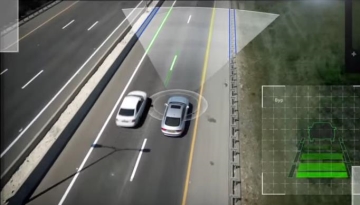
[Planning - Autonomous Vehicles ③] Camera, Lidar “Cars finally have eyes”
As commercialization of Level 3 autonomous driving technology begins, interest in advanced driver assistance systems is also increasing. ADAS systems serve as a foundation for autonomous vehicles, and while they initially primarily functioned to inform drivers of road conditions through notifications, they have recently advanced to the level of automatically controlling the steering wheel, brakes, and other components. The Genesis EQ900 is equipped with advanced driver assistance systems (ADAS) including Advanced Smart Cruise Control (ASCC), Blind Spot Detection (BSD), Autonomous Emergency Braking (AEB), Driver Attention Alert (DAA), Smart High Beam (SHBA), and front seat pre-active seatbelts. The new i30 wagon incorporates ADAS technologies such as Adaptive Cruise Control (ACC), AEB, and Lane Keeping Assist System. For these ADAS systems to operate, detection through cameras, lidar, and radar sensors is essential. When examining ADAS system installation by vehicle type, except for some small vehicles, either cameras alone or a combination of radar and stereo cameras are applied. Cameras can cover a range of up to 100m ahead, surround view, and rear areas. They function in a role that provides intuitive assistance to drivers by enabling actual visual observation. For autonomous driving, a minimum of 5 or more camera sensors per vehicle must be installed to achieve 360-degree full coverage detection.
2017.04.24by 김지혜 기자
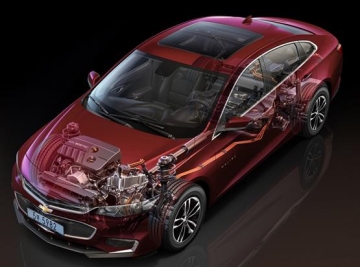
[Planning-Autonomous Vehicles⑤] 'Running SW' Artificial Intelligence Cars, Software Dominates
Vehicles with electrified systems are commonly referred to as "running semiconductors." However, as the importance of software that drives these electronic devices grows, it may now be appropriate to call automobiles "running software." Whereas the previous trend was to install various functions for vehicle stability and convenience, with accompanying software (SW) to operate them, automobiles are increasingly becoming software-centric. Vehicle software can be divided into electronic component SW platforms and infotainment platforms. In the electronic component SW platform, AUTOSAR (automotive open system architecture), an open-standard automotive software, is at the center. AUTOSAR comprises 9 core partners with approximately 50 member companies, including BMW, Bosch, Continental, Daimler, Ford, GM, Peugeot Citroën, Toyota, and Volkswagen as core partners, consisting of 7 OEM companies and 2 Tier 1 suppliers. The purpose of AUTOSAR is to address the growing complexity of software as electronic devices increase, and to reduce costs by enhancing software reusability.
2017.05.22by 김지혜 기자
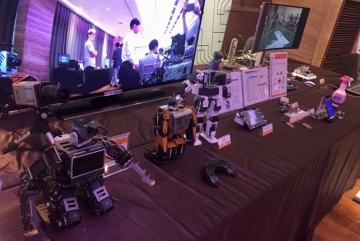
Will domestic CPU cores bloom in the IoT era?
The first phase of domestic CPU development, which began in June 2015, has entered its final stages. On the 19th, the "Second Domestic CPU Core Roadshow" was held to introduce the achievements of the "Domestic CPU Core Commercialization Project." Over one year, what new cores were developed and what results were achieved? Ha Sang-tae, head of the System and Materials Industrial Technology Division at the Korea Institute of Industrial Technology Evaluation and Planning, said, "There are still negative views on domestic CPU development, but various institutions are producing results," adding "positive effects are expected in securing product competitiveness for 'Things' corresponding to IoT (Internet of Things), where hyper-connectivity and intelligence are being realized." Song Yong-ho, director of the Intelligent Semiconductor Promotion Division, said, "We confirmed the potential for domestic CPUs to be utilized in various ways," and "continuous attention must be paid to development." The domestic CPU core roadshow introduced ADchips' ARK (revised name of emCore), ETRI's Aldebaran, and KETI's MENSA core, the same as last year. SoC development cases using cores included low-power mobile healthcare by Hancom GMD (ARK), tampering prevention and security-enhanced smart meters by S&A (Aldebaran), and voice recognition with built-in ultrasonic data communication capability by Emtec Vision (MENSA), discussing the advantages and disadvantages experienced using domestic CPUs.
2017.05.22by 김자영 기자

[Technical Contribution] Caltera: "Evolution of Precision Sensing, UWB Infrastructure Enhances Parking Safety"
Discussing new possibilities in parking assistance and precision sensing with UWB, Lee Sang-min, Korea Branch Manager at Caltera.
2026.10.23by 편집부
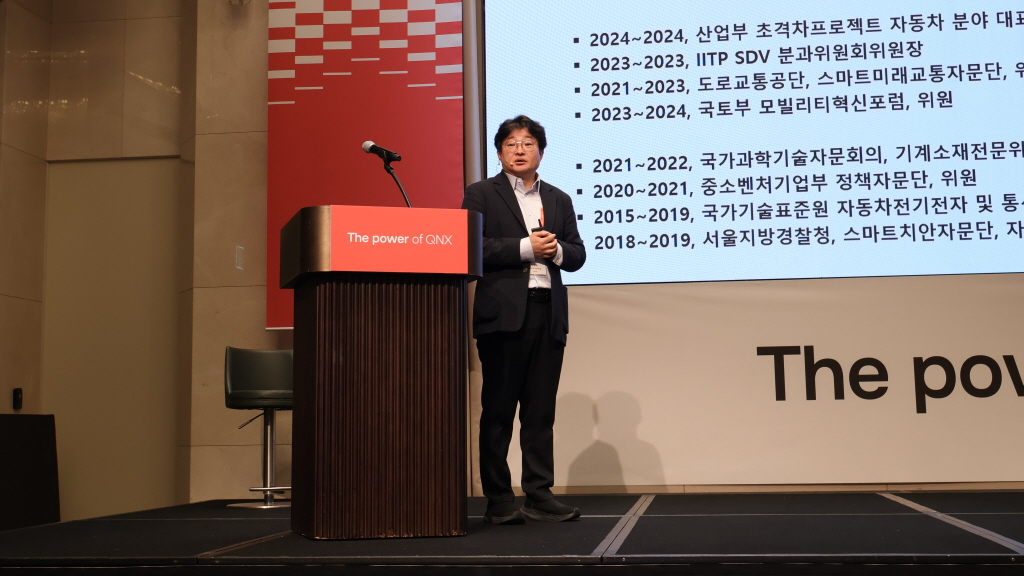
Professor Jeong Gu-min from Kookmin University, "QNX RTOS will become an important foundational technology in the physical AI era"
As software-defined vehicles (SDV) establish themselves as a new standard in the automotive industry, forecasts indicate that future competitiveness will be determined not by vehicle hardware but by software platforms and AI utilization capabilities. With the automotive industry rapidly transitioning to centralized architecture and AI-based development systems, an analysis suggests that how effectively vehicle platforms can be simplified and operated cost-efficiently will become core competitiveness for next-generation SDV and AI-defined vehicles. Professor Jeong Gu-min from Kookmin University emphasized at QNX TechForum Korea 2026 that "the automotive industry is now shifting from hardware competition to software ecosystem competition," highlighting that API-centric platforms and AI utilization will determine success or failure in the future automotive industry.
2026.10.23by 배종인 기자











