


What is the relationship between iPhone X's face recognition feature and augmented reality?
 Published2017.09.29 10:36
Can reduce complexity compared to competitors and lower hardware unit costs
Apple removed fingerprint recognition and introduced Face ID. DigiEco released a report covering iPhone X's Face ID. Researcher Hwang Byung-sun stated that allowing consumers to choose from among iris recognition, fingerprint recognition, face recognition, and PIN numbers means that 'none of the security sensors are completely finished products.'
The front-facing camera of iPhone X has an IR camera and a Dot Projector. Competitors' iris recognition sensors also use IR LEDs, but the fundamental difference is that image processing is based on 3D rather than 2D.
The Dot Projector projects 30,000 invisible dots onto the user's face, which the IR camera reads and transmits the data to the A11 Bionic chip. The A11 processes the data through 3D modeling and compares it with the previously registered face. This process will repeat within 1 second.
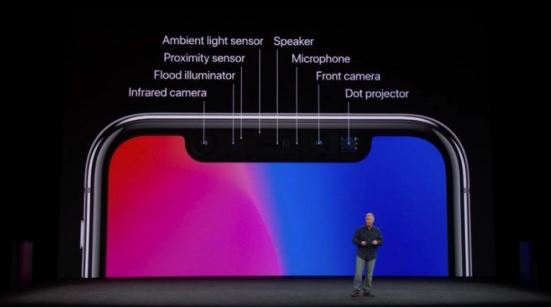
iPhone X front-facing camera and sensor configuration status
According to Apple's announcement, Face ID uses a Flood Illuminator so it can be used in dark environments, and cannot be hacked even with a 3D mask. While Touch ID's error rate is 1 in 50,000, Face ID is 1 in 1,000,000.
The report evaluated the removal of the fingerprint sensor as 'an appropriate strategy that iPhone X should adopt.' It added that 'it is no exaggeration to say Apple popularized the fingerprint sensor built into the home button initially, and removing it again is a decision fitting Apple's DNA.'
Advantages compared to competitors include reducing consumer choice complexity and lowering hardware production unit costs. The report also noted that considering the narrow-bezel display, unlike competitors that added fingerprints on the back, iPhone X gains a design differentiation point.
As a result, the depth camera is 'a predictable scenario that Apple mounted it considering AR.' Animoji, which creates 3D emoticons using the captured face, is a case validating this direction.
Meanwhile, while there are limitations in discussing iPhone X's Face ID technology before its release, it remains to be seen whether it will demonstrate a high success rate beyond Caucasians.
Related news

Will Flexible OLEDs and Next Year's Foldable Phones Become a New Growth Engine?
"Apple adopted OLED in iPhone 8 because of augmented reality (AR)" All smartphones from Samsung, LG, and Apple released in the second half of this year are equipped with OLED (organic light-emitting diode) displays. The Note 8 is no exception, and LG has adopted an OLED display in its V series for the first time. Apple is also applying OLED to the iPhone X, and it is expected that OLED adoption in smartphones will become mainstream. Seo Hyun-chul, Executive Director at Shinhan Financial Investment, stated, "iPhone 8 is scheduled to launch an AR-based shopping app through strategic collaboration with IKEA. OLED is essential to implement AR with this app." He forecasted that when 5G networks are commercialized, as AR smartphones become mainstream, the majority of 1.9 billion smartphones in 2024 will adopt OLED.
2017.10.06by 김지혜 기자

[Survey Results] Smartphones that were supposedly prepared with everything consumers might like, but what features are consumers ignoring?
E4ds News conducted the third survey in its [Survey Series] with the topic 'We prepared everything since we didn't know what you'd like. Mobile Showdown, what's your choice?' In September, the premium smartphone market door opened with prices exceeding one million won. Samsung Galaxy Note8, LG's V30, and Apple's iPhone X and iPhone 8. We asked consumers what features they really wanted and which features they thought were most unnecessary. This survey was conducted for 13 days from September 6th to 18th through email and Facebook advertisements targeting the general public, with a total of 321 participants. Among survey respondents, those in their 40s (43.3%) participated the most, followed by those in their 30s (34.2%), 20s (13%), 50s (8.6%), and 10s (0.6%). <Editor's Note>
2017.09.25by 김자영 기자
Why AR, Expected to Surpass the VR Market, Is Attracting Attention in Terms of Commercialization
Among the technologies showcased in Apple's new iPhone X, released in its 10th anniversary, the standout technology is 'facial recognition'. This technology is implemented through the TrueDepth camera system, a 3D camera based on a 3D sensing module. There is another technology made possible by a 3D camera that measures depth. That is 'augmented reality (AR)'. In June, Apple unveiled 'ARKit', an augmented reality platform, at its developer conference 'WWDC 2017'. Subsequently, it announced that it was developing an app utilizing AR technology through collaboration with IKEA. The iPhone X is equipped with an OLED display and a 3D depth camera for AR implementation. Market research firm Counterpoint Research predicted that the AR market would reach 60 billion dollars by 2021 in next-generation technology competition, growing faster than VR. Why is AR garnering attention from a business perspective?
2017.10.11by 김지혜 기자
The Problem with AI is Not Performance, but Trust
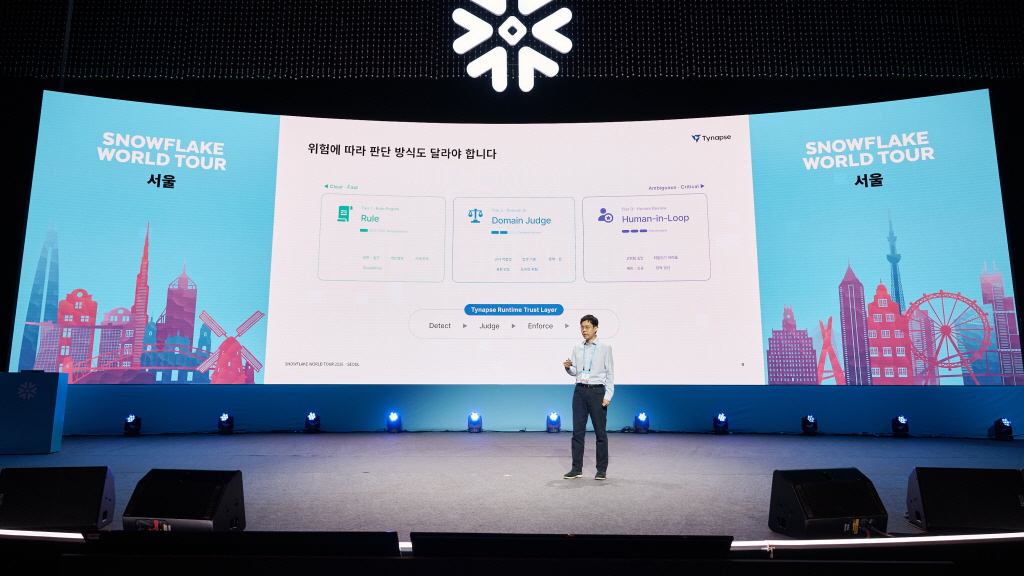
CEO Kang Min-seung emphasized at Snowflake's World Tour Seoul that generative AI has entered a phase where "trust" rather than accuracy becomes the key competitive advantage. As AI is applied to various tasks including consultation, risk management, and operational automation, incorrect data, erroneous responses, and bias are creating actual business risks. He pointed out that enterprises must build a trust layer above AI. To achieve this, accurate data management, semantic structuring, governance, and prompt security are essential. He explained that AI is not merely an automation tool but a technology that reorganizes the entire organization's workflows and decision-making systems. Snowflake provides a platform that supports this trust-based AI operation, emphasizing that enterprises should build "trustworthy AI" rather than "intelligent AI."
2026.08.28by 배종인 기자

The Decisive Factor for AI Agents in Finance: "Trustworthy Data Infrastructure"
The key to spreading AI agents in the financial sector is establishing a trustworthy data system. KB Kookmin Bank is operating over 100 AI agents by 2025 and is promoting expansion to 300. AI is automating repetitive tasks across various areas such as consultation, risk management, wealth management, and relationship management. However, if data quality, governance, and semantic structuring are insufficient, errors and risks increase. KB is building an AI-Ready organization through a multi-model strategy of GPT, Gemini, and Claude, as well as a Snowflake-based data system. The bank emphasized that AI has entered a phase where it restructures not just simple automation but the entire work process and decision-making system.
2026.08.28by 배종인 기자











