

.png)

All-Flash Storage, a Key Tool for Digital Transformation and Cloud Expansion
 Published2017.10.12 17:48
Kaminario announced today, citing a report by research firm Freeform Dynamics, that all-flash storage is most widely used in database-related applications and is being positively received in the market as a catalyst for innovation.
According to a Freeform survey of approximately 300 IT professionals, 70% of responding companies are using all-flash storage for database-related applications. Multiple responses were recorded for virtual server hosting at 51%, OLTP at 48%, and VDI (desktop virtualization) at 34%, and it was also found to be widely used in fields such as cloud infrastructure deployment, real-time analytics, and mobile applications.
Bryan Betts, Senior Analyst at Freeform Dynamics, stated, “Perceptions regarding the utilization of all-flash storage have been changing rapidly recently. Its suitability for enterprise environments has already been accepted by the market, and it is now emerging as the new normal capable of driving new business innovations and reshaping IT environments.”
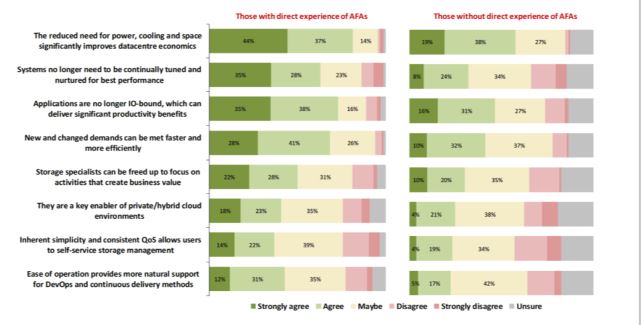
It has been observed that investments in all-flash storage are being made in conjunction with orchestration and automation solutions, particularly for managing cloud environments. In this regard, Freeform Dynamics analyzed that all-flash storage is evolving through three major stages in the storage market: initially emerging to accelerate point applications, then going through a stage where it is used for general-purpose applications, and finally, in the third stage, evolving into a core foundation for cloud environments, Infrastructure as a Service platforms, and software-defined data centers.
Based on the results of this survey, the report forecasted the all-flash storage market through the following analysis.
The pace of the third evolution will accelerate: The majority of enterprises are already leveraging all-flash storage as an opportunity for IT automation and reducing manual system management elements. By eliminating I/O bottlenecks and enabling autonomous storage management in response to infrastructure changes, IT departments will be able to optimize support for cloud applications and maximize the user experience.
The position of hybrid storage is set to shrink: While areas requiring hybrid storage still exist, all-flash arrays are expected to dominate the overall storage paradigm. This shift has been particularly evident over the past year or so, with a growing tendency for customers to purchase solid-state drives individually to address specific performance issues, rather than purchasing hybrid storage solutions. Although database-related applications remain the primary motivation for flash adoption, most enterprise applications are expected to be supported by all-flash arrays in the future.
관련뉴스
Kaminario Unveils All-Flash Storage Based on Intel Technology
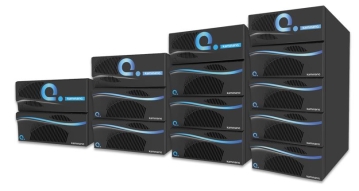
Kaminario has unveiled the newly enhanced features of its latest all-flash storage solution, 'Kaminario K2 Gen6,' based on Intel technology. The Kaminario K2 Gen6 utilizes a storage controller manufactured by Supermicro, equipped with an Intel C6268 chipset featuring Intel® QuickAssist Technology (QAT). The newly configured 'Kaminario K2 Gen6' performs inline compression functionality of Intel® Xeon® Scalable processors through a dedicated compression engine, thereby strengthening the following technical advantages. Intel QAT, which accelerates data compression and decompression, operates as a PCIe/NVMe module and is mounted inside the Supermicro-manufactured storage controller utilizing front-panel PCIe/NVMe slots. Through a highly flexible approach that supports the compression engine, future innovative technologies such as NVMe-connected storage-class memory drives like Intel® Optane™ SSD can be easily adopted.
2017.07.14by 김지혜 기자

Kaminario Recognized for All-Flash Storage Capabilities
Kaminario announced that its all-flash storage K2 achieved the highest scores in 3 out of 5 domains in a core competency assessment conducted by market research firm Gartner on 19 SSA (Solid State Array) products. Kaminario K2 recorded top scores in OLTP (Online Transaction Processing), Analytics, and HPC (High Performance Computing), and ranked second in server virtualization and VDI (Virtual Desktop Infrastructure) segments. Through this report, Gartner establishes competency indicators for 5 major use cases and analyzes 19 SSA (Solid State Array) products based on these criteria, thereby quantifying important factors for infrastructure and operations managers.
2017.08.07by 김지혜 기자
Kaminario Announces New NVMe-Supported All-Flash Storage Product
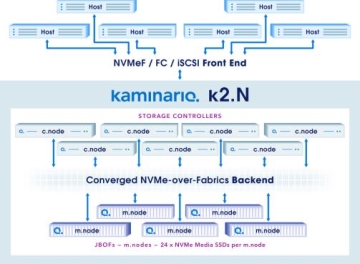
카미나리오는 NVMe 올플래시 스토리지 신제품 ‘카미나리오 K2.N(Kaminario K2.NTM)’과 컴포저블 스토리지의 관리 및 오케스트레이션을 위한 플랫폼 ‘카미나리오 플렉스(Kaminario FlexTM)’를 공개했다. K2.N은 NVMe 드라이브가 적용된 스케일-아웃 및 액티브-액티브 스토리지다. 백엔드에서 컨버지드 이더넷 및 NVMeF를, 프론트엔드에서 NVMeF, fiber channel 및 iSCSI 커넥션을 지원한다. 컨트롤러 노드(c.nodes)와 미디어 노드(m.nodes)로 구성되어 있으며, 공유 NVMeF, fabric 커넥티비티를 지원한다.
2017.08.16by 김자영 기자
.jpg)
SalePoint Signs Multi-Year Partnership Agreement with AWS… Promoting Identity Security that Integrates Even AI Agents
Sailpoint has entered into a multi-year strategic partnership agreement with AWS and is moving forward with establishing an integrated governance system that manages both human and non-human identities together. The plan is to consistently manage access permissions in an environment where AI agents are increasing as work execution entities, while applying the principle of least privilege and automated policy enforcement. The two companies plan to jointly expand capabilities to manage the identities of various entities, including AI agents, within a single layer in the AWS environment. This collaboration is interpreted as a move to design security and governance together in corporate environments where AI adoption is expanding.
2026.03.26by 배종인 기자
.png)
Databricks Unveils Open AI Security Monitoring 'Lakewatch'
Databricks entered the security market on March 24 by unveiling LakeWatch, an open-source agentic SIEM. The core functionality of this product is to integrate and analyze security, IT, and business data in a single environment to support AI-based threat detection and investigation. The company explained that it reduces the limitations of existing security operations centers, which have had to forgo some data due to high cost structures, and enables large-scale data analysis and automation based on open formats and ecosystems. LakeWatch is currently offered as a private preview, with Adobe and Dropbox mentioned as early customers. Databricks also announced an expanded partnership with Anthropic as well as the acquisition of Antimatter and SiftD.ai.
2026.03.26by 배종인 기자











