



ARM Announces Platform for Building Secure Connected Devices
 Published2017.10.25 11:56
Arm has announced the Platform Security Architecture (PSA), the industry's first universal industrial framework for building secure connected devices.
Masayoshi Son, Chairman of Arm and SoftBank, previously announced at last year's Arm TechCon event that the number of connected devices is expected to reach 1 trillion by 2035. Ahead of the Arm TechCon 2017, which runs for four days starting today, Arm has now announced measures to protect these 1 trillion devices.
To realize this vision, people worldwide must acquire greater knowledge about device security, and the IT industry must be confident that it is doing its best to protect devices and data. Fighting hackers who continually seek vulnerabilities to penetrate users' lives, and establishing trust with users is not an easy task for enterprises.
Security is the most critical element across the entire value chain spanning devices and cloud. In particular, the Arm ecosystem has already shipped over 100 billion Arm-based chips and plans to ship an additional 100 billion by 2021, making security even more important. Considering that the total number of humans who have ever existed on Earth is approximately 108 billion, the shipment of nearly 200 billion chips is a remarkable figure. Therefore, Arm and the Arm ecosystem need to ensure that increasingly diverse connected devices are designed with a common security foundation.
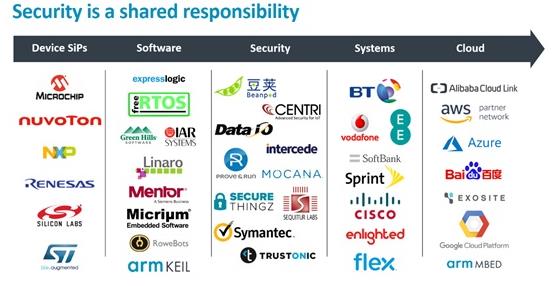
Establishing security for the growing number of connected devices is necessary, but must be done in a way that does not undermine the diversity that serves as the foundation for product innovation and uniqueness. Andy Rose, Arm's Chief Systems Designer, and his team members have made this a top priority in PSA development and have conducted analyses of devices and successful security practices.
Arm stated that it plans to provide open-source reference implementation firmware that complies with PSA specifications, enabling the IoT ecosystem to realize the potential of PSA in the near term. This is being developed based on the Armv8-M system, and the source code is scheduled to be released in early 2018. PSA is available on all operating systems and can be supported by all RTOSs and software partners, including the latest version of Arm's market-validated Mbed operating system.
Paul Williamson, Vice President and General Manager of Arm's IoT Device IP Business Division, stated, "Through Arm's swift action, major partners can now thoroughly test and refine the PSA architecture before the specifications and software announcements scheduled for the first quarter of 2018," and added, "Arm, the Arm ecosystem, and related industries will need to respond more rapidly." He further emphasized, "The fundamental principle that 'security is not optional but mandatory' must be reflected throughout the value chain. Investment in PSA and Trusted Firmware-M demonstrates Arm's commitment and provides a clear and swift path toward a common foundation for IoT security. No device can be an exception."
Comments
Related news
ARM, IP Online Portal Program Expansion "Cortex-M0, M3 Licenses Free"
ARM has added several improvements to the DesignStart program to provide a foundation for easy access to embedded processor technology for developing IoT, intelligent, and connected solutions. Through this, it provides the fastest method to evaluate and design custom SoCs and bring them to market. The improvements provided by the DesignStart program announced this time are as follows: ▲Addition of access to Cortex-M3 ▲Maintenance of existing access to Cortex-M0 to enable application to a wide range of smart embedded applications ▲Provision of a success-based royalty model with low risk by eliminating upfront licensing and evaluation costs ▲Enabling rapid IP access to commence CPU commercialization development within days. More than 20 billion semiconductor chips are equipped with Cortex-M0 and Cortex-M3 processors, with approximately half of them shipped within just a few years. These processors continue to gain popularity due to their diverse features, ultra-compact size, and excellent power efficiency, and can even implement battery-free energy harvesting applications. For example, the Cortex-M0 processor boasts an ultra-compact size that can be mounted on a cross-section of human hair. Innovative cases implemented using the processor can be found at the ARM Innovation Hub.
2017.06.20by 김자영 기자

ARM Computer Vision Calculates Calories 'Right' Even with Just Volume Detected
ARM, a semiconductor design intellectual property (IP) company, held its annual 'ARM Tech Forum 2017' on the 28th (Wednesday) at El Tower in Yangjaedong, Seoul. At this ARM Tech Forum event, various solutions were introduced, centered on the latest CPU and GPU products supporting the newly announced DynamIQ technology. In the presentations, ARM's Chris Turner introduced premium mobile experiences through the ARM Cortex-A73, and Anand Patel presented on the topic of 'ARM GPU Technology'.
2017.06.28by 신윤오 기자
ARM Announces New DesignStart Program Adds Cortex-M3
ARM has announced a new DesignStart program with the addition of Cortex-M3. With this program, DesignStart Eval provides immediate free access for evaluation, design, and prototyping of custom SoCs based on Cortex-M0 or Cortex-M3 processors. DesignStart Pro enables the design of commercial SoCs with only a straightforward success-based royalty model, without upfront licensing fees.
2017.06.29by 신윤오 기자
.jpg)
SalePoint Signs Multi-Year Partnership Agreement with AWS… Promoting Identity Security that Integrates Even AI Agents
Sailpoint has entered into a multi-year strategic partnership agreement with AWS and is moving forward with establishing an integrated governance system that manages both human and non-human identities together. The plan is to consistently manage access permissions in an environment where AI agents are increasing as work execution entities, while applying the principle of least privilege and automated policy enforcement. The two companies plan to jointly expand capabilities to manage the identities of various entities, including AI agents, within a single layer in the AWS environment. This collaboration is interpreted as a move to design security and governance together in corporate environments where AI adoption is expanding.
2026.03.26by 배종인 기자
.png)
Databricks Unveils Open AI Security Monitoring 'Lakewatch'
Databricks entered the security market on March 24 by unveiling LakeWatch, an open-source agentic SIEM. The core functionality of this product is to integrate and analyze security, IT, and business data in a single environment to support AI-based threat detection and investigation. The company explained that it reduces the limitations of existing security operations centers, which have had to forgo some data due to high cost structures, and enables large-scale data analysis and automation based on open formats and ecosystems. LakeWatch is currently offered as a private preview, with Adobe and Dropbox mentioned as early customers. Databricks also announced an expanded partnership with Anthropic as well as the acquisition of Antimatter and SiftD.ai.
2026.03.26by 배종인 기자











