



EMI, a Design Challenge in Automotive LED, Tackled with Fixed-Frequency Buck Controller
 Published2017.10.26 09:24
Switching Frequency Programmable with Proprietary Current-Mode Control Method
Light-emitting diodes (LEDs) are used in various fields including industrial, commercial, and outdoor applications. Beyond the lighting market, LEDs are used in signage, automotive lighting, mobile devices, and monitors. Among these, the automotive LED market is drawing attention from the lighting industry as a B2B business.
As automotive front and rear lighting transitions from conventional halogen lighting to LED lighting, according to LED Insight, the global automotive LED market is projected to grow at over 8% annually, with a market size of $2.3 billion (approximately 2.5778 trillion won) in 2020.
As daytime running lights (DRL) installation becomes mandatory, the automotive LED lighting market is expected to expand. Daytime running lights are small lamps mounted around the headlights that emit light even during the day using high-brightness LEDs to prevent accidents. High-brightness LEDs are used because they consume less energy compared to the conventional halogen bulbs previously used.
The most challenging aspect of high-brightness LED design is resolving EMI. Undesired noise signals generated at the high switching frequency of the LED driver can degrade circuit performance and in severe cases cause it to shut down. To address this, Maxim provides automotive LED controllers that deliver low EMI.
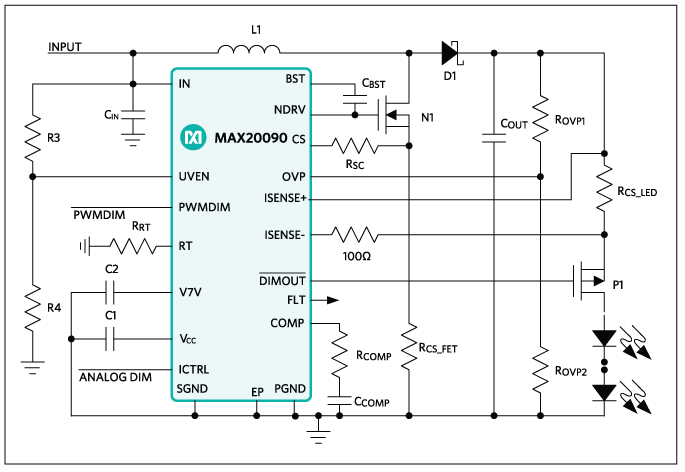
The MAX20090 is an LED driver for automotive front-facing lighting applications including high beam, low beam, daytime running lights, and fog lights. It operates with input voltages from 5V to 65V. Since it senses output current at the high side, it can protect against short circuits to ground or battery input at the output. Spread-spectrum modulation is available to reduce EMI noise, and it provides flexibility for external automotive lighting designs by using single/multi-channel boards to optimize the design.
The MAX20078 is a high-voltage synchronous n-channel MOSFET controller for high-current buck LED drivers. This product uses a proprietary average current-mode control method to regulate inductor current. With this control method, compensation of the control loop is not necessary even at a fixed switching frequency. The input voltage range is broad, from 4.5V to 65V, and no current measurement is required at high voltages. Switching frequency programming is possible from 100kHz to a maximum of 1MHz.
Additionally, it includes a 5V VCC regulator capable of delivering up to 10mA to external electrical circuits and features a current monitor function to monitor the proportionality between analog voltage and inductor current. It has inductor current limit protection, overvoltage protection, and thermal shutdown function, and at 3mm x 3mm size, it is advantageous for space-constrained applications.
Yin Wu, Business Director of Maxim's Automotive Division, stated, "The MAX20078 automotive LED controller is the only solution that combines the low switching noise of a hysteretic buck controller with a fixed-frequency buck controller."
Related news

Simplifying the head unit can solve signal loss and power issues.
The practice of listening to music or radio in cars has continued from the past until now, but the form of the head unit has gradually changed. From cassette tapes to CDs and MP3s, as audio sources transitioned from physical media formats, head units became simplified. To support such systems in automobiles, cables weighing tens of kilograms are required. Cable routing is often done manually, which is time-consuming and costly. Automotive radios have up to 6 cables connected depending on the car model and the band functions supported. As head units become simplified, the amount of cable required can be reduced, thereby saving space and reducing heat dissipation. To reduce the amount of cabling, Maxim Integrated has proposed a "remote tuner solution." The remote tuner architecture serializes the output of a radio tuner located near the antenna using GMSL (Gigabit Multimedia Serial Link) through a single cable. The single cable transmits not only the desired channel but also control signals (I2C) through the back channel of the GMSL link and supplies power to the remote tuner.
2017.08.24by 김지혜 기자

Maxim launches converter tool to accelerate rapid development of power supply devices
Maxim Integrated Korea has launched the 'EE-Sim DC-DC Converter Tool,' which supports the rapid development of high-quality power supply devices. Powerful development tools are necessary to save time and resources during power design. Power designers can use the EE-Sim DC-DC Converter Tool to develop and simulate complex circuits more easily. Novice designers can complete designs in just a few minutes, while professional designers can visualize and control simulation parameters at an advanced level. The EE-Sim DC-DC Converter Tool recalibrates circuits according to components changed by the designer and compares and evaluates differences between designs. As a best-in-class waveform viewer, it allows users to explore simulation results and perform customized design, and can be utilized bidirectionally. The simple interface eliminates the need for training in customized design.
2017.09.06by 김지혜 기자
Solving wearable power issues with a compact battery-optimized solution.
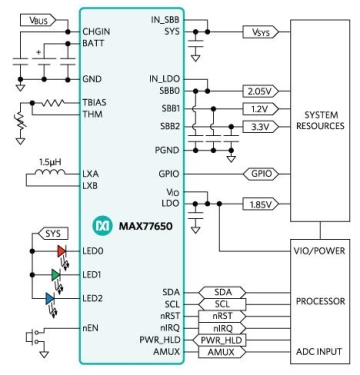
Wearable devices are being used for various purposes, such as smart belts that record daily activity levels and inform users about overeating, and wearable cameras that can be attached to bags or clothing to capture everyday photos. Additionally, as 'Hearable' products—wearables in the form of earphones inserted into the ear—have emerged, devices are becoming smaller and wireless in form. Since Hearable devices must accommodate various sensors such as accelerometers and heart rate sensors in a compact size, the internal components must also be miniaturized. Most PMICs for small lithium-ion battery-powered devices require current regulators such as boost, buck, LDO, regulator chargers, and LED indicators. In response, Maxim Integrated has launched the MAX77650 and MAX77651, which can be used in compact power solutions with a size of 19.2mm² or less—half or smaller than conventional PMICs. Both products are designed to suit low-power wearables where size and efficiency are critical. Both devices feature three independently programmable power rails on a single inductor and SIMO buck-boost regulation that minimizes overall solution size.
2017.09.29by 김지혜 기자

Intel Unveils Next-Generation 'Core Ultra Series 3' and vPro Platform for Enterprise PCs
Intel has officially unveiled the "Intel Core Ultra Series 3" for next-generation enterprise PCs and the latest vPro platform, addressing a wide range of demands from enterprise notebooks to high-performance workstations.
2026.03.26by 배종인 기자
ROHM Launches ESD Protection Diode Compatible with High-Speed Interfaces of 10Gbps or Higher
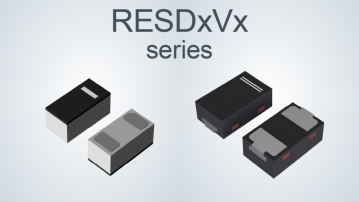
Semiconductor specialist ROHM has developed the 'RESDxVx series' of ESD (electrostatic discharge) protection diodes capable of responding to next-generation high-speed data communication environments exceeding 10Gbps, simultaneously enhancing both signal quality maintenance required in high-speed interfaces and IC protection performance.
2026.03.26by 배종인 기자











